

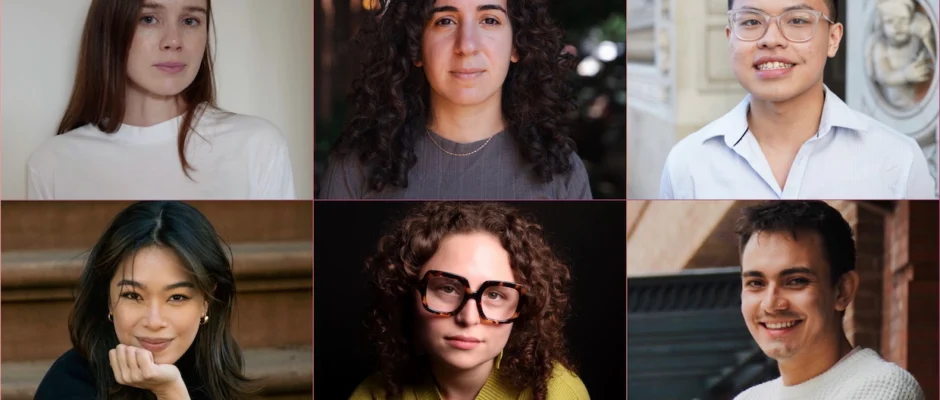
The independent film collective UFO has officially unveiled the selected participants for the fourth cycle of its highly competitive Short Film Lab, a rigorous 18-month program designed to bridge the gap between early-career experimentation and professional cinematic production. Following a record-breaking application season that saw 287 filmmakers vying for just three available spots, the organization has identified Hana Elias, Katherine Clary, and Edward Nguyen as the newest fellows to enter the fold. This latest cohort joins three continuing fellows—Daisy Friedman, Carin Leong, and Emilio Subía—who were selected during the previous spring cycle and remain in the midst of their development and production timelines.
The UFO Short Film Lab has rapidly established itself as a cornerstone of the New York independent film scene, offering a comprehensive support structure that is rare in the short-form medium. Each participant is awarded a total of $20,000 in direct funding, bifurcated into two $10,000 grants to support the creation of two distinct original short films. Beyond the financial injection, the program provides high-level technical resources and professional development, including complimentary access to the latest lens technology from ZEISS and seminar-style workshops hosted at the Brooklyn Academy of Music (BAM). The 18-month duration of the lab allows for a deep, iterative creative process, distinguishing it from shorter, more intensive workshops that often lack the longevity required for thorough project maturation.
Statistical Overview and the Competitive Landscape
The selection process for Cycle IV highlights the growing demand for structured support within the independent film community. With 287 applications received for only three slots, the acceptance rate for the UFO Short Film Lab currently stands at approximately 1.04%, a figure that rivals the selectivity of the nation’s most prestigious MFA film programs and elite fellowships such as the Sundance Institute’s various labs.
This surge in applications underscores a broader trend in the industry where emerging filmmakers are increasingly seeking non-traditional avenues for funding and mentorship. As the costs of high-end production remain a barrier to entry, the provision of $20,000 in cash and the loan of premium ZEISS optics represents a significant capital offset for directors who are often self-funding their early projects. The lab’s commitment to supporting two projects per fellow also reflects a strategic focus on career sustainability, ensuring that filmmakers leave the program with a body of work rather than a single isolated piece.
Profiles of the Cycle IV Fellows
The three filmmakers joining the lab in the upcoming month represent a diverse array of stylistic approaches, ranging from traditional non-fiction to surrealist scripted drama. Their projects for Cycle IV tackle complex themes of state power, cultural memory, and identity.
Katherine Clary
An Arizona-born filmmaker currently based in New York, Katherine Clary brings a practice rooted in philosophical inquiry and the exploration of landscape as a repository for history. Her previous work has garnered attention at the Camden International Film Festival and DOC NYC. For her fellowship project, Clary returns to her roots in the Arizona desert to examine the intersection of two disparate institutions: a potter’s field for the unclaimed dead and a high-tech U.S. Air Force training facility. The film seeks to explore how state power and private grief occupy the same physical and metaphorical terrain, utilizing the desert as a canvas to observe the labor and people that sustain these systems.
Hana Elias
Hana Elias is a journalist and filmmaker whose work spans the geographical and cultural distance between Palestine and New York. Having already earned accolades such as the 2022 IF/Then x The Redford Center Nature Access Pitch and a jury prize at the Arab Film Festival, Elias focuses on storytelling as a mechanism of resilience. Her project for the UFO Lab involves a collaborative process with photographer Adam Rouhana. Using a vintage large-format camera, the film documents a mobile studio set up across Palestinian cities. This non-fiction work examines the tools of photography and the act of self-representation, capturing a collective portrait of Palestinian life through the lens of creativity and spontaneity.
Edward Nguyen
Representing the scripted side of the cohort, Edward Nguyen is a Vietnamese-American writer-director whose work is informed by Southeast Asian "slow cinema" and a desire to challenge monolithic depictions of the diaspora. A graduate of Yale University, Nguyen’s previous film, Mồ Hôi (SWEAT), recently premiered at BFI Flare. His fellowship project is a surreal queer drama set within the Vietnamese jungle. The narrative follows a construction worker whose search for anonymous pleasure leads to a phantasmagoric confrontation with his own psyche. By blending kink, folklore, and national trauma, Nguyen aims to expand the visual and thematic vocabulary of contemporary queer cinema.

Continuing Fellows and the Multi-Cycle Model
The UFO Short Film Lab’s 18-month structure necessitates a rolling enrollment model, where new fellows begin their journey while previous cohorts continue their work. This overlap fosters a community of peers at different stages of the production process. Daisy Friedman, Carin Leong, and Emilio Subía, the three fellows selected in the Spring of 2025, will continue their residency through the current cycle.
This model is designed to simulate the professional environment of a production house while providing the safety net of an academic or non-profit setting. By interacting with both incoming and outgoing fellows, participants gain exposure to a wider variety of creative hurdles and solutions. The mentorship provided by the UFO team and invited industry guests further cements this collaborative atmosphere, offering one-on-one guidance that adapts to the specific needs of each director’s project.
Institutional Support: ZEISS, BAM, and the Mentorship Framework
The success of the UFO Short Film Lab is inextricably linked to its partnerships with major cultural and corporate institutions. The collaboration with ZEISS is particularly noteworthy, as it grants fellows access to world-class cinematography tools that are typically reserved for high-budget commercial and feature productions. By utilizing ZEISS’s newest lenses, fellows are able to achieve a level of visual sophistication that significantly enhances the "festival readiness" of their short films.
The choice of the Brooklyn Academy of Music (BAM) as the site for the lab’s seminar sessions provides a prestigious and historically rich environment for artistic development. As one of the oldest performing arts centers in the United States, BAM’s involvement lends the program a level of institutional gravitas that assists fellows in their subsequent networking and fundraising efforts. The seminars themselves are designed to be intensive, focusing on the mechanics of storytelling, the ethics of non-fiction, and the practicalities of independent production in an evolving digital landscape.
A Proven Track Record: From the Lab to the Oscars
While the UFO Short Film Lab is a relatively young initiative, having launched in 2023, its impact on the festival circuit has been immediate and profound. Films developed through the lab have already secured placements at top-tier international festivals, including Sundance, SXSW, True/False, and Palm Springs ShortFest.
The most notable success to date is that of UFO Fellow Arielle Knight, whose film The Boys and the Bees won the Short Jury Award for Non-Fiction at the 2024 Sundance Film Festival. This victory not only elevated Knight’s career but also gave the film the "Oscar-qualifying" status necessary for consideration for the 99th Academy Awards in 2027. This track record serves as a powerful proof of concept for the lab’s methodology, demonstrating that the combination of significant financial backing, technical resources, and long-term mentorship can yield results that compete at the highest levels of the industry.
Strategic Implications for the Independent Film Industry
The continued growth and success of the UFO Short Film Lab signal a shift in how independent film talent is cultivated. In an era where traditional "middle-class" filmmaking is under pressure from the dominance of major streaming platforms and the decline of mid-budget theatrical releases, programs like UFO provide a vital alternative. By focusing on the short film—not just as a calling card for a feature, but as a legitimate and rigorous art form in its own right—the lab is helping to preserve a space for experimental and diverse voices.
The emphasis on non-fiction and surrealist narratives among the Cycle IV fellows also reflects a broader cinematic trend toward blurring the lines between genres. As filmmakers like Elias and Clary use documentary techniques to explore abstract concepts of power and memory, and directors like Nguyen use scripted surrealism to address historical trauma, the lab is positioning itself at the vanguard of contemporary storytelling.
As Cycle IV commences next month, the industry will be watching closely to see how this new group of filmmakers utilizes the lab’s resources to push the boundaries of the short-form medium. With the backing of UFO, ZEISS, and BAM, these six fellows are poised to become the next generation of directors shaping the global festival landscape and beyond. The $20,000 investment per fellow, while modest by Hollywood standards, represents a transformative sum in the world of independent shorts, providing the necessary runway for artistic risks that might otherwise never be taken.