



The monumental production, helmed by director Cheng Kang for the renowned Shaw Brothers Studio, stands as a testament to the studio’s ambition and reach during a pivotal era in Asian cinema. Released in 1972, at a time when the wuxia genre and narratives of masculine heroism dominated the Hong Kong film industry, "The 14 Amazons" carved a unique niche for itself. Its most striking departure was its all-female heroic ensemble, a significant thematic and casting choice that offered a powerful counterpoint to the prevailing cinematic trends. This deliberate emphasis on female warriors also appeared to engage in a subtle, yet significant, competitive dialogue with contemporary productions. For instance, the film’s numerical title, "14 Amazons," can be seen as an escalation from earlier popular films like "Twelve Gold Medallions" and "Thirteen Taibao," suggesting a desire to outdo and outshine its predecessors in terms of scale and ambition.
The sheer scope of "The 14 Amazons" was underscored by its extensive production timeline. Reports indicate that the film took a considerable two years to complete, a testament to the intricate planning and execution involved. This prolonged period of development and filming allowed Shaw Brothers to mobilize a vast array of its stars and extensive studio resources, including elaborate sets, costuming, and special effects available at the time. The immediate impact of this ambitious undertaking was widely recognized, culminating in significant accolades. The film garnered multiple awards at the prestigious Golden Horse Awards, including the coveted Best Director award for Cheng Kang and Best Supporting Actress for veteran actress Lisa Lu, further cementing its critical and commercial success.
Historical Setting and Narrative Core
The narrative of "The 14 Amazons" is deeply rooted in the annals of Chinese history, specifically during the tumultuous Northern Song dynasty. The film draws upon the celebrated legends of the Yang family, a clan historically revered for its unwavering loyalty to the state and its formidable military achievements. The story is set in motion by a tragic event: the death of Yang Zongbao in a fierce battle against invading forces from the Western Xia. The film portrays his demise as a valiant stand, with the warrior falling in combat while defending the nation.
In the wake of this devastating loss, the mantle of national defense falls upon the women of the Yang clan. This extraordinary responsibility is shouldered by the formidable matriarch, She Tai-jun. Under her resolute leadership, the widows and daughters of the fallen Yang warriors are compelled to assemble their own army. Their mission is twofold: to avenge their fallen kin and to decisively repel the invading Western Xia forces. The narrative unfolds as a compelling saga of sacrifice, profound patriotism, and indomitable resilience. The women of the Yang family march to war, confronting overwhelming odds and demonstrating an enduring spirit that embodies the strength and legacy of their lineage.
Ideological Underpinnings and Theatricality
At its heart, "The 14 Amazons" prioritizes mythmaking over strict historical accuracy. The film masterfully draws from the rich tapestry of well-known legends surrounding the Yang warriors, imbuing its storytelling with a distinctively theatrical tone. This theatricality is evident in both its dialogue, which often carries the cadence and dramatic flair of traditional Chinese opera, and in its characterizations, which frequently lean towards archetypal representations.
The ideological framework of the film is strikingly clear and unambiguous. It presents a stark dichotomy between the forces of righteousness and those of treachery. The film unequivocally positions the Yang women and their allies as noble patriots, while the invading Western Xia forces and any internal figures exhibiting disloyalty are depicted as the clear antagonists. This moral clarity aligns with a broader trend observed across Chinese-language cinema of the period, which frequently embraced nationalist storytelling. Such narratives emphasized themes of loyalty, self-sacrifice, and an unwavering sense of moral rectitude. These themes often resonated with contemporary political sentiments, celebrating patriotism as the paramount virtue.
Characterization and Narrative Predictability
While "The 14 Amazons" excels in its grand sweep and thematic resonance, its approach to characterization reveals certain limitations. The characters are largely schematic, functioning more as archetypes embodying specific virtues or vices rather than fully fleshed-out individuals with complex internal lives. The narrative focus is primarily concentrated on the central trio: the matriarch She Tai-jun, the valiant Mu Guiying, and the young Yang Wenguang. These characters receive the lion’s share of the dramatic attention and plot development.
In contrast, the remaining heroines, though visually prominent and contributing to the sense of collective strength, often lack distinct personalities or individual arcs. Their roles are frequently reduced to reinforcing the overwhelming power and unity of the female army. The screenplay, while competently structured and occasionally generating suspense, adheres closely to the expected trajectory of its source material. This adherence, while ensuring narrative coherence, can result in a story that feels familiar and, at times, predictable to audiences acquainted with similar epic tales.
However, an interesting aspect that injects a degree of realism, albeit partial, is the depiction of the physical hardships endured by the heroines. The film does not shy away from showing the characters facing and enduring significant punishment and adversity. This stands in contrast to many similar films of the era, where protagonists often appeared almost superhuman, impervious to the consequences of battle and hardship. The inclusion of these moments of vulnerability and suffering adds a compelling layer of grit and relatability to the otherwise larger-than-life figures.
Technical Prowess and Cinematic Ambition
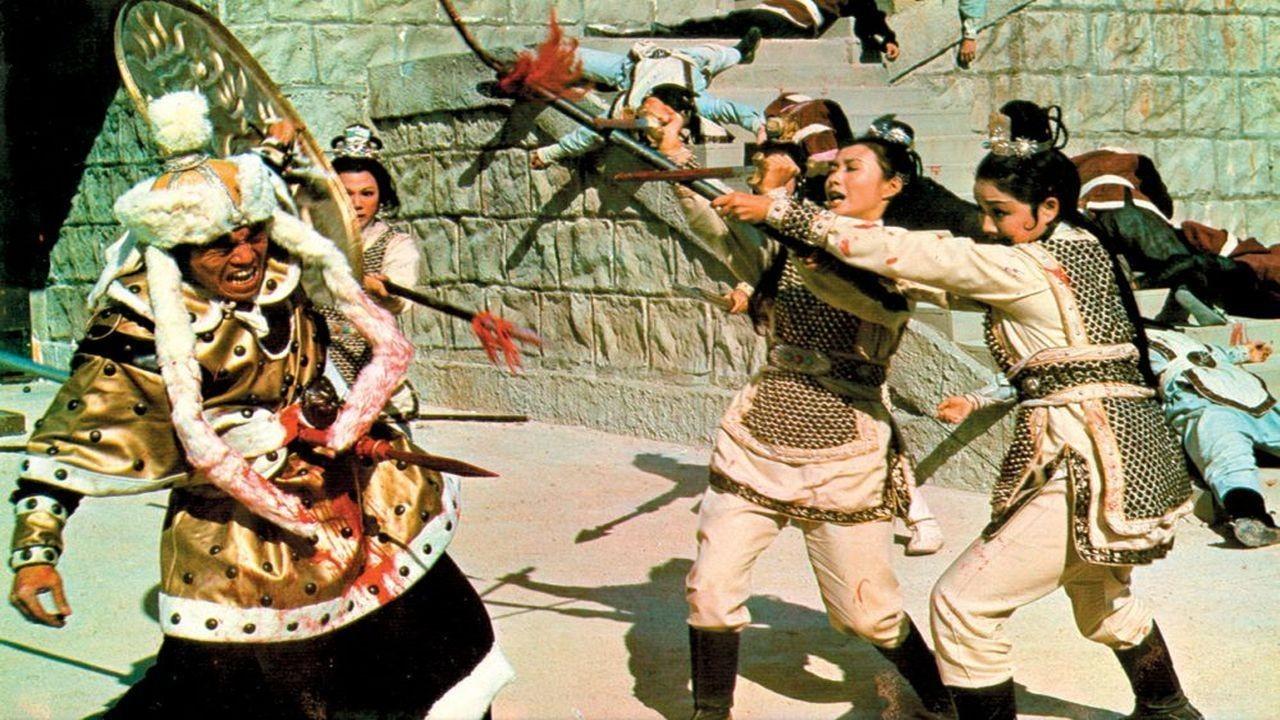
From a technical standpoint, "The 14 Amazons" presents a compelling, if somewhat uneven, display of filmmaking prowess. The sheer scale of the production is undeniable, a hallmark of Shaw Brothers’ commitment to grand cinematic spectacles. The film features elaborate battle sequences that were groundbreaking for their time, vast outdoor sets that conveyed the epic scope of the conflict, and inventive visual ideas. One particularly memorable sequence, the so-called "human bridge," exemplifies the film’s ambition to push the boundaries of genre conventions and visual storytelling.
The action choreography, a crucial element in a film of this nature, was overseen by the then-young Ching Siu-tung, who would go on to become a legendary action choreographer himself. His early work on "The 14 Amazons" shows flashes of remarkable creativity. The sequences that emphasize agility and verticality, such as intricate combat scenes taking place in treetops, highlight a nascent talent for dynamic and visually engaging action. Nevertheless, the film’s embrace of operatic movements and staging, heavily influenced by Peking Opera, occasionally impacts the pacing. While adding to the theatrical grandeur, these stylistic choices sometimes reduce the immediate impact and visceral thrill of the action sequences, creating moments where the narrative momentum can feel somewhat arrested.
Cinematically, the film adheres to the polished and vibrant studio aesthetic that became synonymous with Shaw Brothers productions. The use of color is striking, and the framing of shots is consistently careful and composed, contributing to the film’s epic aspirations. The battle scenes, though stylized, are executed with a palpable sense of grandeur. The editing, credited to Chiang Hsing-lung and Fan Kung-ming, is generally effective in maintaining narrative clarity throughout the sprawling story. However, certain sequences can feel extended, leading to a sense of the film’s considerable length. Despite this, the visual compositions captured in the desert landscapes are undeniably impressive, offering breathtaking vistas that enhance the epic scale of the narrative.
Performances and Ensemble Cast
The success of "The 14 Amazons" is significantly bolstered by its star-studded ensemble cast, a common feature of Shaw Brothers productions that ensured a high level of performance quality. Lisa Lu delivers a particularly commanding portrayal of She Tai-jun. She skillfully balances the character’s inherent authority and strategic acumen with moments of deep emotional weight, anchoring the film with her powerful presence. Ivy Ling Po, as the heroic Mu Guiying, and Lily Ho, as the young Yang Wenguang, bring charisma and undeniable screen presence to their respective roles, making their characters compelling figures within the narrative.
The supporting cast includes seasoned veterans such as Tien Feng and Lo Lieh, who bring their considerable experience and gravitas to their roles. Even when confined to more conventional villainous archetypes, their performances add depth and credibility to the film’s antagonists. However, the sheer size of the ensemble, while a strength in terms of star power, inevitably leads to uneven character development. Many actors, despite their talent, are left with limited material to work with, their roles serving more as functional components of the larger narrative rather than opportunities for significant individual expression.
Sound Design and Auditory Experience
The sound design in "The 14 Amazons" played a crucial role in shaping the film’s atmospheric and emotional impact, a fact duly recognized by its accolades at the Golden Horse Awards. The strategic use of music and sound effects was instrumental in reinforcing the film’s operatic tone. These elements effectively heightened both the emotional resonance and the dramatic stakes of the narrative. The score and soundscape worked in concert to amplify the grandeur of the battles and the pathos of the characters’ sacrifices.
While generally effective, the sound design occasionally verges on excess, a common characteristic of films aiming for heightened dramatic effect. The robust use of percussive elements, soaring orchestral passages, and dramatic vocalizations, while contributing to the epic feel, can sometimes feel overwhelming. However, this stylistic choice is largely consistent with the film’s overall theatrical and mythological aspirations, aiming to immerse the audience in a heightened reality.
Legacy and Enduring Appeal
Ultimately, "The 14 Amazons" stands as a fascinating and significant artifact of its cinematic era. It represents a bold confluence of spectacle, deeply embedded ideology, and the preservation of cultural tradition, all woven into a singular cinematic experience. While the film may not achieve the pinnacle of narrative depth or the nuanced complexity of character development found in some other cinematic achievements, its sheer ambition, its impressive scale, and its undeniable cultural significance ensure its lasting appeal.
Decades after its initial release, "The 14 Amazons" continues to hold a certain charm. It is appreciated not only as a piece of compelling entertainment but also as a valuable reflection of the aesthetic sensibilities, patriotic values, and the burgeoning cinematic ambitions that characterized early 1970s Hong Kong cinema. The film’s success and its distinct approach paved the way for future explorations of female-led narratives in martial arts and historical epics, leaving an indelible mark on the genre. The availability of this classic film through platforms like Imprint Asia allows new generations of film enthusiasts to discover and appreciate its monumental contribution to cinematic history.