



Pima County Sheriff Chris Nanos, who has garnered national attention as a lead figure in the ongoing search for Nancy Guthrie, the mother of Today show co-anchor Savannah Guthrie, is now confronting intense scrutiny from local officials following the recent uncovering of a decades-old disciplinary record and a serious perjury allegation stemming from comments made during a deposition. This escalating crisis has plunged the Pima County Sheriff’s Office into a maelstrom of legal and political challenges, diverting attention from the high-stakes kidnapping investigation and raising profound questions about accountability in public office.
Unanimous Vote Triggers Historic Territorial Law
On Tuesday evening, the Pima County Board of Supervisors in Pima County, Arizona, delivered a unanimous vote that set in motion an extraordinary process. The board invoked a territorial-era law, A.R.S. § 11-253, which mandates that Sheriff Nanos must answer their questions under oath. This rarely utilized statute empowers the board to compel sworn testimony from a county employee—including an elected official like the sheriff—regarding "the specific duties of their whatever the position is," as explained by Dr. Matt Heinz, one of the five members of the board of supervisors, in an interview with The Hollywood Reporter.
The board’s decision represents a significant escalation, with the drafted questions focusing not on the recent Nancy Guthrie case, but almost entirely on Nanos’s law enforcement career spanning more than four decades. The board and its external legal counsel are meticulously preparing a set of inquiries designed to challenge Nanos to defend his suitability for employment within law enforcement, let alone his current role as an elected leader. Sheriff Nanos is anticipated to be formally served with these questions on April 7, coinciding with the board’s next scheduled public meeting, marking a critical juncture in this unfolding saga.

While the Pima County Board of Supervisors lacks the direct authority to remove the sheriff from office, this invocation of A.R.S. § 11-253 serves as a powerful mechanism to exert immense public pressure on Nanos, potentially compelling him to resign. The political ramifications are also considerable within the local Democratic Party, of which both Nanos and Heinz are members. The party has the power to issue a censure, condemn Nanos’s actions, or cast a formal vote of "no confidence," actions that could severely undermine his standing and legitimacy. It is notable that Dr. Heinz had previously supported Heather Lappin, Nanos’s opposing candidate in the most recent sheriff election, where Nanos secured victory by a slim margin of fewer than 500 votes, underscoring the underlying political tensions.
A Career Under the Microscope: El Paso Disciplinary Record Exposed
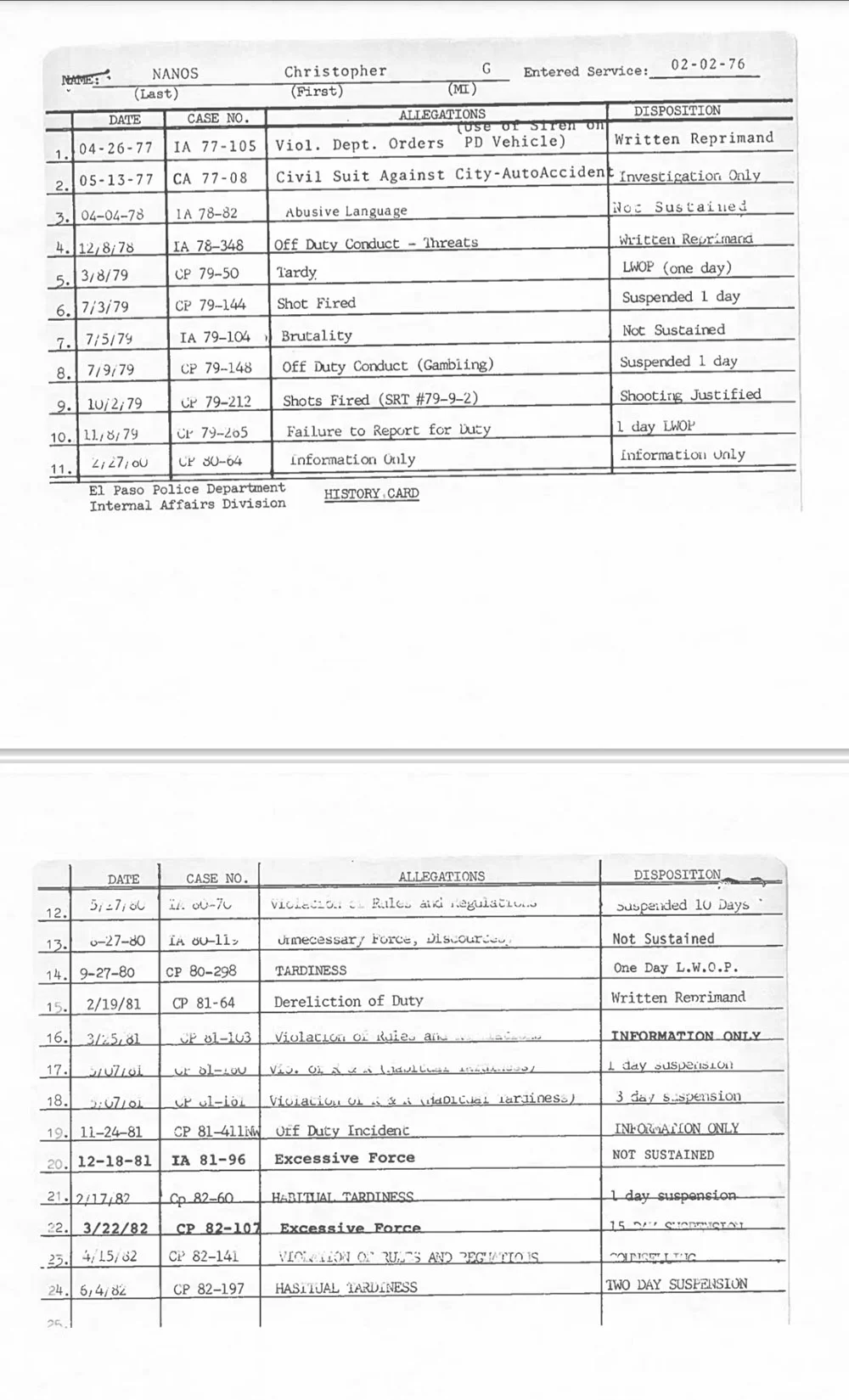
The roots of the current controversy stretch back to the nascent stages of Nanos’s law enforcement career in El Paso, Texas. His official resume, which has been publicly available online via the Pima County Sheriff’s Office website, asserts that Nanos served with the El Paso Police Department from 1976 to 1984. However, recently unearthed employment records from the El Paso Police Department, brought to light by local reporters and subsequently corroborated by Dr. Heinz (and provided to THR), paint a starkly different picture. These records indicate that Nanos’s tenure with the department concluded on August 3, 1982, when he resigned "in lieu of termination." This revelation alone presents a significant discrepancy in his public employment history.
A more comprehensive review of El Paso PD internal affairs files, which have also been made public, reveals a troubling pattern of disciplinary actions against Nanos. Between July 1979 and June 1982, Nanos was suspended a total of eight times, accumulating 32 days of lost pay. These suspensions included a notable 15-day suspension in March 1982 for "excessive force." Dr. Heinz provided specific details regarding this incident, alleging that Nanos struck a handcuffed man in the head with a flashlight, an action that reportedly resulted in the man requiring intensive care unit (ICU) treatment.
Beyond the suspensions, Nanos also received three separate written reprimands and was documented for leaving work without pay on three distinct occasions. Two of these instances were attributed to "habitual tardiness," a recurring issue that also led to two of his official suspensions. The collective weight of these disciplinary actions—ranging from excessive force to chronic punctuality issues—paints a portrait of a police officer whose early career was marked by significant professional misconduct and operational inefficiency.

AZPOST Certification and Allegations of Misrepresentation
The revelation of Nanos’s comprehensive disciplinary history from El Paso has triggered serious questions regarding his Arizona Peace Officer Standards and Training (AZPOST) certification. This certification is a critical document that enables a law enforcement officer to transfer their standing from an outside state to Arizona. Dr. Heinz contends that an individual with such a substantial and severe disciplinary record, particularly one involving excessive force and a resignation in lieu of termination, would typically not have been eligible to receive AZPOST certification. He argues that this history fundamentally disqualifies Nanos from holding any position in law enforcement, let alone the highest elected law enforcement office in Pima County.
Further adding to the allegations of misrepresentation, when Nanos applied for subsequent law enforcement roles in Arizona, he reportedly cited "personal" reasons and the pursuit of a "better paying job" as his motivations for departing the El Paso Police Department. Dr. Heinz characterizes this explanation as, "Minimally, that is a lie by omission," asserting that the true circumstances of his departure involved an impending termination for "insubordination" and "consistent inefficiency." Nanos was, in essence, permitted to resign as an alternative to being fired. Documents from his application process for Arizona roles do, however, correctly list his end-of-employment date from El Paso, indicating that while the dates might have been accurate on some forms, the reasons for departure appear to have been deliberately obscured or downplayed.
Perjury Allegations: A December 2025 Deposition Under Scrutiny
Perhaps the most legally perilous accusation facing Sheriff Nanos involves an allegation of perjury. This claim centers on his testimony during a December 11, 2025, deposition, which was unrelated to his own employment but nonetheless included questions about his disciplinary history as a law enforcement officer. During this sworn testimony, Nanos was directly asked, "Did you ever receive discipline as a law enforcement officer?" He responded, "Yes." When pressed further about the "nature or extent of the discipline," Nanos described it primarily as relating to his driving record: "Primarily, it would have been like — I’m not a very good driver. So I had a lot of car accidents so, you know, letter for this or documented verbal for that."

The critical exchange occurred when he was explicitly asked, "Did you ever receive a discipline that rose to the level of suspension?" To this, Nanos unequivocally replied, "No." This direct denial of ever having been suspended as a law enforcement officer stands in stark contrast to the newly revealed El Paso Police Department internal affairs records, which document eight distinct suspensions totaling 32 days. The Pima County Board of Supervisors views this discrepancy as a clear case of perjury under oath and has formally urged the Arizona Attorney General to pursue a perjury charge with the Department of Justice. A perjury conviction, if obtained, could carry severe legal consequences, including imprisonment, and would undoubtedly lead to his removal from office and permanent disbarment from law enforcement.
Sheriff’s Office Responds Amidst Legal and Political Pressure
In response to the Board of Supervisors’ decision and the mounting allegations, a spokesperson for the Pima County Sheriff’s Office issued a statement to The Hollywood Reporter. The statement confirmed the Sheriff’s intent to comply with the directive: "In response to Board’s decision, Sheriff Nanos will comply with A.R.S. § 11-253 to provide a report to the Pima County Board of Supervisors. He has always been transparent and will provide a report once more direction is provided by the Pima County Administrator." However, the statement concluded with a caveat common in such legal situations: "Because this is a legal matter, the Sheriff is unable to comment any further on this matter." This measured response underscores the serious legal implications now confronting the Sheriff.
The political dynamics within Pima County are further complicated by the fact that both Sheriff Nanos and Dr. Matt Heinz are registered Democrats. Heinz’s open support for Nanos’s opponent in the last election highlights a clear division within the local party structure. The revelations and subsequent actions by the Board of Supervisors put significant pressure on the broader Pima County Democratic Party to take a stance. A formal censure, condemnation, or vote of "no confidence" from his own party could be politically devastating for Nanos, potentially eroding his support base and making his continued tenure untenable.
The Shadow of the Nancy Guthrie Case

This escalating crisis surrounding Sheriff Nanos’s past conduct and alleged perjury casts a long shadow over the high-profile investigation into the abduction of Nancy Guthrie. Nanos had emerged as a national figure, leading the joint investigation with the FBI into the early morning kidnapping of the 84-year-old mother of Savannah Guthrie from her Tucson, Arizona, home on Sunday, February 1. The investigation remains active, with no suspect yet identified.
Throughout the initial stages of the Guthrie search, Nanos and his department received what has been described as "mixed reviews" for their performance. This new wave of scrutiny, however, threatens to further complicate an already sensitive and high-stakes investigation. Public trust in the leadership of the Pima County Sheriff’s Office, already tested by the unsolved kidnapping, could be severely eroded by allegations of a misrepresented past and perjury. The effectiveness of the department and its ability to inspire confidence in the community may be jeopardized at a time when clear, unimpeachable leadership is paramount.
Broader Implications for Public Trust and Accountability
The revelations surrounding Sheriff Chris Nanos carry profound implications beyond Pima County, touching upon broader themes of transparency, integrity, and accountability in law enforcement leadership. The use of a territorial-era law to compel testimony from an elected official underscores the gravity of the allegations and the determination of local oversight bodies to ensure ethical conduct.
The public expects its elected officials, especially those entrusted with upholding the law, to maintain the highest standards of honesty and integrity. Discrepancies in employment records, a history of serious disciplinary actions, and particularly allegations of perjury under oath, strike at the very core of this trust. Should the allegations be substantiated, the case could set a significant precedent for how past conduct, even decades removed, can impact the fitness of an individual for public office. It highlights the ongoing need for rigorous vetting processes and continuous oversight to ensure that those who lead law enforcement agencies are beyond reproach, both in their professional history and their present conduct. The coming weeks, particularly leading up to the April 7 board meeting, will be critical in determining the future of Sheriff Chris Nanos and the leadership of the Pima County Sheriff’s Office.