


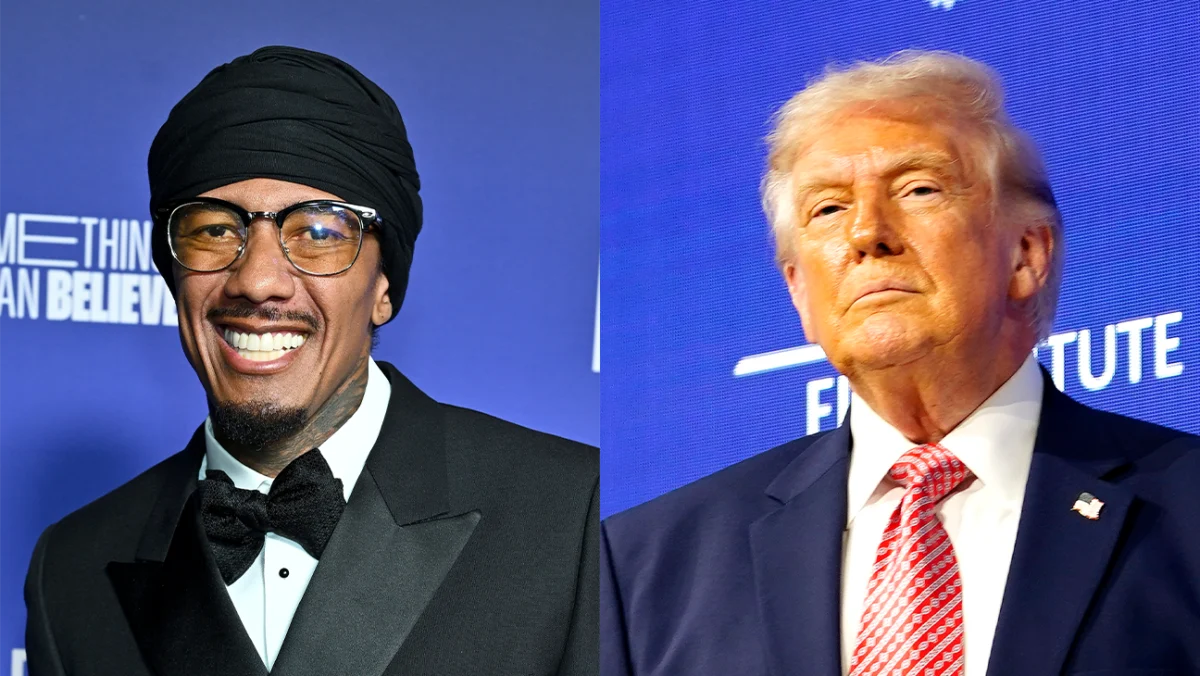
Comedian and producer Nick Cannon ignited a fresh wave of public discourse after making strong political declarations during a recent episode of his show, Big Drive, featuring model and media personality Amber Rose. Cannon openly expressed his support for former President Donald Trump, stating unequivocally, "I f*** with Trump," and controversially labeled the Democratic Party as "the party of the KKK." These remarks, made in conversation with Rose, who also voiced her backing for Trump and critical views of the Democratic Party, have prompted widespread discussion, particularly regarding the historical claims presented.
The exchange unfolded as Rose asserted that Democrats "don’t care about Black people, don’t care about people of color and the Republicans do." Cannon quickly echoed her sentiment, stating, "I agree with you 100 percent." He continued, "People don’t know that the Democrats are the party of the KKK. People don’t know that the Republicans are the party that freed the slaves. I mean, both of you and I have some conservative views. You’re just a little bit more outspoken than I am. And honestly, I don’t subscribe to either party. I rock with W. E. B. Du Bois, when he said there’s no such thing as two parties. It’s just one evil party with two different names."
Rose, not a stranger to public commentary, reiterated her non-affiliation with any single political party but confirmed her vote for Donald Trump in the 2024 U.S. presidential election, claiming he was "definitely by far the better option for us." When she expressed satisfaction with the trajectory of Trump’s hypothetical second term, Cannon interjected enthusiastically, "motherfucker’s cleaning house. He’s doing what he said he was gonna do." He further elaborated on his perception of Trump’s policies, adding, "We got the Gulf of America now. He’s like the club. He’s charging a $5 million bottle service fee to get into the country."
The Historical Claims: A Detailed Examination
The assertions made by Cannon, particularly concerning the historical ties of political parties to the Ku Klux Klan and the abolition of slavery, warrant a detailed factual examination. While elements of his statements touch upon historical events, the context and evolution of these political entities are far more nuanced than presented.
The Democratic Party and the KKK:
Cannon’s claim that "the Democrats are the party of the KKK" is a historical oversimplification that omits critical context about party realignment in American politics. The Ku Klux Klan, a white supremacist terrorist hate group, was indeed founded in Pulaski, Tennessee, in December 1865, shortly after the Civil War. Its initial members were predominantly former Confederate soldiers, many of whom were indeed aligned with the Democratic Party of that era. During the post-Civil War Reconstruction period and well into the mid-20th century, the Democratic Party’s base in the Southern states, often referred to as the "Solid South," was deeply entrenched in white supremacist ideologies and policies of racial segregation, including Jim Crow laws. Many prominent segregationists and members of the KKK held positions within the Democratic Party during this time.
However, a pivotal shift occurred in the mid-20th century, largely spurred by the Civil Rights Movement. The Democratic Party, under leaders like Presidents Franklin D. Roosevelt (with his New Deal coalition) and particularly Lyndon B. Johnson (who championed the Civil Rights Act of 1964 and the Voting Rights Act of 1965), began to embrace civil rights legislation and integrate Black Americans into its coalition. This progressive stance on civil rights alienated many conservative white voters in the South, who then began to migrate to the Republican Party. This phenomenon, often termed the "Southern Strategy," saw the Republican Party, under figures like Richard Nixon, strategically appeal to these disaffected white Southern voters. By the late 20th century, the political landscape had dramatically transformed, with the Democratic Party becoming the primary advocate for civil rights and racial equality, while the Republican Party absorbed a significant portion of the formerly Democratic conservative base. To exclusively link the modern Democratic Party to the KKK without acknowledging this profound ideological and demographic shift over more than a century is to present an incomplete and misleading historical narrative.
The Republican Party and the Abolition of Slavery:
Cannon’s counter-claim that "the Republicans are the party that freed the slaves" is historically accurate in its foundational premise but also requires contextualization. The Republican Party was indeed founded in 1854 by anti-slavery activists, former Whigs, and Free-Soilers who opposed the expansion of slavery into new Western territories. Its core platform was dedicated to preventing the spread of slavery and advocating for its eventual abolition. Abraham Lincoln, a Republican, was elected president in 1860 on an anti-slavery platform, an event that triggered the secession of Southern states and the outbreak of the Civil War.
During the Civil War, President Lincoln issued the Emancipation Proclamation on January 1, 1863, which declared all enslaved people in Confederate states in rebellion against the Union to be free. This was a crucial step towards the total abolition of slavery. The 13th Amendment to the U.S. Constitution, which formally abolished slavery and involuntary servitude across the entire nation, was passed by Congress in 1865 and subsequently ratified by the states. While the Republican Party played a central role in these historical achievements, it is essential to understand that this was the Republican Party of the 19th century, whose ideological tenets and demographic makeup were distinct from its modern iteration.
W.E.B. Du Bois’s "One Evil Party" Critique:
Nick Cannon’s invocation of W.E.B. Du Bois’s quote about "one evil party with two different names" is also noteworthy. Du Bois, a prominent African American sociologist, historian, civil rights activist, and author, was a lifelong critic of systemic racism and economic inequality in the United States. His statement often reflects a deeper critique of the fundamental structures of American power and capital, arguing that both major parties, despite their differences, ultimately served the interests of a ruling class or perpetuated certain injustices. While a powerful statement, its application to specific contemporary party platforms or historical claims about the KKK requires careful interpretation, as Du Bois’s analysis was typically more about underlying societal power dynamics rather than a literal historical equivalency of specific political actions by each party.
Amber Rose’s 2024 Endorsement and Trump’s Policies:
Amber Rose’s declaration of voting for Donald Trump in the 2024 election and her agreement with his "cleaning house" rhetoric reflect a segment of the electorate that finds appeal in Trump’s populist messaging and promises of decisive action. Cannon’s "Gulf of America" analogy, referencing a "club" charging a "$5 million bottle service fee to get into the country," appears to be a colloquial, if crude, interpretation of Trump’s stringent immigration policies and rhetoric surrounding border security. Trump’s first term was marked by significant efforts to curb both legal and illegal immigration, including building parts of a border wall, implementing travel bans, and increasing deportations. These policies resonate with voters who prioritize national sovereignty and tighter border controls, viewing them as necessary measures to protect national interests and resources.
Reactions and Implications
The statements made by Nick Cannon and Amber Rose have predictably generated considerable discussion across social media and political commentary platforms. The immediate implication is the re-ignition of debates surrounding historical literacy and the responsibility of public figures when disseminating historical claims. Fact-checking organizations, like the Associated Press, frequently address such historical misrepresentations, emphasizing the complex evolution of political parties rather than static historical identities.
The broader impact of celebrity political endorsements is a recurrent theme in American politics. Public figures like Cannon, with millions of followers across various platforms, possess a significant megaphone. Their opinions, whether informed or not, can influence public perception, particularly among their fan bases who may look to them for guidance or simply absorb their views uncritically. This highlights the ongoing challenge of distinguishing between entertainment and informed political analysis in the digital age.
Furthermore, these comments contribute to an increasingly polarized political landscape where historical narratives are often weaponized or selectively employed to bolster contemporary political arguments. The simplification of complex historical events, such as the evolution of political parties and their stances on race, can obscure critical understanding and hinder productive dialogue. Instead of fostering nuanced discussion, such remarks often entrench existing divisions and reinforce partisan narratives, regardless of their historical accuracy.
In conclusion, Nick Cannon’s outspoken support for Donald Trump and his controversial historical assertions, echoed by Amber Rose, underscore the intersection of celebrity culture, political discourse, and historical interpretation. While celebrities are entitled to their political views, the manner in which historical claims are presented by influential figures carries significant weight and can impact public understanding and political engagement. The incident serves as a stark reminder of the continuous need for historical accuracy, critical thinking, and responsible communication in the public sphere, especially concerning sensitive and historically charged topics.