



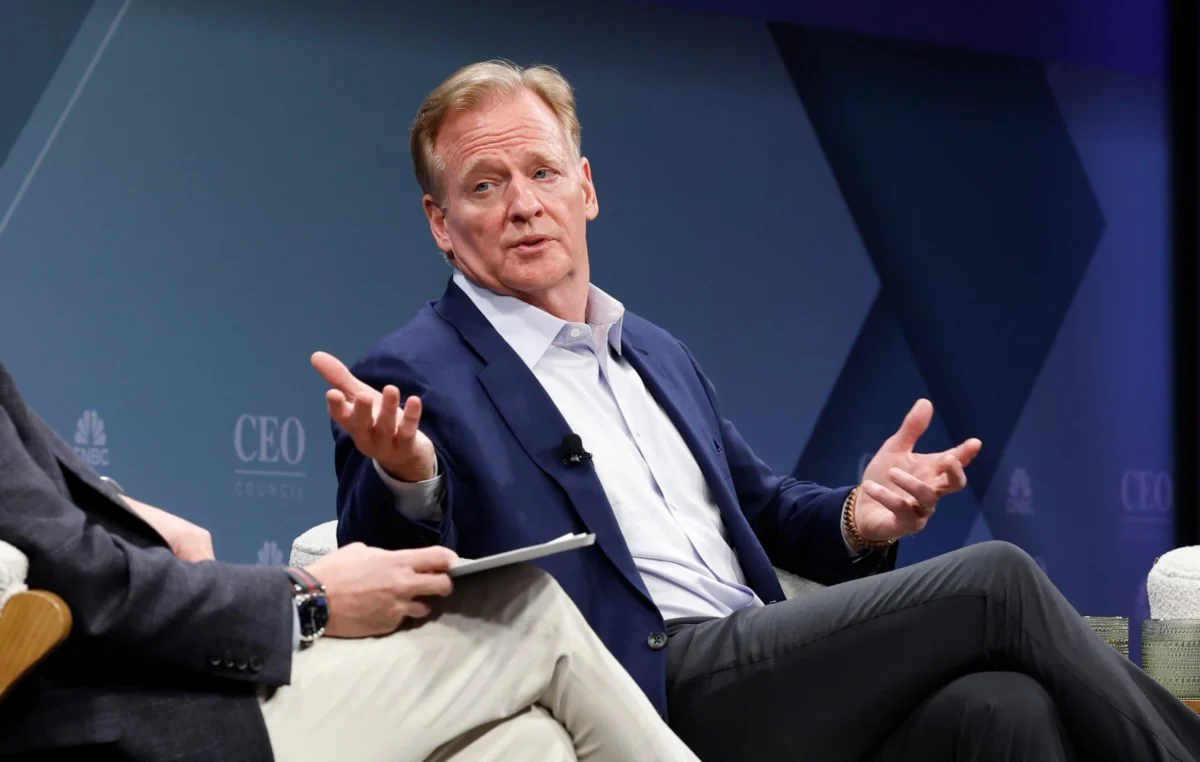
The National Football League and Paramount Global’s CBS division are currently engaged in high-stakes negotiations to restructure and extend their existing media rights agreement, a move that could see the network’s annual payments surge by more than 50 percent. According to individuals familiar with the matter, the league and CBS executives are navigating a bid-ask spread with a midpoint increase of approximately 50% to 60%, reflecting the skyrocketing value of live sports content in an increasingly fragmented media landscape. Under the current 11-year agreement, which was originally brokered in 2021 and implemented in 2023, CBS pays an estimated $2.1 billion annually for its package of Sunday afternoon games. A successful conclusion to these talks would likely push that figure north of $3 billion per year, reinforcing the NFL’s position as the most lucrative property in American television.
The impetus for these early negotiations stems from a unique confluence of corporate restructuring and contractual triggers. While the existing media rights deals for the NFL’s primary partners—CBS, NBC, Fox, and Amazon—are slated to run through the 2033-34 season, the league holds a strategic opt-out clause that could be exercised following the 2029-30 season. However, Paramount’s specific situation is more pressing due to a "change-of-control" provision triggered by Skydance Media’s acquisition of Paramount Global. This legal safeguard allows the NFL to terminate its contract as early as 2027 if ownership of the broadcasting partner changes hands. To secure long-term stability for the newly merged Paramount-Skydance entity, the network is seeking to eliminate this uncertainty by paying a premium now in exchange for the league waiving its right to exit the deal early.
The Financial Architecture of the Proposed Extension
The financial implications of the proposed deal are staggering and highlight the "NFL premium" that networks are willing to pay to maintain their foothold in the live sports market. If the 50% increase is finalized, CBS would begin paying the new, elevated fee as early as next season. This accelerated payment schedule would grant the network an eight-year runway of certainty, ensuring that the cornerstone of its Sunday programming remains intact through the mid-2030s.
For Paramount, the math is complex but essential. The company’s adjusted projection for its earnings before interest, taxes, depreciation, and amortization (EBITDA) for 2026 stands at $3.6 billion. However, the corporate landscape for Paramount is currently in flux. Paramount Chief Financial Officer Dennis Cinelli recently informed investors that if the proposed merger between Paramount and Warner Bros. Discovery is approved by federal regulators, the combined company would boast a projected adjusted EBITDA of $18 billion. This massive increase in scale would provide the necessary capital to absorb the higher NFL rights fees while simultaneously competing with tech giants like Amazon and Apple in the streaming wars.
David Ellison, the CEO of Skydance who is set to lead the combined Paramount-Skydance entity, recently emphasized the critical nature of the partnership. During a recent CNBC appearance, Ellison described the NFL as one of the company’s "most important partners," noting that the network had just come off a historic season that included a record-breaking Super Bowl broadcast. While Ellison declined to provide specific details on the active negotiations, he signaled a commitment to maintaining the relationship for the "foreseeable future."
The Sunday Afternoon Marketplace and the Fox Factor
The NFL’s strategy appears to be one of sequential negotiation. By establishing a new valuation benchmark with CBS, the league creates a blueprint for its other partners. Fox, which currently pays roughly $2.2 billion annually for its Sunday afternoon package—slightly more than CBS due to the historical weighting of the NFC market—is expected to be the next network at the bargaining table. Because the Fox and CBS packages are structurally similar, the terms agreed upon with Paramount will likely serve as the "floor" for Fox’s renewal.
Lachlan Murdoch, CEO of Fox Corp., has acknowledged the upcoming financial pressure. Speaking at the Morgan Stanley Technology, Media & Telecom Conference, Murdoch stated that while Fox intends to continue its mutually beneficial relationship with the NFL, the company has not yet entered "material conversations" regarding a renewal. Murdoch also hinted at a broader strategic shift, noting that Fox would have to "rebalance" its sports portfolio once it commits to the higher NFL fees. This suggests that smaller sports leagues or secondary rights packages currently held by Fox could be at risk as the network consolidates its capital to protect its most valuable asset.
Challenges for Disney, NBC, and Amazon
While CBS and Fox appear to be moving toward a new status quo, the situation is more fraught for the league’s other partners. The NFL has not yet begun substantive discussions with Amazon, NBCUniversal, or Disney, and it remains unclear if those entities will be willing to accept a 50% price hike.
Disney, in particular, faces a difficult calculation. Its subsidiary, ESPN, already pays the highest annual fee of any partner, shelling out $2.7 billion per year for Monday Night Football and a rotating spot in the Super Bowl broadcast. A 50% increase would push Disney’s annual bill to over $4 billion. Sources familiar with Disney’s internal thinking suggest the company would likely "balk" at such a figure, especially as it continues to navigate a transition toward a direct-to-consumer model for ESPN.
Furthermore, executives at NBC and Disney have reportedly expressed frustration over the perceived dilution of their respective packages. In recent years, the NFL has moved to bolster Amazon Prime Video’s Thursday Night Football schedule by providing the streaming giant with more high-profile matchups. This has led to concerns that the "prestige" windows of Sunday Night Football and Monday Night Football are being cannibalized to support the league’s digital expansion. If these networks are asked to pay significantly more for what they perceive as a "diminished" product relative to previous years, the negotiations could become contentious.
Chronology of the NFL Media Rights Evolution
To understand the current negotiations, one must look at the timeline of the NFL’s recent media strategy:
- March 2021: The NFL announces landmark 11-year media rights deals with CBS, NBC, Fox, ESPN/ABC, and Amazon, totaling more than $110 billion.
- 2023: The new deals officially take effect, introducing "flex scheduling" for Monday and Thursday nights and moving Sunday Ticket to YouTube TV.
- July 2025: The FCC approves the $8 billion merger between Skydance Media and Paramount Global, triggering the "change-of-control" provision in the NFL’s contract with CBS.
- February 2026: Super Bowl LX at Levi’s Stadium in Santa Clara demonstrates the continued dominance of NFL ratings, providing the league with fresh leverage.
- May 2025 – Present: The NFL and Paramount begin formal talks to waive the 2029-30 opt-out and the 2027 change-of-control trigger in exchange for a 50-60% price increase.
Downstream Implications for the Sports Industry
The "NFL effect" extends far beyond the gridiron. As the league absorbs a larger share of the networks’ sports budgets, other professional leagues are finding themselves in a precarious position. The National Hockey League (NHL), for instance, currently has broadcast deals with Disney and Warner Bros. Discovery that expire after the 2028 season. NHL Commissioner Gary Bettman has reportedly explored the possibility of early renewal talks, but industry analysts suggest he will likely be forced to wait until the Paramount-WBD merger is finalized.
The financial vacuum created by the NFL’s demands is also creating opportunities for mid-tier broadcasters. Mark Lazarus, CEO of Versant (the parent company of NBCUniversal and CNBC), recently noted that his company is "prepared for the sports landscape to be shifting." Lazarus suggested that as major networks like Fox "rebalance" and potentially drop rights to Major League Baseball (MLB) or the NHL to afford the NFL, Versant’s cable properties, such as USA Network, could step in to acquire those rights at more favorable valuations.
Conclusion and Market Outlook
The current negotiations between the NFL and Paramount represent a pivotal moment in the evolution of sports media. For the NFL, the goal is to lock in long-term financial growth and eliminate the risk of market volatility by removing opt-out clauses. For Paramount and CBS, the deal is a necessary defensive maneuver to ensure their survival and relevance in a post-merger world.
As the bid-ask spread narrows, the industry is watching closely. If CBS agrees to a $3 billion-plus annual fee, it will set a new market standard that will reverberate through the boardrooms of Disney, Comcast, and Fox. In an era where "appointment television" is a dying breed, the NFL remains the only property capable of commanding these historic sums, proving once again that in the world of media, the shield is the ultimate currency. The finalization of this deal will not only secure the future of football on CBS but will also dictate the financial health and programming strategies of the entire American media landscape for the next decade.