

Mubi has released the official international trailer for Orphan, the latest cinematic endeavor from Academy Award-winning Hungarian filmmaker Laszlo Nemes. The film, also known by its Hungarian title Árva, is slated for theatrical release in the UK, Ireland, and Germany starting May 15th, 2026, promising audiences an intricate historical drama set against the tumultuous backdrop of 1957 Hungary. The announcement comes following the film’s extensive tour through major international film festivals in late 2025, where it garnered a notably mixed critical reception, prompting both intrigue and caution among cinephiles.
A Deep Dive into Post-Revolutionary Hungary
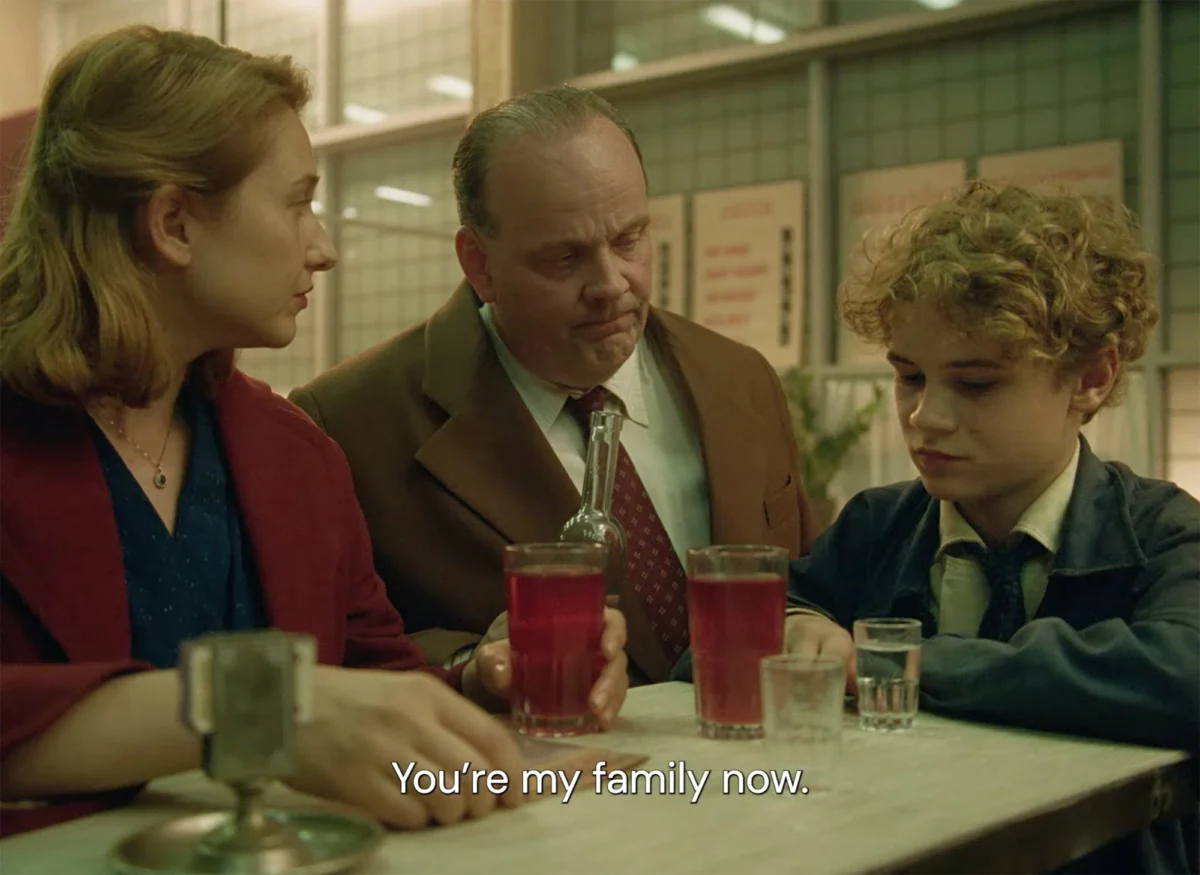
Orphan unfolds in Budapest, a city still reeling from the devastating aftermath of the 1956 Hungarian Uprising against the Soviet-backed Communist regime. At its heart is the story of Andor, a young Jewish boy portrayed by Bojtorján Barabás, who has been raised by his mother (Andrea Waskovics) on idealized tales of his long-absent, presumably deceased, father. This carefully constructed world of memory and myth is violently shattered when a brutish man, played by Grégory Gadebois, suddenly appears, claiming to be Andor’s true father and asserting his right to participate in his upbringing. The film thus plunges into a profound exploration of identity, truth, and the fragile nature of familial bonds, all while navigating the profound societal and personal dislocations of a nation grappling with historical trauma.
The narrative poses fundamental questions about the veracity of personal histories and the psychological toll of political upheaval on individual lives, particularly on a child caught between conflicting narratives. The film’s tagline, "Freedom has its price," subtly underscores the thematic weight, hinting at the sacrifices, compromises, and enduring scars left by the struggle for national liberation and its subsequent suppression. Supporting cast members include Elíz Szabó, Sándor Soma, and Marcin Czarnik, each contributing to the ensemble that populates this vivid, yet disquieting, historical tableau. The central conflict of a child confronted by a shattering truth about his parentage serves as a potent metaphor for a nation struggling to reconcile its past with a challenging present, where official narratives often diverge from personal realities.
Laszlo Nemes: An Auteur’s Evolving Vision
Laszlo Nemes has rapidly established himself as one of contemporary cinema’s most distinctive voices. His previous works, Son of Saul (2015) and Sunset (2018), have solidified his reputation for crafting meticulously researched historical dramas with a unique and often challenging cinematic style. Son of Saul, his debut feature, earned widespread international acclaim, including the Grand Prix at the Cannes Film Festival and the Academy Award for Best Foreign Language Film. Set within the Auschwitz concentration camp during World War II, the film utilized an immersive, subjective perspective, primarily through relentless close-ups on its protagonist, Saul Ausländer, a Sonderkommando member. This stylistic choice intensely conveyed the horrors of the Holocaust, immersing the audience in Saul’s immediate, harrowing experience rather than a broader, more distant historical overview. Its stark, unflinching portrayal of human endurance and moral compromise earned it accolades for its audacity and profound emotional impact. The film’s critical and commercial success positioned Nemes as a significant new voice in world cinema.

Following this monumental success, Nemes presented Sunset, a sprawling period drama set in Budapest prior to World War I. This film, also premiering at the Venice Film Festival, continued Nemes’ exploration of historical introspection and individual search for identity amidst societal decay. While critically lauded for its ambitious scope and exquisite cinematography, it received a more varied reception than Son of Saul, with some critics finding its narrative more elusive and its pacing more deliberate. Despite its more polarizing reception, Sunset reaffirmed Nemes’ commitment to an auteurial vision, characterized by a distinct visual language, a profound sense of historical authenticity, and a willingness to challenge conventional storytelling structures. Its grand visual style and intricate period detail showcased Nemes’ capacity for large-scale historical reconstruction, a quality that Mubi highlights in its description of Orphan as an "exquisitely mounted historical vision."
Orphan marks Nemes’ third feature, and its arrival is met with significant anticipation, particularly given his track record. His consistent focus on pivotal historical moments and the intimate human dramas unfolding within them suggests a thematic continuity, even as his stylistic approach may evolve. The promise of an "exquisitely mounted historical vision," as used by Mubi in its promotional material, aligns with the high production values and meticulous period detail expected from a Nemes film, echoing the visual richness of Sunset and the carefully constructed realism of Son of Saul. This dedication to historical veracity and aesthetic precision remains a hallmark of his cinematic signature.
The Festival Circuit and Critical Divergence
The film’s journey through the 2025 international film festival circuit provides crucial context for its forthcoming public release. Orphan first premiered at the prestigious Venice Film Festival last fall, a significant platform for launching acclaimed arthouse cinema. Following its Venice debut, the film continued its extensive festival run, making appearances at the Toronto International Film Festival, Zurich Film Festival, London Film Festival, AFI Fest, and the Denver Film Festival. This widespread festival presence typically signals a film’s artistic merit and its potential to engage diverse audiences globally, often building momentum and critical buzz ahead of commercial release.
However, the initial critical reception at Venice was described as "very mixed reviews," a phrase that often indicates a film’s capacity to divide critics rather than unite them in universal praise or condemnation. This divergence is further underscored by its current 60% rating on Rotten Tomatoes, a platform that aggregates critical opinions, where a score below 70% is generally considered "rotten." Specific criticisms cited included observations that the film is "unevenly paced & curiously uninvolving." For a director of Nemes’ stature, whose debut feature was met with near-unanimous acclaim, such remarks suggest that Orphan may present a departure or a more challenging viewing experience. These reviews imply that the film might not conform to traditional narrative structures or pacing expectations, potentially prioritizing atmosphere, character psychology, or thematic exploration over conventional plot progression. This makes Orphan a particularly compelling watch for "curious cinephiles only," as noted in the original assessment, implying an audience receptive to films that demand active engagement and contemplation, even if they deviate from mainstream sensibilities. The film’s nuanced historical setting and complex psychological underpinnings may require a particular investment from its audience, appealing more to those seeking artistic challenge than straightforward entertainment.
Historical Context: The Shadow of 1956
To fully appreciate the narrative depth of Orphan, an understanding of the 1956 Hungarian Revolution is paramount. The Hungarian Uprising was a nationwide revolt against the Soviet-imposed government of the Hungarian People’s Republic, lasting from October 23rd to November 10th, 1956. Sparked by student protests and fueled by years of Soviet domination, economic hardship, and political repression under the Stalinist regime, the revolution quickly escalated into a popular uprising demanding greater freedom, democracy, and withdrawal from the Warsaw Pact. For a brief, hopeful period, it seemed as though Hungary might successfully break free from Soviet influence, inspiring democratic movements across the Eastern Bloc.

However, these hopes were brutally crushed. On November 4th, Soviet forces launched a massive invasion of Hungary, deploying tanks and troops to suppress the rebellion. The ensuing conflict resulted in an estimated 2,500 Hungarian deaths and 700 Soviet deaths, along with widespread destruction across the country, particularly in Budapest. The aftermath was equally devastating: approximately 200,000 Hungarians fled the country, seeking refuge in the West, representing about 2% of the population. Internally, thousands were arrested, imprisoned, or executed for their participation in or support of the uprising. The revolution’s suppression solidified Soviet control for decades and left an indelible scar on the Hungarian national psyche. It fostered a climate of fear, distrust, and disillusionment, where open dissent was brutally suppressed, and personal histories often became entangled with political narratives and state-enforced silence. The trauma of 1956 profoundly shaped subsequent generations, creating a society marked by collective memory and unresolved grief.
It is within this fraught historical context that Orphan situates its narrative. The film’s 1957 setting, just one year after the revolution’s brutal suppression, is crucial. It places the protagonist, Andor, in a society grappling with collective trauma, where truth is often obscured, and personal identities are frequently reshaped by political realities. The appearance of a "brutish man" claiming paternity could symbolize the disruption of established narratives, the intrusion of harsh realities into idealized pasts, or even the coercive nature of authority in a post-totalitarian state. The story of a boy whose perception of his father is challenged speaks volumes about a nation forced to re-evaluate its heroes, its history, and its very sense of self in the shadow of a failed revolution. The film promises to explore how personal narratives of loss and longing intersect with national trauma, providing a nuanced portrayal of a turbulent period.
Mubi’s Curatorial Strategy and Distribution Impact
Mubi’s acquisition and distribution of Orphan for the UK, Ireland, and Germany highlights its ongoing commitment to bringing world-class arthouse and independent cinema to a discerning audience. Mubi operates as both a curated streaming service and a distributor, known for its selective approach, offering a daily rotation of critically acclaimed films from across the globe. By championing filmmakers like Laszlo Nemes, Mubi reinforces its brand identity as a platform for challenging, artistically significant works that might not always find broad mainstream distribution. Their commitment to auteur-driven cinema, often with a strong international focus, positions them uniquely in the crowded entertainment landscape.
The decision to release Orphan theatrically in these territories before its eventual streaming debut on the Mubi platform underscores a strategic belief in the film’s artistic merit and its potential to draw audiences to cinemas. This dual-platform approach maximizes exposure and caters to different viewing preferences, ensuring that the film reaches both dedicated cinephiles who prefer the theatrical experience and a broader audience on Mubi’s streaming service. Mubi’s promotional emphasis on the film being an "exquisitely mounted historical vision from Academy Award-winning director Lászlό Nemes" directly addresses the expectations set by Nemes’ previous work and aims to attract viewers who appreciate high-quality, thought-provoking international cinema. Their role is not merely as a distributor but as a curator, actively shaping the landscape of independent film consumption and providing a vital platform for films that prioritize artistic vision over commercial expediency.
Production Insights and Collaborative Efforts
The screenplay for Orphan is credited to Laszlo Nemes himself, alongside Clara Royer, marking another collaboration between the two, who previously co-wrote Son of Saul. This continuity in their writing partnership suggests a shared vision and a deep understanding of the intricate historical and psychological narratives Nemes seeks to explore. The precision and depth evident in Son of Saul‘s script indicate that their combined efforts on Orphan will likely yield a rich, multi-layered narrative. The production boasts an international roster of producers, including Mike Goodridge, Gregory Jankilevitsch, Alexander Rodnyansky, Ildiko Kemeny, and Ferenc Szále. The involvement of such a diverse group of producers, often representing different national film funds or production companies, is characteristic of major European arthouse productions. This collaborative model facilitates access to a broader range of financing and expertise, crucial for mounting ambitious historical films like Orphan, which demand high production values to authentically recreate a specific historical period. It underscores the global nature of contemporary filmmaking, where artistic visions transcend national borders through international co-production, pooling resources and talent to realize complex cinematic projects.

While specific details about the film’s visual language beyond the trailer are scarce, Nemes’ previous works have often featured distinctive cinematography and immersive sound design. Son of Saul was notable for its use of 35mm film and a narrow aspect ratio, contributing to its claustrophobic intensity and the feeling of being perpetually close to the protagonist. Sunset was praised for its grand, sweeping visuals that captured the elegance and underlying tension of pre-war Budapest, often employing long takes and intricate camera movements. It is reasonable to anticipate that Orphan will continue this tradition of strong aesthetic choices, carefully crafted to enhance its thematic concerns and historical setting, ensuring a visually compelling and atmospherically rich experience for its audience. The trailer itself offers glimpses of a stark, period-accurate Budapest, hinting at a visual style that balances historical authenticity with Nemes’ characteristic artistic sensibility.
Broader Implications and Anticipated Discourse
The release of Orphan is a significant event for several reasons. For Laszlo Nemes, it represents a critical juncture in his career. Following the monumental success of Son of Saul and the nuanced reception of Sunset, Orphan will further define his trajectory as an auteur. The mixed reviews, while potentially challenging for immediate commercial success, also position the film as a work that sparks conversation and critical analysis, aligning with the spirit of independent cinema. It encourages audiences to engage with a film on its own terms, rather than simply expecting a replica of previous triumphs, thereby fostering deeper cinematic literacy and appreciation for challenging art.
Furthermore, Orphan contributes to the ongoing cinematic exploration of Hungary’s complex 20th-century history. Hungarian cinema has a rich tradition of confronting national traumas and political upheavals, and Nemes’ film adds a contemporary voice to this dialogue, particularly concerning the lasting impact of the 1956 revolution. Its focus on individual psychological struggle within a deeply scarred society offers a poignant reflection on memory, truth, and the construction of identity in post-conflict environments, making it a valuable historical and cultural document.
For Mubi, Orphan reinforces its commitment to high-quality, challenging international cinema, solidifying its position as a key player in the arthouse distribution landscape. By supporting films that may not fit neatly into commercial categories but possess profound artistic merit, Mubi continues to cultivate an audience eager for thoughtful and ambitious cinematic experiences. As Orphan prepares for its May 2026 release, it stands poised to generate considerable discussion, not only about its artistic merits but also about the enduring power of cinema to illuminate the complexities of history and the human condition. It invites viewers to delve into a turbulent past, prompting reflection on how historical events continue to shape individual lives and collective memory, a timeless theme that resonates deeply even decades later.