



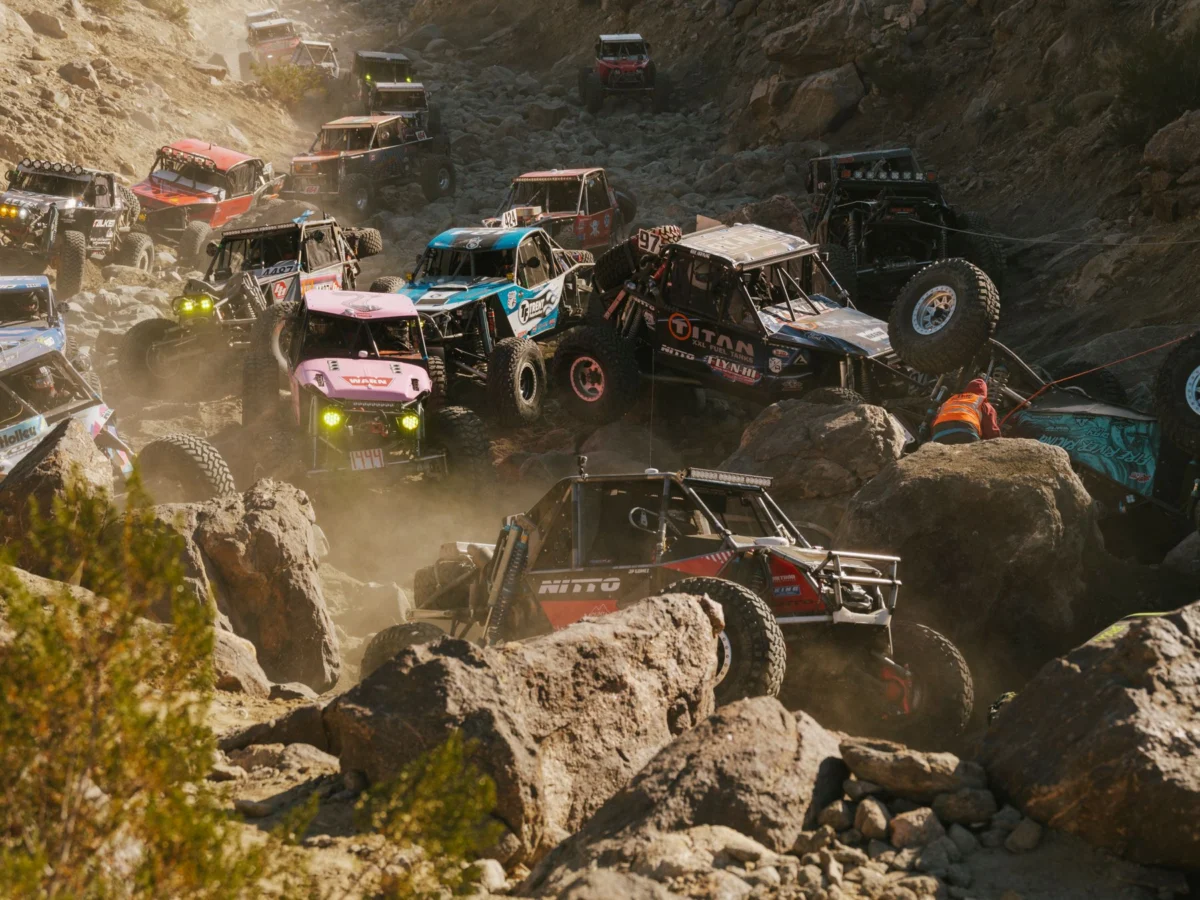
A massive plume of dust hangs suspended over the Johnson Valley in Southern California, a stark contrast to the typically clear desert horizon. Located just beyond the small community of Lucerne Valley, this expanse of public land transforms annually into a dense hub of automotive activity. The landscape is populated by a diverse array of off-road machinery: vintage Toyota pickups reinforced with welded roll cages, contemporary Ford Broncos, dirt bikes, and utility task vehicles (UTVs), alongside miniature four-wheelers operated by children. Flanking the central activity are sprawling recreational vehicle (RV) campsites that extend deep into the desert. At the center of this temporary metropolis lies a structured vendor village and a makeshift hospitality hub, creating a self-sustaining city in one of the most inhospitable environments in North America.
This settlement is known as Hammertown, a temporary desert municipality that materializes every January for a 16-day duration to host the King of the Hammers off-road race series. The event has frequently been described as a hybrid of the Burning Man festival and the aesthetic of the Mad Max film franchise, though it is underpinned by significant corporate sponsorship and a rigorous competitive framework. What began as an informal wager between a small group of friends has evolved into a cornerstone of the global off-road racing calendar, drawing tens of thousands of enthusiasts and millions of digital spectators.
The Genesis and Evolution of the Ultra4 Series
The King of the Hammers recently marked its 20th year of operation, a milestone that underscores its transition from a niche gathering to a major sporting enterprise. The event’s origins date back to 2007, when 13 friends met in the desert to see who could navigate a series of treacherous rock trails and open desert stretches the fastest. The stakes were modest, but the challenge was unprecedented. This inaugural meeting birthed the Ultra4 racing class, a category of vehicle defined by its versatility. Unlike traditional desert racers designed for high speed or rock crawlers designed for technical precision, Ultra4 rigs must excel at both.
The centerpiece of the event is the "Race of Kings," widely regarded as the most grueling single-day off-road race on the planet. The course requirements are extreme, necessitating vehicles that can exceed speeds of 100 mph on flat desert lakebeds while maintaining the low-gear torque and suspension articulation required to scale near-vertical rock faces. The 2024 iteration of the race covered 245 miles of the most punishing terrain in the Johnson Valley. The difficulty of the course was highlighted by the finishing rate; out of a field of elite drivers, only two teams managed to cross the finish line within the mandated 14-hour time limit.
Chronology of Growth: From Secret Meeting to Global Event
The trajectory of King of the Hammers reflects the broader professionalization of off-road sports. Following the 2007 "OG13" race, the event’s popularity surged through word-of-mouth and early internet forums.
- 2007: The inaugural race is held with 13 competitors and no spectators.
- 2008-2010: The event gains official structure, and the "Ultra4" brand is established to govern the growing class of hybrid vehicles.
- 2012: The introduction of the "Every Man Challenge" allows for stock and modified classes, opening the event to a wider range of participants beyond professional trophy truck drivers.
- 2015-2019: Expansion into a multi-day format including UTVs, motos, and the "Tough Truck" categories. Sponsorship from major energy drinks and automotive manufacturers becomes a primary revenue driver.
- 2020-2024: The event surpasses 80,000 on-site attendees and establishes a robust digital broadcasting infrastructure, reaching a global audience of over 1.2 million viewers via live streams.
Today, the event features approximately 750 racers from around the world. The participant pool is a mix of high-profile professionals with factory backing and dedicated amateurs who spend the entire year preparing their "rigs" for the brutal conditions of the Hammers.
Economic Impact and the Professionalization of Off-Roading
The growth of King of the Hammers is intrinsically linked to the booming off-road vehicle market. According to data from Grand View Research, the global off-road vehicle market is currently valued at more than $22 billion. This valuation is reflected in the equipment visible at Hammertown. The era of the "shit-box"—a term affectionately used for dented, sticker-covered, budget-built trucks—has largely given way to a new standard of engineering.
Modern Ultra4 rigs are often purpose-built from the ground up, featuring custom-fabricated chassis, advanced telemetry systems, and specialized suspension components that can cost upwards of $100,000. For top-tier trophy trucks and elite Ultra4 competitors, the investment can easily exceed $500,000. This influx of capital has transformed the vendor village from a simple parts exchange into a high-stakes trade show where major manufacturers like Toyota, Ford, and various aftermarket giants showcase their latest technology.
General admission tickets now start at $100, and the influx of 80,000 people provides a significant seasonal boost to the local economy of the Morongo Basin. The logistical undertaking of building Hammertown—which includes providing sanitation, emergency services, and internet connectivity to a dry lakebed—is a multi-million dollar operation in itself.
Socio-Political Symbolism and the Ethos of Autonomy
Beyond the mechanical and economic aspects, King of the Hammers serves as a cultural touchstone for a specific segment of the American public. The personalization of the vehicles often extends beyond performance modifications to include political and social statements. Custom vinyl wraps, antenna-mounted flags, and tailgate stickers are ubiquitous throughout the camps.
While the American flag is the most prominent symbol, other emblems of rugged individualism and constitutional advocacy are frequent. Gadsden flags (the "Don’t Tread on Me" banner), "1776" motifs, and references to the Second Amendment are common sights. While partisan political flags are present, they are often overshadowed by broader themes of "autonomy" and "freedom." This preoccupation with self-reliance is a natural byproduct of the environment; the Johnson Valley is one of the largest open Off-Highway Vehicle (OHV) areas in the United States, representing a rare space where participants feel a sense of liberation from urban regulations.
The community is defined by a cycle of "break, fix, repeat." This ethos creates a unique social bond among attendees. In the "pits" and campsites, it is common to see rival teams assisting one another with welders and spare parts deep into the night. The shared struggle against the terrain fosters a community that values technical skill and physical endurance above all else.
Land Management and Environmental Considerations
The continued success of King of the Hammers is dependent on a complex relationship with the Bureau of Land Management (BLM) and the U.S. military. Johnson Valley is a shared-use area, and part of the land used for the race is adjacent to the Marine Corps Air Ground Combat Center at Twentynine Palms.
Organizers must navigate rigorous permitting processes to ensure the event complies with environmental regulations and land-use policies. This includes managing the impact on local flora and fauna, such as the desert tortoise. The sustainability of the event depends on the community’s ability to maintain the land’s "open" status, a point of constant focus for advocacy groups like the BlueRibbon Coalition, which fights to keep public lands accessible for motorized recreation.
The professionalization of the race has also brought a more structured approach to environmental stewardship. Organizers implement "pack it in, pack it out" policies, and the temporary nature of Hammertown is designed to leave the lakebed as undisturbed as possible once the 16-day window concludes.
Media Reach and the Future of Ultra4
The digital footprint of King of the Hammers has become a critical component of its business model. With 1.2 million viewers tuning in online, the event has transitioned from a localized desert race to a global media property. This digital reach allows sponsors to justify the high costs of participation and provides a platform for the sport to grow outside of the traditional off-road strongholds in the American West.
The Ultra4 series has already expanded internationally, with sanctioned races taking place in Europe and Australia. This globalization suggests that the "Hammers" formula—combining high-speed desert racing with technical rock crawling—has a universal appeal.
As the event enters its third decade, the challenges remain as much about logistics and land use as they are about the terrain itself. However, the enduring draw of Hammertown suggests that the appetite for this unique brand of mechanical endurance shows no signs of waning. King of the Hammers is no longer just a race; it is a manifestation of a subculture that finds its identity in the dust, the rocks, and the pursuit of autonomy in the open desert. The event stands as a testament to how a small gathering of enthusiasts can reshape an entire industry and create a temporary city that, for two weeks every year, becomes the center of the off-road universe.