


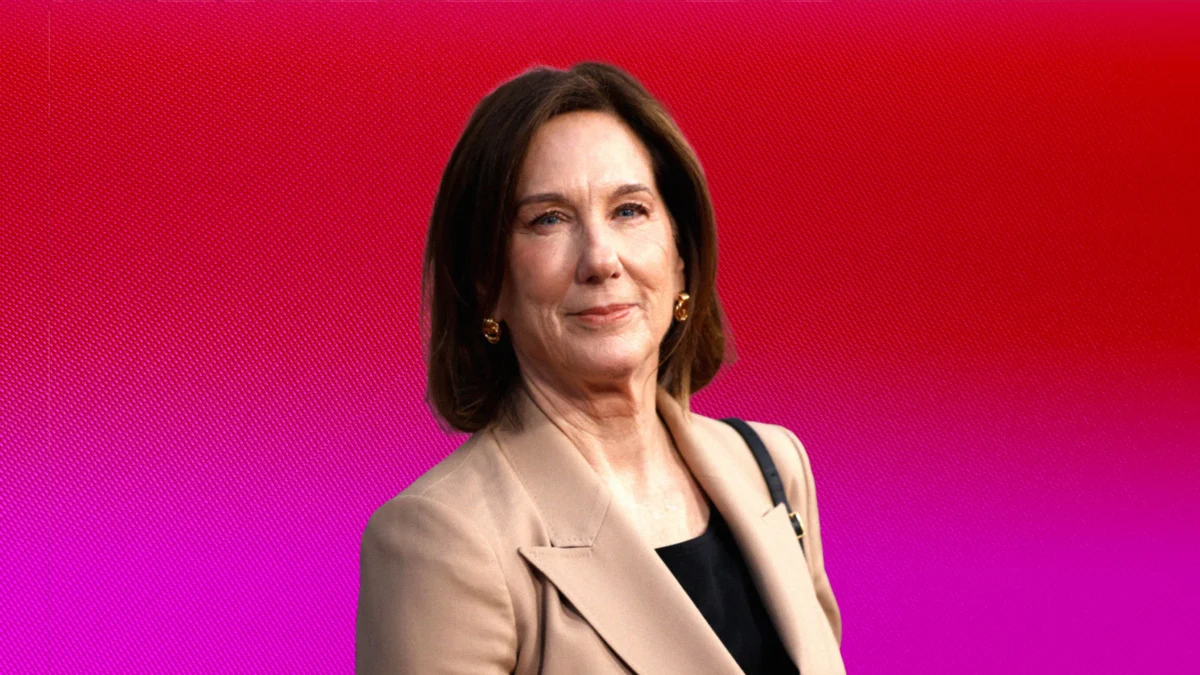
The intersection of legacy filmmaking and emerging technology reached a critical juncture this week in Manhattan as Kathleen Kennedy, the prolific producer behind many of cinema’s most enduring hits, challenged the industry’s current trajectory regarding artificial intelligence. Speaking at the Runway AI Summit, Kennedy, whose credits include Jurassic Park and the Star Wars franchise, addressed a fundamental concern regarding the education of future filmmakers in an era increasingly dominated by automated tools. During a conversation with the head of the American Film Institute (AFI), Kennedy posed a question that has since resonated throughout the creative community: “How are you going to teach taste?”
The inquiry comes at a pivotal moment for the entertainment industry, as major studios and tech startups navigate the volatile landscape of generative AI. Kennedy, 72, emphasized that while the AFI has begun integrating AI tools into its curriculum, the essence of filmmaking remains rooted in discernment rather than mere production. According to Kennedy, the ability to make specific, meaningful choices—defined by an individual’s unique point of view—is what separates a "prompt-generator" from a visionary director. Her remarks served as a sobering counterpoint to an event characterized by high-octane corporate optimism and claims of a technological revolution on par with the discovery of fire.
A Chronology of Technological Optimism
The Runway AI Summit, hosted by the New York-based AI video startup Runway, convened less than a week after a significant disruption in the sector: OpenAI’s decision to halt the rollout of its video generation tool, Sora. This move reportedly derailed a $1 billion deal with Disney, adding a layer of tension to the Manhattan gathering. Despite this setback, the summit began with a tone of "normalization of magic," a phrase coined by Runway co-founder and CEO Cristóbal Valenzuela.
The event’s schedule reflected an industry-wide push to position AI as an inevitable and beneficial evolution of the creative process. At 10:00 a.m., Valenzuela delivered a keynote titled "The Normalization of Magic: AI and What’s Ahead of Us." Invoking Arthur C. Clarke’s third law—that any sufficiently advanced technology is indistinguishable from magic—Valenzuela projected AI-generated imagery, including a surreal depiction of Steve Jobs conversing with a Greek philosopher in an ancient agora.
Throughout the morning, executives from major corporations reinforced this narrative. Phil Wiser, the Chief Technology Officer at Paramount, categorized generative AI as one of the top five technological trends in human history, placing it alongside the printing press. This sentiment was echoed by representatives from Adobe and Electronic Arts (EA), who argued that AI would "close the gap between imagination and creation." To emphasize this transition, summit attendees were provided with T-shirts bearing the slogan “Thank You For Generating With Us,” a play on the iconic "Thank You For Shopping With Us" plastic bag design, signaling an attempt to normalize "generating" as a standard creative verb.
The Sora Setback and the Economic Landscape
The backdrop of the summit was shaped by recent financial and operational hurdles in the AI sector. The cancellation of OpenAI’s Sora IPO and the subsequent collapse of the Disney partnership have tempered some of the more aggressive forecasts regarding AI’s immediate impact on Hollywood. Earlier prophecies suggested that Sora would fundamentally remake film production by 2025; however, technical limitations and ethical concerns regarding training data have slowed that momentum.
Despite these challenges, the summit served as a platform for companies like Runway to assert their dominance. Runway currently offers a suite of text-to-video tools and visual effects (VFX) plugins used by "creatives" across the globe. The company also operates an annual AI-generated film competition, attempting to foster a community of filmmakers who view the technology not as a threat, but as a primary medium. However, the economic reality of AI remains complex. The technology requires immense computational power, leading to a surge in data center construction that has sparked public protests and environmental concerns over energy consumption.
The Counter-Narrative: Kennedy’s Reality Check
While corporate speakers focused on "efficiency" and "unlimited possibility," Kathleen Kennedy’s fireside chat introduced a pragmatic perspective based on decades of production experience. Kennedy, who recently transitioned from her role as the head of Lucasfilm, shared specific instances where technological shortcuts failed to meet the standards of high-end filmmaking.
She cited an example from a recent production—widely believed to be the upcoming film The Mandalorian and Grogu—where the use of 3D-printed props proved insufficient. Because these items were not crafted by experienced prop masters who understand the physical stresses of a film set, the props frequently broke during takes. Kennedy argued that the intuition of a human craftsman, who understands how an object behaves rather than just how it looks, is a form of "taste" and expertise that AI cannot currently replicate.
Kennedy’s critique extended to the creative process itself, stressing the importance of "thinking time" and the role of "chance and accident." She expressed concern that the industry’s drive to streamline production through AI would eliminate the very moments where genuine creativity emerges—the periods of struggle and trial-and-error that define artistic growth.
Supporting Data: The Human Element in the Loop
The debate over AI in Hollywood is underscored by shifting attitudes toward automation. According to recent industry surveys, while 60% of VFX professionals see AI as a tool that could reduce repetitive tasks, nearly 75% express concern about the loss of entry-level positions where young artists traditionally learn their "taste" and craft.
Adobe’s Hannah Elsakr presented a formula during the summit: (Humanity x Creativity) raised to the power of AI = Unlimited Possibility. While mathematically abstract, the equation reflects a corporate desire to keep the "human in the loop" to mitigate fears of total displacement. Similarly, Mihir Vaidya of EA stated that the "origin of creativity is the human mind," suggesting that AI serves merely as a conduit for human intent.
However, critics of this view point to the "synthetic" quality of current AI outputs. During the summit, several demonstrations of AI-generated content were met with polite applause despite visible digital artifacts and an "uncanny valley" aesthetic. A notable point of contention was the mention of a completely AI-generated Coca-Cola holiday advertisement. While Silverside AI studio managing director Rob Wrubel touted the project’s efficiency, the ad had previously faced significant public backlash for its perceived lack of soul and "conspicuously digital" appearance.
Broader Impact and Implications for the Future of Film
The central tension revealed at the Runway AI Summit is the distinction between "creation" and "generation." Kennedy’s remarks suggest that the film industry is approaching a crossroads where it must decide whether it values the process of artistic labor or merely the speed of the final output.
The implications for film education are particularly significant. If institutions like the AFI prioritize AI proficiency, there is a risk that the next generation of filmmakers will lack the foundational skills acquired through "toil"—the act of writing and rewriting, or the physical mastery of a musical instrument. Kennedy’s argument posits that the "gap between imagination and creation" is not an inefficiency to be solved, but the space where human creativity is forged.
Furthermore, the environmental and ethical costs of AI continue to loom over the industry. The energy crisis mentioned by several attendees highlights a growing conflict: the desire for "instant" high-fidelity video generation versus the global need for sustainable energy practices. As data centers expand to meet the demands of generative models, the film industry may face increasing pressure to justify the carbon footprint of AI-assisted productions.
Conclusion: The Persistence of Human Discernment
As the Runway AI Summit concluded, the disparity between the "hype machine" and the reality of creative production remained clear. While executives continue to compare AI to fire and the printing press, veteran leaders like Kathleen Kennedy serve as a reminder that technology is only as effective as the "taste" of the person wielding it.
The future of Hollywood likely involves a hybrid model where AI tools are used for specific technical efficiencies, but the core narrative and aesthetic choices remain firmly in human hands. Kennedy’s "traditionalist" stance is not a rejection of progress, but a call to preserve the human virtues of intuition, experience, and discernment. In an era where anything can be generated with a prompt, the value of the "discerning filmmaker" may become the industry’s most precious—and rarest—commodity.