

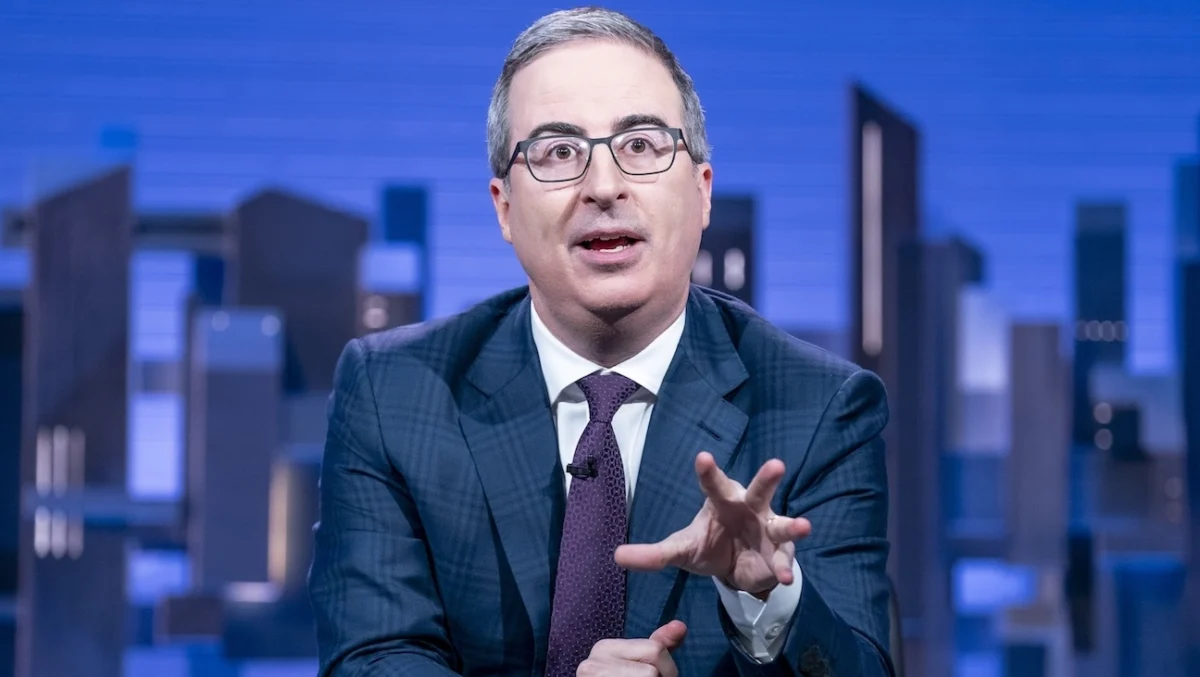
On a recent broadcast of Last Week Tonight, host John Oliver critically examined President Donald Trump’s deliberate avoidance of the term "war" to describe ongoing military engagements with Iran, instead opting for "military operation." This linguistic choice, ostensibly made to circumvent legal and political hurdles associated with a formal declaration of war, became a central point of Oliver’s segment, drawing attention to the serious implications of the United States’ military posture in the Persian Gulf region. The comedian highlighted the apparent contradiction between the administration’s rhetoric and the escalating reality on the ground, where casualties mount and threats intensify.
The Semantic Battlefield: War vs. Military Operation
President Trump’s rationale for his word choice was directly quoted by Oliver during the broadcast. "I won’t use the word ‘war’ because they say if you use the word war, that’s maybe not a good thing to do," Trump stated. "They don’t like the word war because you’re supposed to get approval, so I’ll use the word ‘military operation,’ which is really what it is." This candid admission immediately sparked discussion among political commentators and legal experts regarding the constitutional division of war powers in the United States. Under Article I, Section 8 of the U.S. Constitution, Congress holds the sole power to declare war. The War Powers Resolution of 1973 further stipulates that the President must notify Congress within 48 hours of deploying armed forces into hostilities or situations where hostilities are imminent, and must withdraw them within 60 days unless Congress has authorized such use of force or declared war. Trump’s statement suggests an awareness of these constitutional constraints and a strategic maneuver to bypass them, effectively pursuing military action without explicit congressional authorization.
Oliver’s satirical response underscored the perceived absurdity of the President’s explanation, comparing it to a child’s stream-of-consciousness dialogue. While comedic, the segment’s underlying message was serious: the label applied to military engagement carries significant weight, determining legal frameworks, congressional oversight, and international perceptions. The distinction between "war" and "military operation" is not merely semantic; it touches upon the very foundation of democratic checks and balances concerning the commitment of national resources and human lives to conflict.
Escalation and Chaos: A Chronology of Recent Events
The "Iran war," as Oliver termed it, had reportedly entered its second month, characterized by a series of volatile exchanges and heightened tensions. The chronology of events leading to this point reveals a cycle of provocation and retaliation that has pushed the region to the brink.
June 2019: Tensions significantly escalated following attacks on oil tankers in the Gulf of Oman, which the U.S. blamed on Iran. Iran, in turn, shot down a U.S. surveillance drone, claiming it had violated Iranian airspace, a claim disputed by Washington. President Trump reportedly approved, then abruptly called off, retaliatory strikes against Iran, citing concerns about potential casualties.
July 2019: Iran seized a British-flagged oil tanker in the Strait of Hormuz, a critical chokepoint for global oil shipments, in apparent retaliation for the seizure of an Iranian tanker by British forces off Gibraltar. This incident highlighted the fragility of maritime security in the region and the potential for a broader conflict to disrupt global energy markets.
August 2019: Reports indicated that the U.S. was exploring options for increasing its military presence in the region, including the potential deployment of an additional 10,000 troops, a move that would significantly bolster American forces. These discussions occurred against a backdrop of continued rhetoric from President Trump, who threatened severe repercussions should Iran close the Strait of Hormuz. His social media posts, in particular, conveyed an aggressive stance, including a threat to attack Iran’s power grid, "starting with the biggest" power plant first. Such threats, Oliver noted, would be considered war crimes under international law if committed during a declared war, further highlighting the precarious legal status of the ongoing "military operation."
Early September 2019: Amidst these escalating threats, President Trump claimed that potential strikes against Iran had been delayed following "fruitful conversations" with Iranian officials. However, these claims were swiftly and unequivocally denied by Tehran, underscoring a significant disconnect in communication or a deliberate misrepresentation of diplomatic efforts. Simultaneously, Iranian-backed forces or proxies continued to target U.S. bases and allied interests in the region, demonstrating a persistent and active engagement in hostilities.
The human cost of these operations has been substantial. Reports cited by Oliver indicated that approximately 2,000 Iranians and 13 U.S. service members had been killed in the escalating conflict, figures that underscore the deadly reality on the ground, irrespective of the terminology used by political leaders. The absence of a formal war declaration does not diminish the lethal impact of these engagements.
Historical Context: A Fraught Relationship
The current tensions between the United States and Iran are deeply rooted in decades of complex and often adversarial relations, particularly since the 1979 Islamic Revolution. The overthrow of the U.S.-backed Shah and the subsequent hostage crisis at the U.S. embassy in Tehran marked a definitive break, ushering in an era of mutual distrust and proxy conflicts.
For decades, U.S. policy towards Iran has oscillated between containment, sanctions, and attempts at diplomacy. The landmark 2015 Joint Comprehensive Plan of Action (JCPOA), or Iran Nuclear Deal, represented a significant diplomatic breakthrough. Under the agreement, Iran agreed to limit its nuclear program in exchange for sanctions relief from the U.S., EU, and UN. However, President Trump’s decision in May 2018 to withdraw the U.S. from the JCPOA and re-impose a "maximum pressure" campaign of sanctions marked a dramatic shift, unraveling years of diplomatic efforts and intensifying economic hardship within Iran. This withdrawal, coupled with subsequent escalations, including the U.S. designation of Iran’s Islamic Revolutionary Guard Corps (IRGC) as a foreign terrorist organization, set the stage for the current military confrontations. The "maximum pressure" strategy, intended to compel Iran to negotiate a new, broader agreement, has instead been perceived by Tehran as an act of economic warfare, leading to increased regional assertiveness and a willingness to challenge U.S. interests.
International and Domestic Reactions
The escalating tensions have elicited varied reactions both domestically and internationally. Louisiana Senator John Kennedy, a Republican, offered a defense of the administration’s actions, stating, "Here’s why we went into Iran: We had no choice. The president didn’t start a war. He was trying to stop a war." Oliver, in his comedic critique, likened this reasoning to other common rationalizations like "spend money to make money" or "fake it ’til you make it," suggesting it’s a phrase used by those "in way over their heads."
Beyond the comedic realm, official responses from various stakeholders have highlighted the gravity of the situation. The U.S. State Department and Pentagon have consistently maintained that American military actions in the region are defensive in nature, aimed at protecting U.S. personnel and interests from Iranian aggression. They argue that these actions fall within the President’s constitutional authority as Commander-in-Chief to defend the nation, without requiring a formal declaration of war.
Iranian officials, however, have vehemently rejected U.S. claims of "fruitful conversations," portraying them as false narratives designed to de-escalate international pressure while continuing aggressive policies. Iran has consistently reiterated its right to self-defense and vowed retaliation for any attacks on its sovereignty or interests, often emphasizing its missile capabilities and regional influence.
The international community, including European allies and the United Nations, has largely expressed deep concern over the escalating tensions. Many nations have called for de-escalation, restraint, and a return to diplomatic solutions, warning against the destabilizing impact of a full-blown conflict in a region already grappling with multiple crises. The UN Secretary-General has repeatedly urged all parties to exercise maximum caution to avoid miscalculation and prevent further escalation. Public opinion in the U.S. has also shown division, with significant debate over the legality and wisdom of military engagements without explicit congressional approval, raising questions about accountability and democratic process in foreign policy.
Legal and Constitutional Ramifications
The debate over President Trump’s use of "military operation" instead of "war" is not merely rhetorical; it has profound legal and constitutional ramifications. The War Powers Resolution of 1973 was enacted precisely to reassert congressional authority over the deployment of U.S. forces into hostilities, following controversial presidential actions in Vietnam. Critics of the administration’s approach argue that the ongoing military actions in Iran, characterized by casualties, retaliatory strikes, and threats of further aggression, clearly constitute "hostilities" under the War Powers Resolution, thereby triggering congressional reporting and authorization requirements.
Many members of Congress, particularly from the opposition party, have voiced concerns that the President is circumventing constitutional checks and balances, effectively engaging in an undeclared war. They have called for resolutions to mandate congressional approval for any offensive military action against Iran, seeking to reclaim Congress’s constitutional prerogative. The executive branch, however, has historically interpreted its powers more broadly, asserting that the President, as Commander-in-Chief, has inherent authority to use military force to protect national interests, especially in response to perceived threats. This ongoing tension between presidential prerogative and congressional oversight remains a central theme in American foreign policy and is acutely highlighted by the situation with Iran.
Broader Implications: Geopolitical and Economic
Regardless of the terminology employed, the ongoing military engagements between the U.S. and Iran carry significant broader implications for global geopolitics and the world economy.
Regional Stability: The Persian Gulf is a highly volatile region, with existing conflicts in Yemen, Iraq, and Syria. A direct military confrontation between the U.S. and Iran would undoubtedly destabilize the entire region, potentially drawing in other regional actors such as Saudi Arabia, Israel, and various non-state militias. This could lead to a catastrophic humanitarian crisis and a protracted conflict with unpredictable consequences.
Economic Impact: The Strait of Hormuz, through which approximately 20% of the world’s petroleum liquids pass, is a critical choke point for global energy supplies. Any disruption to shipping in this strait, whether through direct conflict or heightened security risks, would send shockwaves through international oil markets, leading to soaring prices and potential global economic recession. Insurance premiums for shipping in the Gulf have already increased significantly, impacting trade and supply chains.
International Alliances: U.S. actions without broad international consensus or congressional authorization could strain relationships with key allies, particularly European nations that remain committed to the JCPOA and favor diplomatic solutions. This could further isolate the U.S. on the global stage and weaken international efforts to address other pressing geopolitical challenges.
Humanitarian Concerns: Any large-scale conflict would inevitably result in a significant loss of life, displacement of populations, and destruction of infrastructure, exacerbating existing humanitarian crises in the Middle East.
In conclusion, John Oliver’s segment on Last Week Tonight served as a comedic yet piercing commentary on the serious implications of political rhetoric concerning military engagement. President Trump’s choice to label the ongoing conflict with Iran as a "military operation" rather than a "war" underscores a deliberate strategy to navigate constitutional boundaries. However, as Oliver and many analysts have pointed out, the semantic distinction does not alter the grim reality of escalating hostilities, mounting casualties, and profound geopolitical and economic risks. The situation highlights the urgent need for clarity, accountability, and a comprehensive strategy that addresses the underlying tensions while respecting democratic processes and avoiding further destabilization of an already fragile region.