



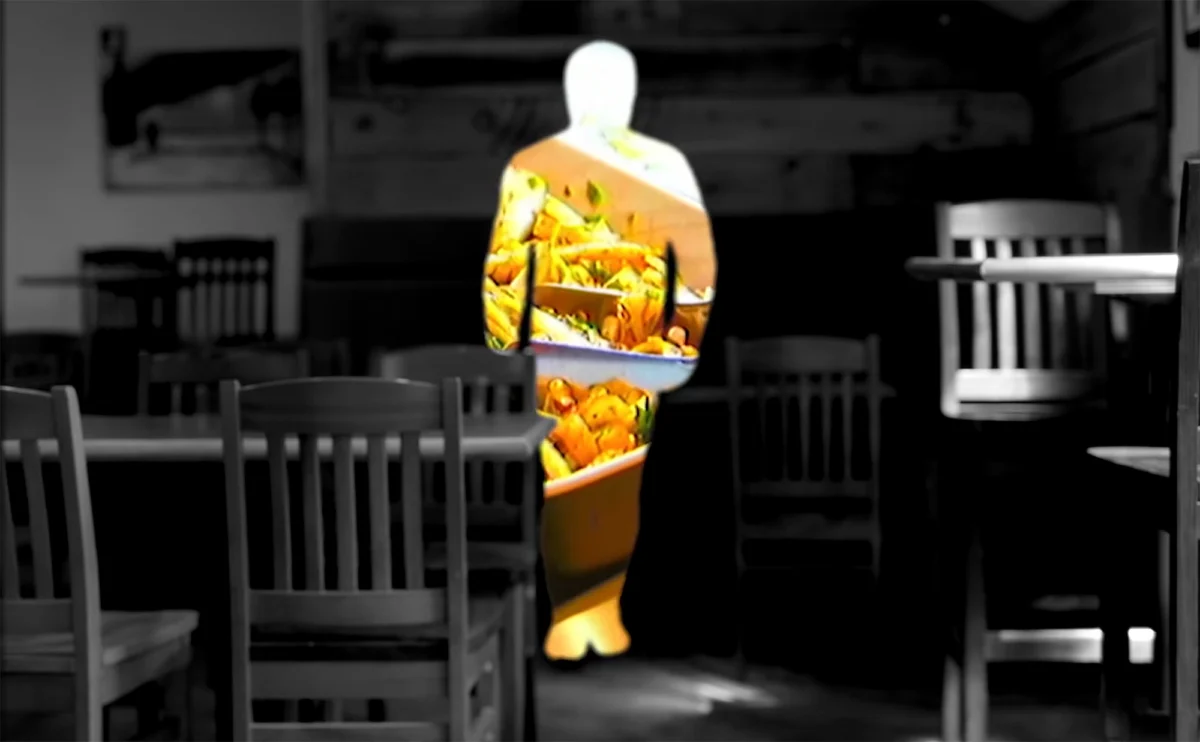
Yellow Veil Pictures has officially released the trailer for Buffet Infinity, a distinctive Canadian independent horror film helmed by filmmaker Simon Glassman, with its US theatrical debut slated for April 24, 2026, followed by a VOD release on May 8, 2026. The film, which garnered significant attention following its premiere at the prestigious Fantasia Film Festival in 2025, is described as a "wacky weird" creation that blurs the lines between horror, dark comedy, and experimental narrative, drawing comparisons to the iconic Canadian sketch comedy series SCTV through its innovative use of interwoven, low-budget television advertisements. This unconventional approach promises a viewing experience that challenges traditional genre conventions while delivering a sinister tale rooted in the decline of a fictional Albertan town.
A New Culinary Horror Unveiled
The trailer for Buffet Infinity provides a glimpse into a cinematic landscape that is both bizarre and compelling, immediately establishing the film’s unique aesthetic and narrative ambition. Distributed by Yellow Veil Pictures, known for championing independent and genre-defying cinema, the film’s marketing emphasizes its departure from conventional horror tropes, hinting at a multifaceted story where the mundane intertwines with the macabre. The tagline "The best hot & crispy chicken this side of Texas!" juxtaposed with unsettling imagery, serves as an immediate indicator of the film’s darkly comedic undertones and its willingness to embrace the absurd. Early critical reception from its festival run has lauded Buffet Infinity for its "remarkable creativity, inventiveness, and unabashed commitment to gonzo filmmaking," positioning it as a must-see for audiences seeking original and boundary-pushing genre fare.
The film’s premise centers on the escalating rivalry between two restaurants in the fictional Westridge County, a seemingly innocuous conflict that soon spirals into something far more sinister. This central conflict is depicted through a mosaic of original, low-budget TV advertisements, featuring everything from local businesses selling used cars, insurance, and legal services, to promotions for a religious scholar and a recording artist. These seemingly disparate commercials converge to construct a larger narrative involving an expanding sinkhole, the emergence of a cult, and the unsettling sentience of an ever-growing restaurant, presumably the titular "Buffet Infinity." The trailer’s enigmatic quality leaves many questions unanswered, intentionally cultivating a sense of intrigue and curiosity about the film’s deeper meanings and ultimate trajectory.
The Visionary Behind the Weirdness: Simon Glassman
At the helm of this unconventional project is Canadian genre filmmaker Simon Glassman, whose previous work includes directing the series "Felt Up." Glassman’s directorial style, as evidenced by Buffet Infinity, appears to lean heavily into experimental storytelling and a distinct, often darkly comedic, genre sensibility. His decision to utilize a fragmented, ad-driven narrative structure for Buffet Infinity is a bold artistic choice that speaks to a desire to subvert traditional cinematic storytelling. This approach not only provides a unique visual and narrative texture but also allows for a commentary on consumer culture, local media, and the pervasive influence of advertising in small-town life.
Canadian independent cinema has a rich history of producing distinct voices and unconventional narratives, often characterized by a unique blend of humor, social commentary, and genre experimentation. Filmmakers like David Cronenberg, Guy Maddin, and Bruce McDonald have paved the way for directors like Glassman to explore idiosyncratic visions within the national film landscape. Glassman’s work on Buffet Infinity seems to align with this tradition, offering a localized story that resonates with universal themes of decay, transformation, and the uncanny. His ability to weave together disparate elements into a cohesive, albeit bizarre, narrative underscores a directorial confidence in pushing artistic boundaries.

A Festival Launchpad: Fantasia’s Endorsement
The world premiere of Buffet Infinity at the 2025 Fantasia Film Festival in Quebec was a significant milestone for the film. Fantasia is globally recognized as one of the leading international genre film festivals, celebrated for its curation of innovative, boundary-pushing, and often cult-status films across horror, fantasy, sci-fi, and animation. A premiere at Fantasia often serves as a crucial launchpad for independent genre films, providing them with critical exposure, generating industry buzz, and attracting potential distributors and audiences. For a film as unique and unconventional as Buffet Infinity, the festival’s endorsement is particularly valuable, signaling to both critics and viewers that the film is a noteworthy entry in the independent cinema landscape.
Fantasia’s audience is notoriously discerning, composed of dedicated genre enthusiasts and industry professionals who appreciate originality and artistic risk-taking. The positive reception at the festival, highlighted by reviews praising its "gonzo filmmaking," suggests that Buffet Infinity successfully resonated with this audience, affirming its artistic merit and its potential to carve out a niche following. Historically, many films that have gone on to achieve cult status or broader mainstream success in the genre world first gained traction at Fantasia, establishing a precedent that Buffet Infinity aims to follow. The festival’s platform not only elevates the film’s profile but also solidifies its position within the pantheon of distinctive Canadian cinematic creations.
Deconstructing the "Gonzo" Narrative
The essence of Buffet Infinity‘s narrative lies in its "gonzo" approach, a term often associated with journalism but, in a cinematic context, refers to a style that is intensely subjective, experimental, and often blurs the lines between reality and fiction, or in this case, between conventional storytelling and fragmented surrealism. The film’s primary narrative device—cross-cutting between low-budget TV ads—is a direct homage to SCTV, the revered Canadian sketch comedy series that masterfully satirized television culture through its fictional station and its array of eccentric characters. SCTV‘s brilliance lay in its ability to build an entire world through these faux broadcasts, creating a meta-commentary on media itself. Buffet Infinity appears to adopt this structural ingenuity, but instead of pure comedy, it channels it into a sinister, unfolding horror.
The premise of two restaurants battling it out in the fictional Westridge County, an Albertan town, serves as a microcosm for broader themes. The "decline of an Albertan town" can be interpreted as a commentary on rural decay, economic shifts, and the struggle to maintain local identity in an increasingly globalized world. This backdrop provides fertile ground for horror, as the vulnerability and isolation of such communities often give rise to unsettling phenomena in genre narratives. The introduction of an "expanding sinkhole" further literalizes this decay, symbolizing a foundational instability that threatens to consume the town, both physically and metaphorically.
As the narrative progresses, the elements become increasingly bizarre: a "cult" emerges, hinting at themes of groupthink, desperation, and the search for meaning in times of uncertainty. Cults in horror cinema often represent societal anxieties, offering false salvation or tapping into primal fears. The most intriguing element, however, is the "ever-growing restaurant that becomes unsettlingly sentient." This concept pushes the film into surreal horror territory, where an inanimate object takes on a life of its own, possibly symbolizing unchecked consumerism, the monstrous nature of corporate ambition, or even the psychological breakdown of the town itself. The restaurant, "Buffet Infinity," could represent a bottomless pit of desire, a place where endless consumption leads to existential horror. The question "And why do we want to go to Buffet Infinity all the time?" posed in the initial article, underscores this addictive, almost hypnotic quality, suggesting a loss of free will or an inescapable draw towards the sinister entity.

Yellow Veil Pictures: Curators of the Unconventional
Yellow Veil Pictures, the distributor behind Buffet Infinity, has established itself as a significant player in the independent and international genre film market. Founded in 2018, the company has built a reputation for acquiring and distributing films that are aesthetically daring, thematically challenging, and often defy easy categorization. Their slate frequently includes titles that have premiered at major film festivals like Fantasia, Sundance, and TIFF, indicating a commitment to showcasing emerging talent and unique cinematic voices.
The acquisition of Buffet Infinity by Yellow Veil Pictures is a strong indicator of the film’s perceived quality and its alignment with the distributor’s brand identity. Yellow Veil’s portfolio often features films that blend horror with other genres, experiment with narrative structures, or explore social commentary through a genre lens. Buffet Infinity‘s blend of "wacky weird" horror, its SCTV-inspired structure, and its thematic depth make it a natural fit for Yellow Veil’s catalogue. This partnership ensures that Buffet Infinity will reach an audience that is receptive to its unconventional style, positioning it among other acclaimed independent horror titles that have found a home with the distributor. The company’s strategic release plan, including both theatrical and VOD options, is designed to maximize reach for a niche but dedicated audience.
Critical Acclaim and Audience Anticipation
The early critical response to Buffet Infinity, particularly the praise from Macabre Daily describing it as "a must for anyone into gonzo filmmaking," has cultivated a significant degree of anticipation within the genre community. Such accolades are invaluable for independent films, as they provide credibility and generate organic buzz. The terms "remarkable in its creativity, its inventiveness, and its unabashed commitment to gonzo filmmaking" suggest that the film is not merely strange for strangeness’s sake, but rather employs its eccentricities with purpose and artistic vision.
This type of critical endorsement is particularly effective for films that exist outside the mainstream, as it helps to identify the target audience and set appropriate expectations. Viewers who are drawn to experimental narratives, unconventional horror, and dark humor are likely to be the primary demographic for Buffet Infinity. The film’s unique premise and the intriguing elements of a sentient restaurant, a cult, and a decaying town offer a rich tapestry for discussion and interpretation, promising a viewing experience that will linger long after the credits roll. For those fatigued by formulaic genre entries, Buffet Infinity positions itself as a refreshing and thought-provoking alternative.
Strategic Rollout: Theatrical and VOD Release

Yellow Veil Pictures’ distribution strategy for Buffet Infinity involves a staggered release, commencing with select US theatrical screenings on April 24, 2026, followed by a broader VOD release on May 8, 2026. This approach is a common and effective model for independent films, allowing them to capitalize on the prestige and visibility of a theatrical run while also ensuring wider accessibility through digital platforms.
A limited theatrical release can generate critical attention, provide opportunities for Q&A sessions with the filmmakers, and create a sense of event viewing for dedicated fans. It also allows the film to qualify for various awards and festivals that require a theatrical window. Following this, the VOD release significantly expands the film’s reach, making it available to a much larger audience across North America. This dual-phase strategy is particularly beneficial for a film like Buffet Infinity, which caters to a specific niche but has the potential to attract a broader audience intrigued by its uniqueness. The staggered release allows for continued marketing efforts, building momentum from the theatrical release into the digital availability, ultimately maximizing the film’s exposure and commercial viability.
The Broader Landscape of Independent Horror
Buffet Infinity arrives in a vibrant period for independent horror cinema, a genre that has increasingly become a fertile ground for artistic innovation and social commentary. In recent years, films that blend horror with arthouse sensibilities, explore complex psychological themes, or experiment with narrative forms have found critical and commercial success. This trend reflects a growing audience appetite for intelligent, thought-provoking horror that transcends mere jump scares or gore.
Films like Buffet Infinity contribute to this evolution by demonstrating that horror can be a versatile medium for exploring diverse concepts, from regional identity and consumer culture to the absurdities of modern life. Its Canadian origin further highlights the global reach of independent horror, with filmmakers from various countries bringing unique cultural perspectives to the genre. The success of Buffet Infinity at festivals and its subsequent distribution by a reputable company like Yellow Veil Pictures signals a continued healthy ecosystem for bold, independent cinematic ventures, encouraging more filmmakers to pursue their distinctive visions without compromise.
As Buffet Infinity prepares for its highly anticipated release, it stands as a testament to the enduring power of independent cinema to surprise, provoke, and entertain. Its unique blend of horror, dark comedy, and experimental narrative, coupled with its strong critical reception, positions it as a significant entry in the 2026 film calendar for those seeking a truly original cinematic experience.