



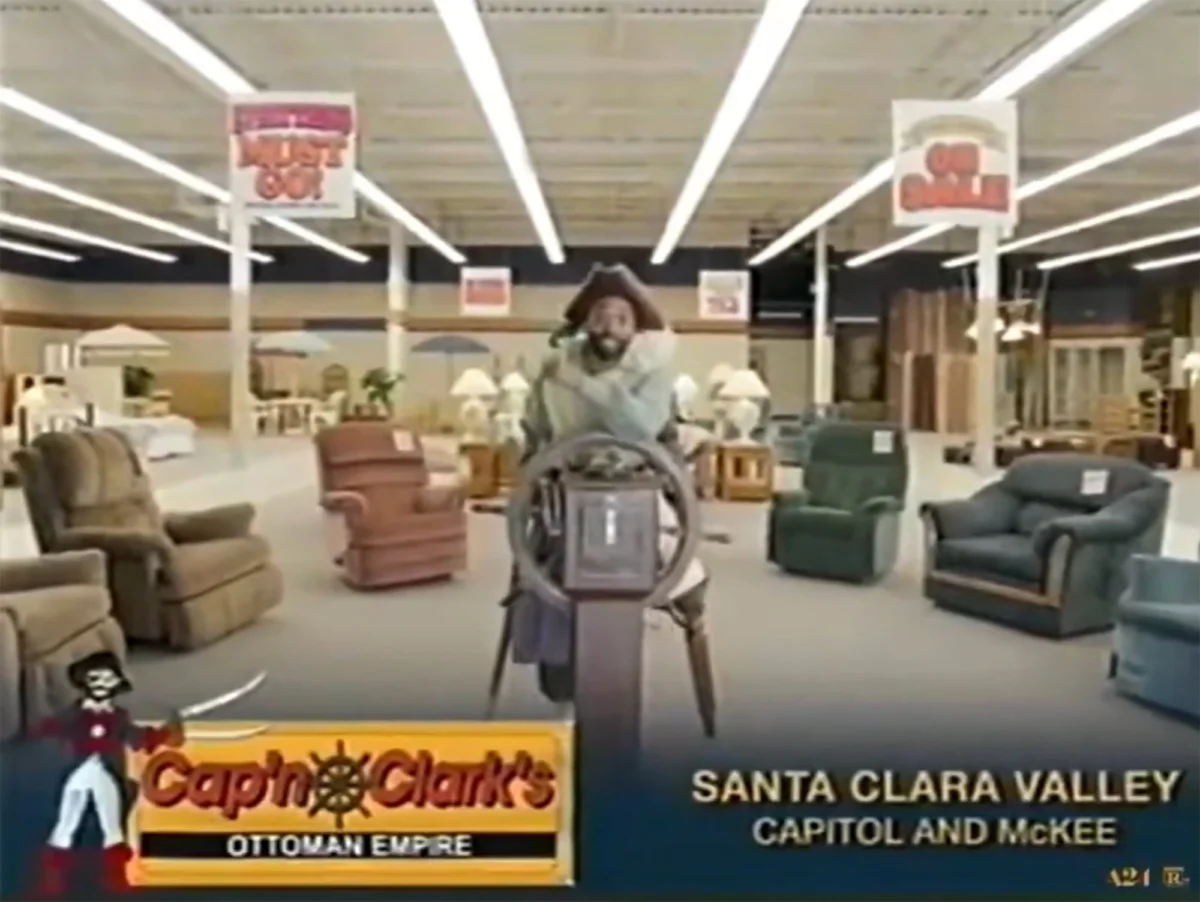
A24, the independent film studio renowned for its distinctive and often unconventional genre releases, has commenced an intriguing viral marketing campaign for its highly anticipated Backrooms feature film, quietly releasing a retro-styled television commercial featuring acclaimed actor Chiwetel Ejiofor. This strategic promotional move, discovered by astute online communities, further deepens the mystique surrounding the adaptation of the internet-born horror phenomenon, building on the atmospheric dread established by earlier trailers. The 30-second spot, designed to mimic a vintage 1990s VHS recording, promotes "Cap’n Clark’s Ottoman Empire," a fictional furniture store central to the film’s narrative, where Ejiofor’s character, Clark, works before encountering the eponymous liminal spaces. The campaign also includes an interactive element, allowing curious fans to receive a cryptic fax by contacting a number displayed in the commercial, underscoring A24’s commitment to immersive and fan-engaging promotional tactics.
The "Cap’n Clark’s Ottoman Empire" Campaign Unveiled
The core of this latest marketing push is a meticulously crafted commercial for "Cap’n Clark’s Ottoman Empire." The video, circulated across various online platforms after being reportedly spotted on services like Pluto TV, immediately transports viewers to an era of analog television and grainy aesthetics. It features Chiwetel Ejiofor, known for his powerful performances in films like 12 Years a Slave and Doctor Strange, embodying the role of Clark, a charismatic yet slightly off-kilter furniture salesman. Ejiofor delivers a humorous spiel, encouraging viewers to visit his establishment for unbeatable deals on ottomans and other home furnishings, complete with an enthusiastic, almost frantic energy typical of local commercials from decades past. His line, "The only thing you’ll be wanting – is more space to keep it all!", now takes on a darkly ironic tone given the film’s premise of infinite, inescapable spaces.
The visual style is crucial to the campaign’s effectiveness. The simulated VHS degradation, complete with tracking lines and faded colors, lends an air of authenticity to the "found footage" aesthetic that is deeply ingrained in the Backrooms lore. This choice is not merely nostalgic; it serves to blur the line between promotional material and the film’s reality, creating an unsettling sense that the commercial itself might be a relic from the strange universe depicted in the movie. The commercial concludes with a phone number, (408) 357-2875, and a call to action to "fax your order today!" This detail, initially appearing as a quaint anachronism, is actually the gateway to the campaign’s interactive component.
An Interactive Dive into the Uncanny

The true genius of A24’s viral strategy lies in its interactive layer. As discovered and publicized by accounts such as the "Backrooms Movie Updates" Twitter handle (@KaneHypeGuy), dialing the provided number and sending a fax does not result in a typical promotional brochure. Instead, recipients receive a scanned fax of a document that, while ostensibly another advertisement for "Cap’n Clark’s Ottoman Empire," carries an increasingly unsettling undertone. The fax, designed to look like a sales offer, details various furniture pieces but is subtly permeated with a sense of the uncanny, hinting at the bizarre realities Clark is soon to encounter. This direct, tangible interaction provides a unique connection for the audience, transforming passive viewers into active participants in the unfolding mystery. It leverages the digital native audience’s familiarity with online ARG (Alternate Reality Game) elements, making the film’s universe feel more tangible and immediate. This level of engagement significantly amplifies the anticipation for the film, inviting viewers to piece together clues and speculate about the deeper meanings embedded within the promotional material.
The Genesis of the Backrooms Phenomenon
To fully appreciate the impact of this marketing campaign, it is essential to understand the cultural lineage of the Backrooms concept. The phenomenon originated in 2019 with an anonymous post on 4chan’s /x/ (paranormal) board. The post featured an image of an irregularly lit, monochromatic yellow room with stained carpets and buzzing fluorescent lights, accompanied by a chilling caption: "If you’re not careful and you noclip out of reality in the wrong areas, you’ll end up in the Backrooms, where it’s nothing but the stink of old moist carpet, the madness of mono-yellow, the endless background noise of fluorescent lights at maximum hum-buzz, and approximately six hundred million square miles of randomly segmented empty rooms to be trapped in God save you if you hear something wandering around nearby, because it sure as hell has heard you…"
This simple yet profoundly unsettling concept immediately resonated with online communities, tapping into the collective fascination with "liminal spaces"—transitional or forgotten places that evoke a sense of eerie familiarity and solitude. The idea of "noclip," a term borrowed from video game glitches where players can pass through solid objects, perfectly encapsulated the accidental, involuntary entry into this bizarre dimension. The Backrooms quickly evolved from a single image and paragraph into a sprawling "creepypasta" narrative, with countless users contributing their own interpretations, levels, entities, and survival guides. It became a prime example of collaborative online storytelling, demonstrating the power of collective imagination in shaping digital folklore.
Kane Pixels: From YouTube Sensation to Feature Director
The Backrooms concept truly exploded in popularity thanks to the work of then-16-year-old YouTuber Kane Parsons, known online as "Kane Pixels." Beginning in early 2022, Parsons started releasing a series of short films on his YouTube channel that meticulously visualized the Backrooms. His videos, characterized by their impressive photorealism, unsettling sound design, and narrative ingenuity, quickly garnered millions of views and widespread critical acclaim. Parsons’ shorts, such as "Found Footage" and "The Third Test," transformed the abstract concept into a tangible, terrifying experience, showcasing his prodigious talent for visual effects and atmospheric horror.

His work cemented the visual language of the Backrooms, portraying it as an infinite labyrinth of sterile, yellow-walled rooms, echoing with the omnipresent hum of fluorescent lights. This professional-grade execution caught the attention of Hollywood, leading to the remarkable announcement that A24 would produce a feature film adaptation, with Parsons himself at the helm, making his directorial debut. This trajectory—from anonymous internet post to viral YouTube series to major studio feature—is a testament to the cultural impact of digital storytelling and the ability of young, independent creators to capture the zeitgeist.
A24’s Strategic Approach to Horror and Marketing
A24’s involvement in the Backrooms project signals a significant endorsement of the material’s artistic and commercial potential. The studio has cultivated a reputation for backing unique, director-driven projects, particularly within the horror genre, producing acclaimed films like Hereditary, Midsommar, and The Witch. Their approach often prioritizes atmosphere, psychological depth, and unconventional narratives over jump scares, aligning perfectly with the existential dread inherent in the Backrooms concept.
The choice of viral marketing for Backrooms is not accidental but a calculated move that leverages the film’s origins. Historically, viral campaigns have been incredibly effective for horror films, particularly those with a "found footage" or mysterious premise. The Blair Witch Project (1999) famously pioneered this by creating a fictional mythology around its "missing" filmmakers, blurring the lines between reality and fiction. More recently, films like Cloverfield (2008) and District 9 (2009) utilized intricate online games, fake websites, and cryptic clues to build immense hype. For Backrooms, a property born from internet lore, an ARG-style campaign is a natural fit, directly engaging the very online communities that nurtured its growth. A24’s history of clever, often minimalist marketing that allows the film’s themes to shine through makes them ideal stewards for this project. The involvement of heavyweight producers like James Wan (known for The Conjuring universe) and Shawn Levy (known for Stranger Things) further underscores the project’s ambition and potential to reach a broad audience while retaining its indie sensibilities.
Connecting the Dots: Plot and Character Integration
The "Cap’n Clark’s Ottoman Empire" commercial is more than just a promotional gimmick; it is an integral piece of the film’s narrative puzzle. The plot of Backrooms centers on Chiwetel Ejiofor’s character, Clark, a furniture store owner who stumbles upon the eerie, seemingly infinite "backrooms" within his own establishment. This viral commercial effectively serves as a prequel, introducing Clark in his mundane, pre-Backrooms life, making his eventual descent into the uncanny all the more impactful. It establishes his character, his environment, and the sense of everyday reality that will soon be shattered.

The film also stars Renate Reinsve, known for The Worst Person in the World, as a therapist whose patient goes missing into these alternate dimensions, compelling her to enter the unknown to save him. This dual perspective—one from inside the initial discovery, the other from an external investigation—promises a rich narrative tapestry. The concept of "liminal space" itself is a profound thematic element. These are places of transition, often abandoned or forgotten, that evoke a sense of unease because they are neither here nor there. The Backrooms takes this psychological concept and amplifies it into a cosmic horror, where the very fabric of reality becomes fluid and threatening. The commercial, with its slightly off-kilter cheerfulness, subtly hints at the precariousness of the ordinary world before it gives way to the extraordinary.
The Faxed Document: A Glimpse into the Aberrant
Upon sending a fax to the number provided in the commercial, recipients are met with a document that, at first glance, appears to be a standard promotional offer from "Cap’n Clark’s Ottoman Empire." However, closer inspection reveals subtle yet disturbing irregularities. While primarily detailing various furniture items and sales pitches, the document may contain unusual phrasing, seemingly random symbols, or even visual distortions that hint at the encroaching strangeness of the Backrooms. For instance, a promotional offer for "infinite storage solutions" or "space that goes on forever" would take on a sinister double meaning. These subtle clues are designed to be noticed by the most dedicated fans, rewarding their engagement and fueling further speculation about the film’s specific narrative elements and the nature of the Backrooms encountered by Clark. The fax itself becomes a meta-narrative artifact, a piece of the film’s world bleeding into our own, mirroring the "noclip" concept by subtly altering the recipient’s perception of reality.
Anticipation and Broader Implications
The viral marketing campaign for Backrooms is a masterclass in building anticipation through interactive storytelling. By leveraging the existing lore, engaging the fan base, and employing a retro aesthetic that plays into the uncanny nature of the film, A24 has successfully generated significant buzz. This approach not only caters to the existing community of Backrooms enthusiasts but also introduces the phenomenon to a wider audience, piqueing their curiosity with its unique blend of internet culture, psychological horror, and celebrity involvement.
The campaign highlights a growing trend in film promotion, moving beyond traditional trailers and posters to create immersive experiences that draw audiences into the film’s universe before release. For a film based on an online phenomenon, this strategy is particularly effective, mirroring the collaborative, community-driven nature of its origins. As the release date of May 29, 2026, approaches, it is highly probable that A24 will continue to roll out additional layers to this viral campaign, further deepening the mystery and expanding the world of Backrooms. The success of this marketing strategy could serve as a blueprint for future adaptations of internet-born narratives, demonstrating how to effectively bridge the gap between digital folklore and mainstream cinema. The Backrooms film, spearheaded by a young visionary and backed by an innovative studio, is poised to be not just a cinematic event, but a cultural one, challenging perceptions of reality and the spaces we inhabit.