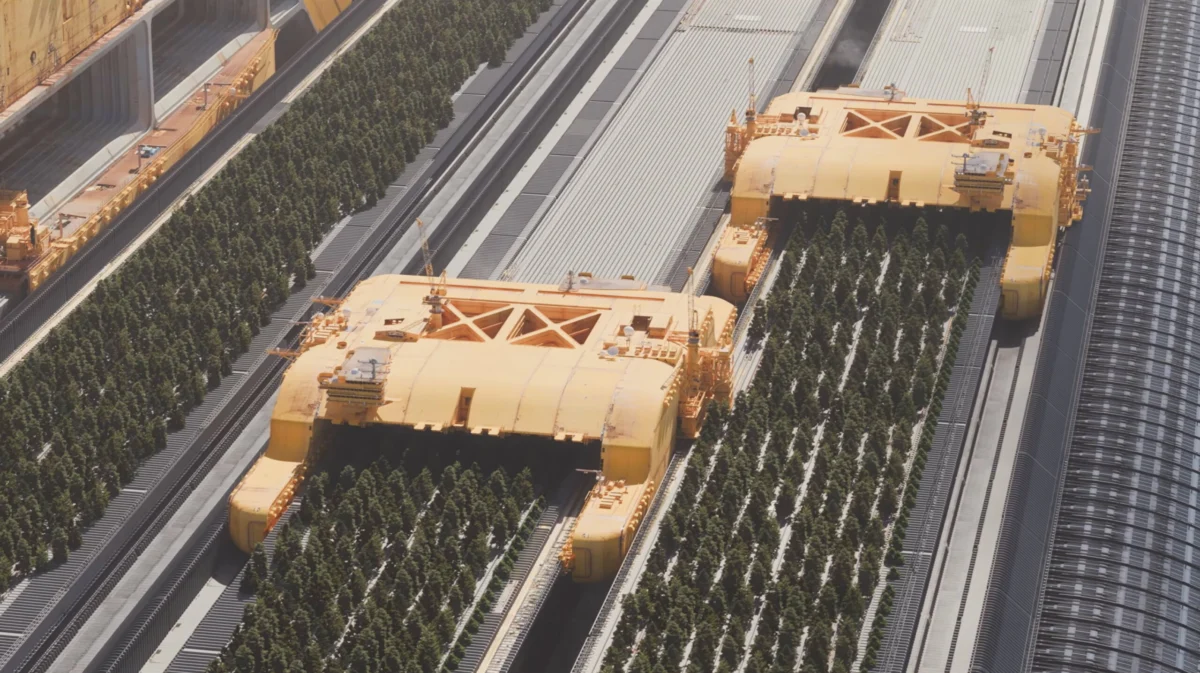
A groundbreaking two-minute hyper-realistic 3D animated short film titled Second Skin, a visionary creation by acclaimed concept artist Paul Chadeisson, has debuted online, offering a profound glimpse into a meticulously crafted futuristic world. Released on April 7, 2026, and sourced from YouTube, the film presents a complex urban landscape enveloped by an artificial "second skin," where colossal construction machines continuously forge new ecosystems and structures atop existing civilization. This visually stunning production, rich in thematic depth and technical prowess, quickly garnered significant attention, showcasing Chadeisson’s distinctive world-building capabilities that have previously shaped the aesthetics of major cinematic productions such as Dune: Part Two, Blade Runner 2049, and The Creator.
The narrative of Second Skin unfolds through evocative voiceovers from its unseen inhabitants, providing a poignant counterpoint to the awe-inspiring visuals. These fragmented dialogues reveal a spectrum of human experience within this altered environment, ranging from enthusiastic acceptance of their manufactured reality to a deep-seated longing for the natural world, with some voices lamenting not having seen real sunlight in decades. The opening line, "I’ve spent my whole life beneath the second skin… At my age, I’m not even sure I want to move anymore," immediately immerses the viewer into a world where adaptation has become a form of existential stasis. The concept of a "second surface like a second chance," as introduced in the YouTube description, hints at a deeper philosophical undercurrent, suggesting that this artificial overlay might represent humanity’s attempt to rectify past environmental missteps or to simply survive in an increasingly inhospitable world.
The Visionary World of Paul Chadeisson
Paul Chadeisson, a France-based concept artist and designer, is renowned for his exceptional ability to envision and realize intricate futuristic environments. His unique aesthetic, characterized by vast, often desolate, yet incredibly detailed industrial and urban landscapes, has left an indelible mark on contemporary science fiction cinema. Second Skin serves as a distilled manifestation of his signature style, presenting a world where technology and nature are intertwined in a complex, often unsettling, embrace. The film’s gigantic construction machines, churning out forests and new buildings simultaneously, are not merely mechanical marvels but symbols of humanity’s ambition to control and reshape its environment on an unprecedented scale. These scenes are rendered with such meticulous detail and atmospheric depth that they transcend mere visual spectacle, inviting viewers to ponder the implications of such extreme architectural and ecological engineering.
Chadeisson’s work on Second Skin leverages his extensive experience in crafting immersive visual narratives for some of the most acclaimed sci-fi films of recent years. His contributions to Blade Runner 2049 were pivotal in expanding the iconic dystopian Los Angeles, adding layers of intricate urban decay and monumental architecture. For The Creator, he helped define the film’s unique blend of advanced AI and war-torn landscapes. His involvement in Dune: Part Two contributed to the epic scale and alien beauty of Arrakis, while upcoming projects like Alien: Romulus and Alien: Earth, along with his work on the Foundation series and Project Hail Mary, underscore his consistent role in shaping the visual identity of high-profile science fiction. This deep background in large-scale world-building is evident in every frame of Second Skin, where even in two minutes, he constructs a universe that feels expansive, lived-in, and fraught with both wonder and melancholy.

Artistic and Technical Craftsmanship
The creation of Second Skin is a testament to the sophisticated intersection of artistic vision and cutting-edge technology. The short film was primarily made using Blender software, a powerful open-source 3D creation suite, demonstrating the capabilities of accessible tools in producing cinema-quality animation. The hyper-realistic rendering, detailed textures, and dynamic camera movements are all hallmarks of a production pushing the boundaries of independent animation. The film’s visual fidelity is comparable to major studio productions, a remarkable achievement for a short conceived and executed with significant artistic freedom.
Beyond Chadeisson’s singular vision, Second Skin is a collaborative artistic endeavor. The screenplay was co-written by Michèle Chadeisson, Paul Chadeisson, and Stéphane Beauverger, suggesting a carefully constructed narrative foundation that underpins the visual spectacle. This collaborative writing process likely contributed to the nuanced voiceovers and the philosophical depth embedded within the film’s brief runtime. Production was handled by Alien Collapse, an entity that supports the realization of such ambitious artistic projects. A critical component of the film’s immersive quality is its music and sound design, expertly crafted by MOODERS. Their contribution is not merely supplementary but integral, creating an atmospheric soundscape that enhances the visual storytelling, adding layers of mood, tension, and emotional resonance to the futuristic environment. The auditory experience, from the hum of gigantic machines to the subtle echoes of human voices, is meticulously designed to draw the viewer deeper into the "second skin" world.
Thematic Resonance and Societal Commentary
Second Skin is more than just a visual spectacle; it is a profound piece of speculative fiction that engages with pressing contemporary concerns. The central concept of a city covered by a "second skin" can be interpreted as a powerful metaphor for humanity’s increasingly artificial existence and its complex relationship with the natural world. The inhabitants’ conflicting emotions—enthusiasm for progress versus nostalgia for sunlight—mirror real-world debates about technological advancement, environmental preservation, and the definition of a truly "human" existence.
The film provocatively asks: at what cost does progress come? If humanity builds layers of infrastructure to survive or thrive, what is lost in the process? The idea of "gigantic construction machines churning out forests & new buildings all in one" paints a picture of humanity attempting to replicate nature through engineering, raising questions about authenticity, ecological balance, and the hubris of technological solutions to environmental crises. The lament of those who "haven’t seen real sunlight in decades" evokes a sense of profound loss, highlighting the psychological and spiritual toll of living in a perpetually controlled, artificial environment. This theme resonates with contemporary discussions around urban planning, climate change, and the potential for technological solutions to exacerbate rather than solve fundamental human needs for connection to nature. The film serves as a cautionary tale, or perhaps a meditation, on the delicate balance between innovation and ecological responsibility.

Paul Chadeisson’s Illustrious Career in Sci-Fi Cinema
Paul Chadeisson’s journey from concept artist to director of his own animated short film is a significant evolution, demonstrating the breadth of his creative talents. His portfolio, accessible on his ArtStation site and through his social media channels (@paulchadeisson on Instagram and YouTube), showcases a consistent vision that has made him a sought-after talent in Hollywood. His involvement in films like Blade Runner 2049 and The Creator cemented his reputation for crafting believable, yet fantastical, future worlds. In Blade Runner 2049, Chadeisson’s contributions helped expand the neo-noir aesthetic established by Ridley Scott, infusing it with new architectural and environmental details that deepened the sense of urban decay and technological advancement. For The Creator, he was instrumental in visualizing the film’s unique blend of gritty realism and advanced artificial intelligence, contributing to its distinct visual identity.
His work on Dune: Part Two further highlights his ability to adapt his style to diverse, expansive universes, helping to translate Frank Herbert’s epic vision into stunning cinematic reality. Upcoming projects such as Alien: Romulus and Alien: Earth suggest a continuing influence on some of the most anticipated science fiction narratives. Beyond film, his work on the Foundation series, an ambitious adaptation of Isaac Asimov’s seminal novels, demonstrates his versatility across different storytelling mediums. Chadeisson’s consistent collaboration with top-tier directors and production designers underscores his role as a critical architect of cinematic realities, pushing the boundaries of visual storytelling in science fiction. Second Skin can be seen as a personal expression of these accumulated experiences, allowing him to explore themes and aesthetics unconstrained by external creative briefs.
The Significance of Short Form Storytelling
In the landscape of modern cinema, short films like Second Skin play an increasingly vital role. They serve as powerful platforms for artists to experiment with complex ideas, hone their craft, and showcase their unique visions without the immense financial and logistical pressures of feature-length productions. For a concept artist like Paul Chadeisson, a short film provides an unparalleled opportunity to transition from contributor to auteur, presenting a complete, self-contained narrative that is entirely his own. This allows for a purity of artistic expression that is often challenging to achieve within the collaborative, commercial framework of blockbuster filmmaking.
Furthermore, short films are crucial incubators for talent and innovation. Many acclaimed directors and visual effects artists begin their careers or test new techniques through short-form projects. Second Skin, with its ambitious visuals and profound thematic content, stands as an exemplar of what can be achieved in this format. It not only demonstrates Chadeisson’s directorial potential but also pushes the technical boundaries of independent animation, setting a new benchmark for hyper-realistic 3D rendering. The accessibility of digital distribution platforms means that such works can reach a global audience, fostering a vibrant community of creators and enthusiasts who appreciate the concentrated power of short-form narratives.

Digital Platforms and Global Reach
The immediate global dissemination of Second Skin via YouTube exemplifies the transformative power of digital platforms in democratizing access to artistic content. In an era where traditional distribution channels can be arduous for independent creators, platforms like YouTube, ArtStation, and social media (X, Instagram) offer direct conduits between artists and their audiences. Paul Chadeisson’s active presence on these platforms, where he regularly shares his work and process, has cultivated a dedicated following, ensuring that new releases like Second Skin receive immediate attention. The film’s debut on YouTube, accompanied by mentions on X (formerly Twitter) and Instagram, highlights a contemporary model of content release that bypasses conventional industry gatekeepers.
This direct access is not just about reach; it’s about fostering community and engagement. Viewers can instantly react, share, and discuss the film, creating a dynamic feedback loop that enriches the artistic experience. For artists like Chadeisson, these platforms also serve as extended portfolios, attracting potential collaborators and clients who can directly witness the quality and depth of their work. The ability to link to more detailed information, such as Paul’s ArtStation post for Second Skin, further enhances the audience’s understanding of the creative process and technical specifications, bridging the gap between artistic output and technical insight.
Future Prospects and Lasting Impact
Second Skin is more than just a captivating short film; it is a potent demonstration of Paul Chadeisson’s comprehensive artistic vision and his capabilities as a storyteller. Given his extensive background in crafting entire cinematic worlds for major Hollywood productions, it is not unreasonable to speculate about the potential for Second Skin to evolve beyond its two-minute format. The rich lore hinted at by the voiceovers, the intricate world-building, and the compelling thematic questions all suggest a universe ripe for further exploration, whether as an expanded short, a feature film, or even a streaming series.
The film’s exploration of humanity’s future in constructed environments and its philosophical undertones could provide a compelling foundation for a larger narrative. The "Second Skin" concept itself offers endless possibilities for plot development, character arcs, and deeper dives into the societal and ecological implications of such an existence. Regardless of whether it expands, Second Skin has already made a significant impact as a standalone piece of art. It stands as a testament to the power of animation to convey complex ideas and emotions within a concise runtime, solidifying Paul Chadeisson’s position not just as a master concept artist, but as a formidable voice in contemporary science fiction storytelling. It challenges viewers to consider the futures we are building, and the very nature of what it means to be human in an increasingly engineered world, leaving an unforgettable visual and intellectual imprint.