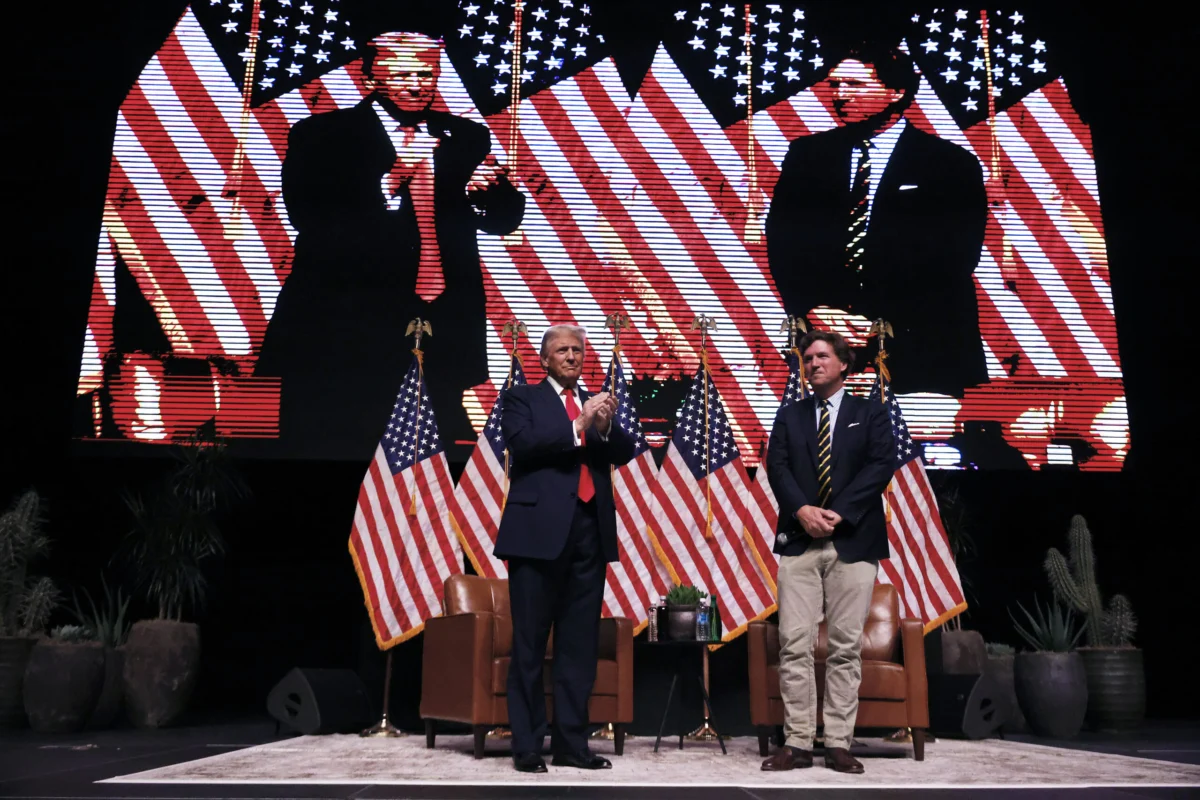
A significant public rift has emerged between former President Donald Trump and conservative media personality Tucker Carlson, escalating into a sharp exchange of words that has reverberated across the American political and media landscape. The dispute centers on Carlson’s recent critiques of Trump’s assertive rhetoric regarding Iran, which Carlson has controversially suggested could lead to nuclear conflict and even invoked comparisons to the Antichrist. Trump, in turn, has dismissed Carlson as a "fool" and a "low-IQ person," denying any ongoing communication with the influential commentator. This public spat highlights the evolving dynamics within the conservative movement, particularly as figures like Carlson carve out independent media empires that sometimes diverge from traditional Republican orthodoxy.
The Incendiary Easter Post: A Catalyst for Conflict
The catalyst for this latest escalation was a series of profanity-laced and threatening social media posts by Donald Trump on Easter Sunday, April 6, 2026. Published on Truth Social, Trump’s platform, the messages targeted Iran with stark warnings regarding the closure of the Strait of Hormuz. The Strait of Hormuz is a critical maritime chokepoint between the Persian Gulf and the Gulf of Oman, through which roughly 20 percent of the world’s oil supply—and a significant portion of global liquefied natural gas—passes daily. Its closure or disruption has historically been a flashpoint for international tensions, directly impacting global energy markets and supply chains.
In his Easter morning tirade, Trump reiterated threats to strike Iran’s energy infrastructure if the country did not immediately reopen the strait. His posts contained highly inflammatory language, including the ominous declaration: "A whole civilization will die tonight, never to be brought back again. I don’t want that to happen, but it probably will. However, now that we have complete and total regime change, where different, smarter, and less radicalized minds prevail, maybe something revolutionary can happen. Who knows?" He concluded one message with a stark ultimatum: "open the f—ing strait, you crazy bastards, or you’ll be living in hell – just watch! Praise be to Allah." The choice of Easter Sunday, a day of profound religious significance for Christians worldwide, for such bellicose and profane declarations drew immediate criticism, particularly from religious conservatives.
Carlson’s Scathing Rebuttal: From Policy Critique to Eschatological Warning
Tucker Carlson, now a commanding voice in the online conservative media landscape with an audience exceeding 21 million followers across X and YouTube combined as of late 2025, swiftly responded to Trump’s posts. On Monday, April 7, 2026, during his widely watched video podcast, Carlson launched a scathing critique of Trump’s Easter message, labeling it "vile on every level." He condemned both the substance and the timing of the former president’s statements, questioning the implications of such threats on a day meant for spiritual reflection.
Carlson’s criticism extended beyond mere decorum, delving into profound questions of presidential authority and the potential for unilateral military action. He argued that Trump’s rhetoric, particularly the threat of leveling critical infrastructure and inciting "regime change," carried the grave risk of pushing the conflict with Iran toward an unthinkable nuclear confrontation. Furthermore, Carlson escalated his critique by invoking Christian eschatology, subtly suggesting that Trump’s actions and pronouncements bore characteristics associated with the Antichrist—a deceptive political figure prophesied to usher in global upheaval. This speculative argument, rooted in Christian theological concepts, significantly broadened the scope of his attack, transforming a policy disagreement into a moral and spiritual indictment.
In a move that could be interpreted as a call for insubordination, Carlson explicitly urged White House staff and other government officials to resign rather than comply with orders they might deem unlawful or dangerous. "Those people who are in direct contact with the president need to say, ‘No, I’ll resign. I’ll do whatever I can legally to stop this, because this is insane. If you give the order, I’m not carrying it out. Figure out the codes on the football yourself,’" he stated, referencing the nuclear launch codes. This direct appeal to officials to resist potential presidential directives underscored the severity with which Carlson viewed Trump’s Easter pronouncements.
Trump’s Retort: Dismissing a Former Ally
Donald Trump wasted no time in responding to Carlson’s pointed accusations. In a call with the New York Post following Carlson’s podcast, Trump fiercely pushed back against the commentator, dismissing him as intellectually inferior. "Tucker’s a low-IQ person who has absolutely no idea what’s going on," the former president asserted. He further claimed that Carlson frequently attempts to contact him, but he deliberately avoids engagement. "He calls me all the time; I don’t respond to his calls. I don’t deal with him. I like dealing with smart people, not fools." This public disavowal marks a significant downturn in a relationship that has, at various points, been characterized by mutual benefit and public camaraderie.
A Tumultuous History: The Shifting Sands of Alliance
The current animosity between Trump and Carlson is not entirely unprecedented, despite periods of apparent reconciliation. Their relationship has been a complex tapestry of public support, private disdain, and strategic alliances, reflecting the often transactional nature of political and media partnerships.
Prior to 2021, Carlson, as a prominent host on Fox News, was largely seen as a staunch supporter of the Trump administration, often defending the president’s policies and actions on his highly-rated prime-time show. However, revelations from the 2023 Dominion Voting Systems defamation lawsuit against Fox News unveiled a starkly different private sentiment. Text messages and emails from 2021 showed Carlson privately expressing intense animosity toward Trump, describing him as a "demonic force" and confessing that he "passionately" hated him. These candid private remarks offered a glimpse into underlying tensions that predated their current public rift, suggesting that Carlson’s public support was, at times, a strategic facade.
Despite these earlier private sentiments, a period of apparent reconciliation occurred in 2023. Following Carlson’s high-profile ouster from Fox News, Trump publicly defended him, criticizing the network’s decision. Later that year, Trump notably chose to sit for an exclusive interview on Carlson’s newly launched web show rather than participate in a Republican primary debate, signaling a strategic alliance that leveraged Carlson’s independent platform to reach a conservative audience directly. This move solidified Carlson’s position as a significant force outside traditional media and momentarily restored the perception of a united front between the two figures.
More recently, however, Carlson has increasingly positioned himself as a contrarian voice within the broader MAGA sphere. While still generally aligned with conservative principles, he has, at times, openly broken with Trump on specific issues, aligning instead with other independent conservative commentators like Candace Owens and Megyn Kelly. This evolving role demonstrates Carlson’s ambition to be more than just a Trump loyalist, but rather a thought leader who can critique and influence the conservative movement from his own powerful digital perch.
The Strategic Significance of the Strait of Hormuz
The Strait of Hormuz, central to Trump’s Easter threats, is one of the world’s most critical maritime choke points. Approximately 30% of all seaborne-traded crude oil and other petroleum liquids pass through it annually. Its strategic importance cannot be overstated, linking the oil-rich Persian Gulf to the open ocean. Any disruption to traffic through the strait has immediate and severe global economic repercussions, primarily through spikes in oil prices.
Historically, the strait has been a focal point of tension between Iran and the United States, as well as its regional allies. Numerous incidents, including tanker attacks, mine placements, and naval confrontations, have occurred in or near the strait over decades, particularly during the Iran-Iraq War in the 1980s and more recently since the US withdrawal from the Joint Comprehensive Plan of Action (JCPOA), or Iran nuclear deal, in 2018. Iran has repeatedly threatened to close the strait in response to sanctions or military pressure, a move that would be considered an act of war by many international observers and would likely trigger a robust military response from the United States and its allies.
Iran-US Relations: A Legacy of Tensions
The broader context of US-Iran relations is one defined by decades of animosity, mistrust, and proxy conflicts. Following the 1979 Iranian Revolution, the two nations have been locked in a geopolitical struggle marked by periods of covert and overt confrontation. Key milestones include the Iran-Contra Affair, the US designation of Iran as a state sponsor of terrorism, and the ongoing regional rivalry playing out in conflicts across the Middle East, from Syria to Yemen.
The Obama administration’s pursuit of the JCPOA in 2015 aimed to de-escalate nuclear tensions in exchange for sanctions relief. However, President Trump’s decision in 2018 to withdraw the US from the deal and reimpose "maximum pressure" sanctions reignited severe tensions. This policy led to a series of escalations, including attacks on oil tankers, drone shoot-downs, and the assassination of Iranian General Qasem Soleimani, bringing the two nations to the brink of war on multiple occasions. Trump’s Easter threats, therefore, resonate within this deeply troubled history, echoing past rhetoric and raising fears of renewed escalation.
The Digital Arena: Carlson’s Enduring Influence
Tucker Carlson’s transition from the highly structured environment of cable news to the more fluid and direct digital realm has been remarkably successful, underscoring the growing power of independent media platforms. With 21 million combined followers on X (formerly Twitter) and YouTube, his reach rivals, and in some demographics, surpasses, that of traditional cable news outlets. This digital empire allows Carlson unprecedented editorial freedom, enabling him to explore niche conservative viewpoints, engage in lengthy monologues, and invite guests who might not fit the mold of mainstream media.
His platform has become a significant force in shaping conservative discourse, often providing a counter-narrative to both mainstream media and, at times, even segments of the Republican Party establishment. Carlson’s ability to command such a large and engaged audience gives him considerable leverage, making his critiques of figures like Donald Trump particularly impactful within the conservative movement. It also highlights the increasing fragmentation of the media landscape, where established figures can bypass traditional gatekeepers and directly address their audience, fostering a more personalized and sometimes more radicalized form of political commentary.
Reactions from the Political and Media Landscape
The public spat between Trump and Carlson has elicited a range of reactions, both overt and inferred, from across the political and media spectrum. Foreign policy analysts have voiced concerns about the implications of such bellicose rhetoric, particularly from a former president who holds significant sway and could potentially return to office. Many emphasize the dangers of inflammatory language in delicate international relations, particularly when involving nuclear-armed states or those on the threshold. The potential for miscalculation, accidental escalation, or a hardening of positions by adversaries is a common theme among these observations.
Religious commentators have also weighed in on Carlson’s use of Christian eschatology, with some criticizing the politicization of religious prophecy, while others might find resonance in his warnings. The debate over the "Antichrist" comparison, however, largely remains within the more niche corners of religious and political commentary, though its invocation in mainstream conservative discourse is notable.
In a contrasting stance, conservative commentator Megyn Kelly, who has had her own on-again, off-again feuds with Trump, notably reaffirmed her unwavering support for the former president. Speaking on her own show this week, Kelly quipped, "I mean, honestly, Trump could drop a nuke and I’d still vote Republican over those people." Her statement, while hyperbolic, underscores a deep-seated partisan loyalty prevalent among some conservative voters and media figures, suggesting that for a segment of the electorate, specific policy concerns or controversial statements are secondary to party allegiance, particularly when facing the alternative of a Democratic administration.
Broader Implications: Geopolitics, Domestic Politics, and Media Ethics
The escalating feud between Donald Trump and Tucker Carlson carries significant implications across multiple domains. Geopolitically, the former president’s threats against Iran, coupled with Carlson’s dramatic warnings, contribute to an atmosphere of instability in the Middle East. Such rhetoric, especially concerning a vital global energy choke point like the Strait of Hormuz, risks exacerbating regional tensions, potentially leading to a renewed cycle of aggression, impacting global oil prices, and further complicating international diplomatic efforts to stabilize the region. Should Trump return to office, these statements provide a chilling preview of a potential foreign policy approach characterized by unilateral threats and a willingness to confront adversaries aggressively.
Domestically, the public disagreement highlights a growing fissure within the conservative movement, specifically within the MAGA sphere. Carlson’s willingness to directly challenge Trump, even on highly sensitive issues and with deeply provocative comparisons, suggests a potential fracturing of absolute loyalty that has long defined Trump’s political base. While Trump remains immensely popular, Carlson’s independent platform offers an alternative voice that can shape opinion, potentially leading to a more diverse, albeit sometimes fragmented, conservative discourse. The question of whether Carlson’s critique will resonate with a significant portion of Trump’s supporters, or if it will simply alienate him further from the core MAGA base, remains an open and evolving political narrative.
From a media ethics standpoint, the exchange raises questions about the responsibility of public figures and commentators, particularly concerning the use of inflammatory language, threats of violence, and religious analogies in political discourse. The blurring lines between news, opinion, and personal attacks, particularly on digital platforms, underscores the challenges of maintaining objective and responsible journalism in an era of hyper-partisanship and direct-to-audience communication.
Conclusion: An Unfolding Narrative of Power and Influence
The ongoing war of words between Donald Trump and Tucker Carlson is more than just a personal dispute; it is a microcosm of the evolving political landscape in the United States. It reflects the immense influence of independent media, the persistent tensions in US foreign policy, and the complex dynamics of loyalty and dissent within the conservative movement. As both figures continue to command significant audiences and exert considerable influence, their unfolding conflict will undoubtedly continue to shape public discourse, with potential repercussions for domestic politics, international relations, and the future trajectory of the conservative movement. The coming months will reveal whether this rift represents a temporary disagreement or a more fundamental realignment of power and ideology within the American right.