The entertainment industry, a cornerstone of California’s economic identity, has been in a state of profound flux for several years. Industry insiders have witnessed firsthand the seismic shifts brought about by evolving consumption patterns, particularly the insatiable demand for streaming content, and a wave of strategic corporate consolidations. These forces have collectively driven a period of unprecedented budget tightening, widespread job reductions, and, in some instances, the controversial outsourcing of creative work to international markets. This painful phase of contraction, marked by significant structural changes, has coincided with the rapid ascent of generative artificial intelligence (AI), exemplified by the public release of ChatGPT in late 2022. This timing was particularly poignant as 2022 also saw major streaming platforms, led by Netflix, pivot their business models to prioritize profitability over subscriber growth at all costs.
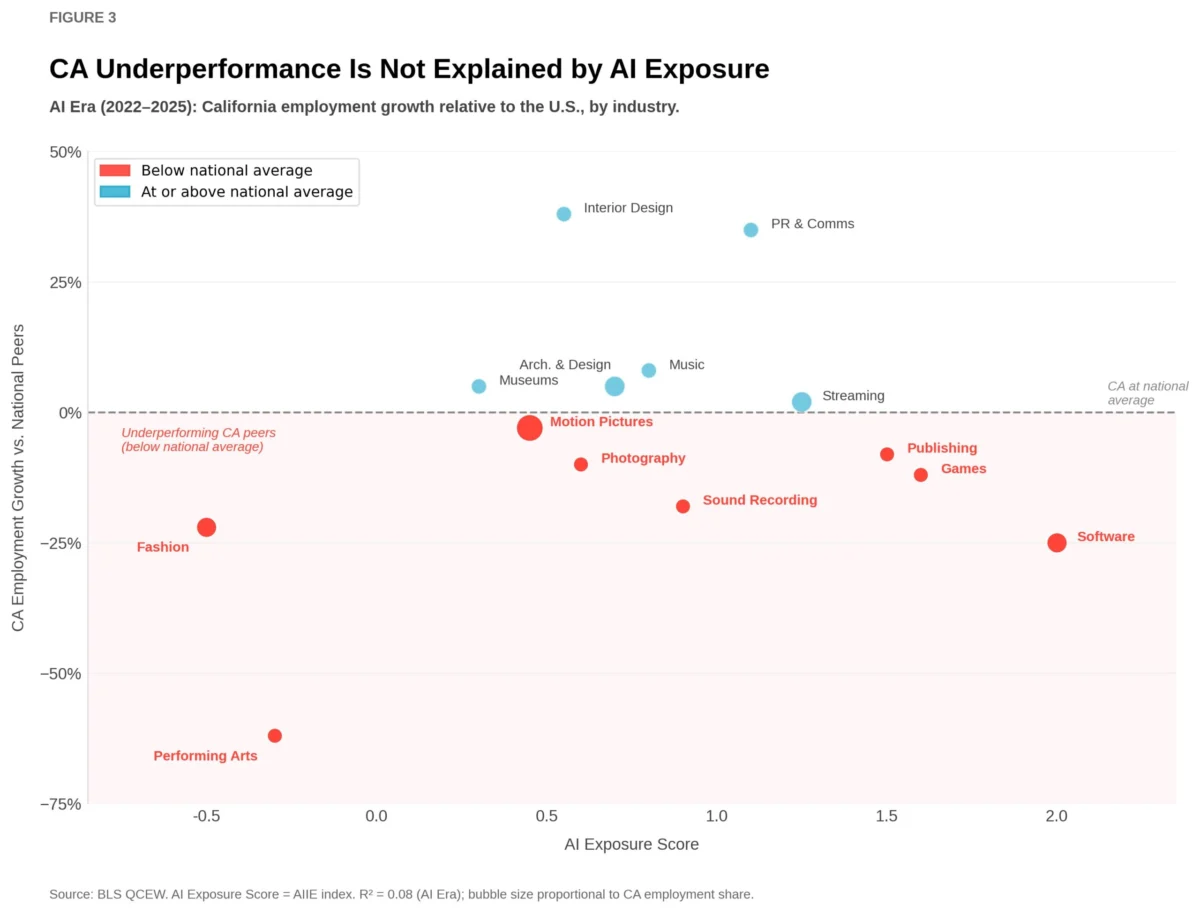
Yet, despite the palpable anxiety surrounding AI’s potential to displace human labor, a new report from the esteemed L.A.-based Otis College of Art and Design, in collaboration with Westwood Economics and Planning Consultants, offers a nuanced and critical perspective. The comprehensive study, titled “Creative Disruption: AI and California’s Creative Economy: 2022–2025,” firmly asserts that generative AI is not the primary culprit behind the dramatic shrinkage of California’s creative workforce. Instead, the report points to a more complex interplay of economic pressures and deep-seated structural transformations within key sectors.
The Economic Undercurrents: Beyond the AI Narrative
The findings, previewed by The Hollywood Reporter ahead of its April 7 release, challenge a widely held perception. Patrick Adler, a founding partner of Westwood Economics and Planning Consultants and co-author of the report alongside Taner Osman, states unequivocally, “The pattern of job loss in terms of the types of jobs that are being lost and when they’re being lost does not support the fact that there’s been this displacement of workers by AI.” This declaration reframes the narrative, compelling a deeper examination of the underlying economic forces that have reshaped the golden state’s creative landscape.
Between 2022 and 2025, California’s creative economy shed a staggering 114,000 jobs, representing a 14 percent decline. This substantial reduction was not evenly distributed but acutely concentrated in two specific sectors: film, television, and sound, which experienced a nearly 30 percent plummet in employment, and traditional media, which saw an even sharper decline of almost 34 percent. These figures paint a stark picture of an industry grappling with profound change, far beyond the capabilities or current impact of AI.
The report meticulously details how the job losses are rooted in a “combination of cost-driven displacement of lower-paying roles and structural changes within creative sectors that have hit California harder than the rest of the nation.” California’s notoriously high cost of living has long been a significant factor, disproportionately affecting individuals in lower-paying creative occupations, many of whom have been compelled to seek more affordable living conditions elsewhere. This demographic shift has been exacerbated by aggressive budget cuts that followed the so-called "Peak TV" era, a period characterized by an unprecedented explosion of content creation driven by the streaming wars.

A Chronology of Transformation: From Peak TV to Profitability
To fully appreciate the report’s context, it is crucial to trace the recent history of Hollywood’s economic evolution. The mid-2010s ushered in the "Peak TV" era, fueled by massive investments from tech giants and traditional media companies vying for dominance in the nascent streaming market. Services like Netflix, Amazon Prime Video, Hulu, and later Disney+, HBO Max, and Apple TV+ poured billions into original content, leading to a production boom that saw a record number of scripted series. This period created an abundance of jobs across the creative spectrum, from writers and directors to set designers, VFX artists, and production crew.
However, by late 2021 and early 2022, the industry began to witness a significant course correction. Investors started demanding profitability over subscriber growth, leading to a widespread reevaluation of content spending. Netflix, the trailblazer of the streaming revolution, famously announced a shift in its strategy towards cost efficiency and sustainable growth, signaling a broader industry trend. This coincided with a wave of major corporate mergers and acquisitions, such as the formation of Warner Bros. Discovery and ongoing consolidations within the media landscape, which often result in duplicated roles being eliminated post-merger for cost synergy.
It was against this backdrop of financial re-calibration and structural consolidation that generative AI burst onto the scene in 2022. The simultaneous emergence of powerful, publicly accessible AI tools like ChatGPT, capable of generating text, images, and even basic code, naturally led to widespread speculation and fear that these technologies would rapidly automate and eliminate creative jobs. The timing made AI an easy, if misdirected, scapegoat for the industry’s economic woes. The Otis College report serves as a crucial intervention, disentangling the impact of AI from the deeper, pre-existing economic and structural challenges.
AI’s Role: Transformer, Not Terminator
A key finding that counters the popular narrative is the paradoxical growth observed in occupations most "exposed" to AI within California’s creative economy. Roles such as writers, software developers, and artists—jobs frequently cited as being at high risk of AI displacement—have actually seen an increase in numbers and job postings. This suggests that rather than replacing these workers, AI is fundamentally changing the nature of their tasks and, in some cases, creating new demands for human oversight and specialized skills related to AI integration. For instance, the demand for "prompt engineers," AI trainers, or specialists in AI-assisted creative workflows, while not explicitly detailed in the original extract, is a logical inference in this context.
The qualitative analyses, derived from extensive interviews with creative professionals across film, fashion, gaming, media, advertising, arts, and architecture, further underscore this point. The report highlights that "No single respondent described AI as having replaced an entire role or workflow." Instead, AI is deployed for "well-defined activities where the output is verifiable, time savings are clear, and the quality of output meets expectations."

Consider the example of post-production in film and television. AI has proven adept at automating laborious, repetitive tasks such as rotoscoping (isolating elements from a background) or wire removal in visual effects. These tasks, while essential, are often time-consuming and less creatively intensive. However, AI struggles significantly with more subjective, creatively driven tasks that require nuanced artistic judgment, emotional intelligence, or complex problem-solving. Furthermore, the report reveals a critical aspect of AI integration: human oversight remains indispensable. Checking and refining AI-generated outputs often creates additional work for human staff. One VFX company owner quoted in the report vividly illustrates this paradox: “They have 15 artists that are sitting at workstations fixing the AI… When you multiply the rate of the artists by 15 and put that against the cost of the work you’re doing, it negates any savings that AI is giving you.” This anecdote powerfully suggests that the supposed cost-efficiency of AI, particularly in its current iteration, is often offset by the continued necessity for skilled human intervention.
The Human Element: Agency, Skepticism, and the Quality Quandary
The report delves into the psychological and ethical dimensions of AI adoption, revealing significant agency among creative workers in determining how much generative AI is integrated into their workflows. While supervisors may set guidelines, the ultimate implementers of AI tools are the workers themselves. This leads to a fascinating divergence in adoption rates and perceptions: “A worker who believes in the technology will iterate patiently; a skeptical one may conclude that AI is not yet able to perform a particular task. Both views were present among interviewees.”
This human-centric perspective highlights several critical concerns. Many interviewees expressed ethical reservations about using AI, particularly regarding intellectual property rights, data sourcing, and the potential for AI to devalue human creativity. Furthermore, a significant number of workers admitted to hiding their use of AI, fearing that embracing the technology might brand them as expendable or signal a willingness to be replaced. This "stigma" creates a barrier to open experimentation and knowledge sharing, potentially slowing down the effective integration of AI into creative processes.
Beyond the ethical and psychological, AI’s integration is already altering the very nature of creative work. Interviewees reported an increase in productivity expectations, with managers often investing in AI tools instead of human collaborators, leading to leaner teams. Crucially, there’s a growing pressure to produce lower-quality work, driven by the speed and accessibility of AI-generated content. A motion creative director quoted in the report articulated this danger profoundly: “The creative director said, ‘At a certain point, you just have to say it’s good enough,’ which I think is the biggest danger of AI. We lower our standards.” This observation strikes at the heart of the creative process, suggesting that while AI can accelerate production, it risks eroding the pursuit of excellence and originality.
Recommendations and Broader Implications
In light of these findings, the Otis College report offers practical recommendations for creative organizations. It advises against rushing the implementation of AI tools, advocating instead for a deliberate, thoughtful approach. Crucially, it stresses the importance of combating the stigma associated with AI use among staffers. Strategies such as "firing freezes" or clear assurances that AI adoption will not lead to job losses are proposed. As Adler explains, “Workers who know they will not be adopting themselves out of a job will experiment more openly, share insights more freely, and invest genuine effort into making AI tools work.” This underscores the critical role of trust in fostering successful technological integration. Adler further emphasizes, “There’s pretty good evidence that we’re uncovering that AI adoption would be a lot faster, a lot deeper if creative workers had more trust in it.”

The implications of this report extend beyond California’s borders, offering valuable insights for creative industries worldwide. It suggests that the current wave of generative AI is more likely to augment human capabilities and transform existing roles than to outright eliminate them in the short to medium term. However, it also highlights the profound challenges related to maintaining creative quality, managing worker morale, and ensuring ethical deployment.
For policymakers and educational institutions, the report signals a need to adapt. Curricula in art, design, film, and media schools must evolve to equip future professionals with the skills to effectively collaborate with AI tools, critically evaluate their outputs, and navigate the ethical complexities of their use. Workforce development programs could focus on upskilling existing professionals in AI literacy and prompt engineering, ensuring that California’s creative talent remains at the forefront of innovation.
Furthermore, the findings provide crucial data for ongoing discussions between studios, tech companies, and creative unions (such as the WGA, SAG-AFTRA, and IATSE) regarding AI’s role in future contracts and labor practices. The report’s emphasis on AI as a task-automator rather than a job-replacer, coupled with the concerns about quality and worker trust, will undoubtedly inform future negotiations aimed at protecting human creativity and ensuring fair compensation in an AI-integrated ecosystem.
In conclusion, while the specter of AI-driven job displacement looms large in public discourse, the Otis College of Art and Design report meticulously disentangles this fear from the economic realities shaping California’s creative economy. It reveals an industry in a profound state of structural transformation, where factors like the high cost of living, post-Peak TV budget cuts, and corporate consolidations are the primary drivers of job loss. Generative AI, while rapidly changing how creative work is done, currently functions more as a powerful tool augmenting human tasks, demanding new skills, and requiring careful management of worker trust and creative standards. The future of California’s vibrant creative sector will hinge not on fearing AI, but on intelligently integrating it, safeguarding human artistry, and addressing the deep-seated economic pressures that truly dictate its trajectory.