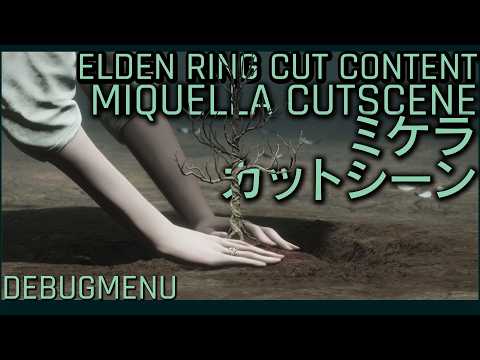
The intricate world-building of Elden Ring, the 2022 Game of the Year from developer FromSoftware, continues to yield secrets years after its initial release. Renowned dataminer and software engineer Lance McDonald has recently brought to light a significant discovery within the game’s internal files: a previously unseen map file containing a deleted cutscene that depicts Miquella, one of the game’s most pivotal yet enigmatic figures, planting the Haligtree. This discovery provides a rare, tangible look at the narrative’s evolution during development and offers concrete visual evidence for lore that was previously only accessible through cryptic item descriptions.
The revelation centers on a specific map file that McDonald identifies as a "work-in-progress" environment used by the developers to film cinematic sequences. This map, which does not appear in the retail version of the Lands Between, showcases the early stages of the Haligtree’s growth. According to McDonald’s analysis, the cutscene was intended to illustrate the moment Miquella began his ambitious project to create a sanctuary free from the influence of the Greater Will and the Golden Order.
The Narrative Significance of Miquella and the Haligtree
In the established lore of Elden Ring, Miquella is the twin brother of Malenia and the son of Queen Marika the Eternal and Radagon. Cursed with eternal childhood, Miquella sought a way to cure his sister’s Scarlet Rot and his own affliction. When the fundamentalist teachings of the Golden Order failed to provide a solution, he turned toward the creation of the Haligtree.
The flavor text of the Haligtree Knight Armor provides the primary context for this endeavor, stating: "Armor worn by knights sworn to the Haligtree. Its left breast is emblazoned with the crest of the Haligtree. Though watered with Miquella’s own blood since it was a sapling, the Haligtree ultimately failed to grow into an Erdtree."
While players have long known of Miquella’s sacrifice, McDonald’s discovery provides the first visual representation of this process. The deleted cutscene apparently depicted Miquella’s ritualistic planting of the sapling. McDonald’s video reveals not just the visuals but also the technical framework—how the developers staged the scene using specific camera triggers and environmental assets that were later excised from the final game.
Technical Details of the Discovery
McDonald’s investigation involved accessing dormant map files that exist within the game’s code but are inaccessible through standard gameplay. These files often serve as "test beds" or "film sets" where developers orchestrate scripted events. The map in question is a specialized environment designed specifically for the playback of the Miquella cutscene.
Crucially, the discovery includes a series of unused lines of spoken dialogue. While the dialogue is not perfectly synced with the surviving visual data, McDonald was able to extract and sequence the audio files to provide a coherent look at the intended narrative beat. These lines offer further insight into Miquella’s motivations and the somber tone of the Haligtree’s inception.
The process of datamining Elden Ring requires a sophisticated understanding of FromSoftware’s proprietary engine. By cross-referencing event scripts with map IDs, researchers like McDonald can reconstruct scenes that were cut late in the production cycle. In this instance, the "intermediate cutscene file"—the bridge that connects the triggers to the animations—was missing, requiring McDonald to manually reconstruct the sequence to demonstrate how it was intended to function.
Chronology of Elden Ring Datamining and Cut Content
The discovery of the Miquella cutscene is the latest in a long history of significant findings by the Elden Ring modding and datamining community. Since the game’s launch in February 2022, several major pieces of cut content have been unearthed:
- The Mimic Tear Questline: Early datamining revealed a complex quest involving a sentient Mimic Tear that would eventually become the player’s Spirit Ash.
- Dream Mist Collection: Files indicated a mechanic where players could collect "Dream Mist" from sleeping NPCs, a system that likely tied into Miquella (often associated with St. Trina, the deity of sleep).
- The Age of Absolute Ending: Traces of a seventh ending, involving the character Goldmask, suggested a different resolution to the game’s political and theological conflicts.
- Colosseum Functionality: Before the official PvP update, dataminers discovered fully modeled interiors for the various colosseums scattered across the map, proving they were intended for multiplayer combat from the start.
This new discovery regarding the Haligtree is particularly noteworthy because it pertains to the game’s most significant lore expansion, Shadow of the Erdtree. Miquella serves as the central figure of the DLC, and seeing his origins in the base game’s cut content provides a vital link between the original narrative and the expansion.
Implications for the Lore of the Lands Between
The fact that FromSoftware chose to cut a visual representation of Miquella planting the tree suggests a deliberate shift in storytelling strategy. Director Hidetaka Miyazaki is known for "environmental storytelling," where players must piece together history from item descriptions and ruins rather than explicit cinematic explanations.

By removing the cutscene, the developers shifted the Haligtree’s origin from a cinematic certainty to a historical mystery. This forces the player to rely on the Haligtree Knight Armor’s description, making the discovery of the tree’s failure feel more tragic and atmospheric. However, the existence of the cutscene proves that, at one point, FromSoftware intended to be much more explicit about Miquella’s role and his ritualistic use of blood to foster the tree’s growth.
The dialogue discovered by McDonald also hints at a deeper relationship between Miquella and his followers. The "Lesser Leonine Misbegotten" and other "marginalized" races found within the Haligtree’s branches were drawn to Miquella’s promise of an inclusive order. The cut dialogue likely reinforced this theme of sanctuary, which remains a cornerstone of the Haligtree’s identity in the final game.
The Role of the Datamining Community
The efforts of individuals like Lance McDonald, Zullie the Witch, and Sekiro Dubi have become integral to the "Soulsborne" experience. For many fans, the game does not end at the credits; the investigation into what could have been provides a secondary layer of engagement.
This community functions as a digital archaeology group, uncovering the "fossils" of a game’s development. These findings often clarify confusing plot points or explain why certain areas of the map feel unfinished or strangely empty. In the case of the Haligtree, McDonald’s work confirms that the area was always intended to be a central pillar of the game’s mythos, rather than a late-addition secret area.
Broader Context: Elden Ring’s Continued Success
The timing of this discovery coincides with a period of renewed interest in the franchise. Following the massive success of the Shadow of the Erdtree expansion, which sold over 5 million units within its first week, players are returning to the base game with a fresh perspective on Miquella’s character.
In addition to narrative discoveries, the Elden Ring brand has expanded into other media and merchandise. Last month, the soundtrack for The Forsaken Hollows was released across major streaming platforms, including Spotify and Amazon Music. This follows the release of the massive Nightreign soundtrack, which features over two hours of music. The continued release of official assets and the discovery of internal files suggest that the ecosystem surrounding Elden Ring remains vibrant and productive.
Analysis of Development Decisions
From a game design perspective, content is typically cut for three reasons: technical constraints, pacing, or narrative consistency. In the case of the Miquella cutscene, it is unlikely that technical constraints were the issue, as the Haligtree area itself is one of the most visually complex in the game.
Instead, the decision was likely narrative. Elden Ring thrives on the "mystery" of Miquella. In the base game, Miquella is never seen awake; he is a withered arm protruding from a cocoon in Mohgwyn Palace. Showing a "healthy" or "active" Miquella in a flashback cutscene might have diminished the impact of finding his abducted, dormant body later in the game. By keeping Miquella off-screen, FromSoftware maintained the character’s status as a near-mythical figure, a move that paid off significantly with his eventual reveal in the DLC.
Conclusion
Lance McDonald’s discovery of the Miquella and Haligtree map files serves as a bridge between the game’s development history and its complex lore. It confirms the long-held theory that Miquella’s blood was the literal lifeblood of the Haligtree and provides a glimpse into a version of Elden Ring that was more cinematic and explicit in its storytelling.
As players continue to explore the Lands Between and the Land of Shadow, these discoveries remind the audience that modern video games are not static products but the result of years of iterative design, where some of the most compelling stories are the ones left on the cutting room floor. The Haligtree remains a symbol of failed ambition within the game, but through the work of dataminers, the ambition of its creators is more visible than ever.