


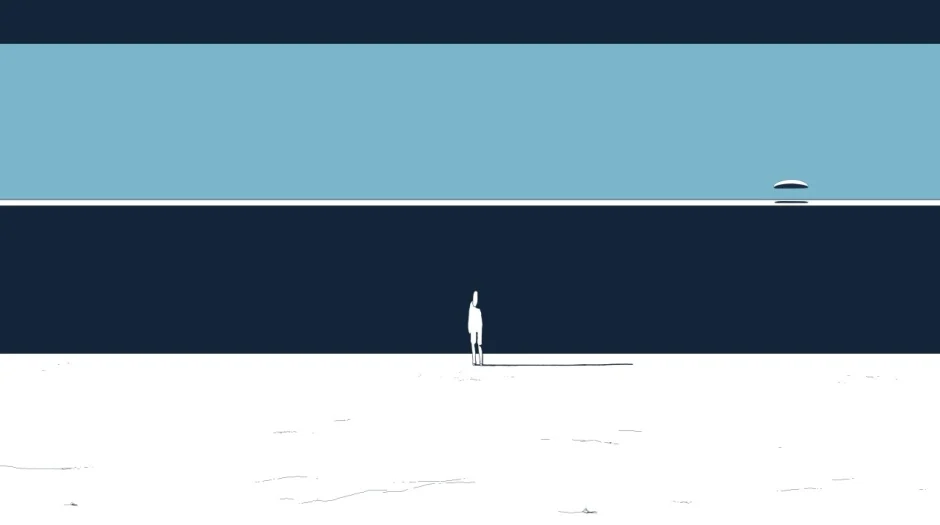
The abstract animated short film Telsche, a poignant collaboration between COLA Animation members Sophie Colfer and Ala Nunu, has officially been released online today, March 27th. This marks the culmination of a three-year journey since the film’s completion and arrives in partnership with Short of the Week, a platform dedicated to showcasing exceptional short films. The film, which eschews dialogue and relies on a stark, minimalist aesthetic of three colors—blue, black, and white—explores profound themes of memory, loss, and the enduring human quest to reconnect with forgotten loved ones.
Set against the surreal expanse of salt flats, Telsche presents a dreamscape world where a young girl grapples with the fading memories of her mother. The abstract nature of the animation, characterized by its deliberate lack of detail and use of expansive wide shots, serves as a powerful visual metaphor for the elusive and often fragmented nature of recollection. The film’s visual language emphasizes contrasts, mirroring the struggle to bring dimly recalled images back into sharp focus. This debut film from Sophie Colfer is a testament to the evocative power of visual storytelling when stripped down to its most essential elements.

The release of Telsche follows a significant period of creative output for both Nunu and Colfer, whose recent works have garnered attention on the international festival circuit. Their joint world premieres at the prestigious SXSW Festival earlier this month underscore their growing prominence in the animation landscape. Nunu directed In The Beginning, an animated short featuring three surreal tales exploring humanity’s complex relationship with animals, with Colfer contributing as the writer. Concurrently, Your Attention Please, a feature documentary addressing the impact of social media on youth safety and mental health, premiered at SXSW, with both Nunu and Colfer contributing animation to the project.
The Genesis of a Visual Poem
The genesis of Telsche‘s evocative narrative can be traced to profound literary and personal inspirations. Ala Nunu draws a direct parallel to T.S. Eliot’s "Four Quartets," particularly the lines that speak of the sea as a liminal space where losses are brought ashore and memories permeate the present. "As the sea reaches toward the shore, as the salt and fog creep into the city, so do our memories wander into our present," Nunu explains, highlighting the core concept of memory encroaching upon a static world through natural elements. This imagery of salt and fog serves as a powerful metaphor for how a tangible object laden with memory can trigger the recollection of something lost.
Sophie Colfer’s personal journey provided another critical layer to the film’s thematic depth. The film was conceived after her return to Hong Kong, her birthplace, after an extended period in the UK. This reunion with the sea, a significant element of her youth, reawakened memories of her family, particularly her mother, a Japanese pearl diver, and her father, an English sailor. The profound childhood memory of watching pearl divers in Japan, descending into the depths without air tanks to collect pearls, resonated deeply. "The sea remains unchanged, while human lives come and go," Colfer reflects. "The sea in Telsche reflects this as the site of memory that allows the character Telsche to connect with her mother, a lost diver." This connection between the enduring sea and the ephemeral nature of human life forms the emotional bedrock of the film.

The Resonance of a Name
The title Telsche itself carries a subtle yet significant narrative arc, evolving from a working title to a deeply resonant identifier. Initially, the film was referred to as Salt, a direct nod to its salt-flat setting. However, during the production process, the name of the protagonist, Telsche, began to be used colloquially. Colfer reveals a subconscious connection to Charley Boorman’s reference to his sister, Telsche, who passed away from ovarian cancer in 1997. Consuming the Long Way Round series during the film’s writing period, Boorman’s poignant reflections on his sister deeply affected Colfer. Researching Telsche Boorman further revealed striking parallels with the film’s imagery, particularly the descriptions of her as a "mermaid whose voice is drowned out by the wintry waves" or her arrival in dreams. Nunu concurs, stating, "It’s clear now why the name Telsche stuck for us and became the title of our film, although it was never a direct reference – simply a subconscious link." This convergence of personal experience and literary evocation solidified Telsche as the film’s definitive title, imbuing it with an additional layer of poignant resonance.
Artistic Intent and Universal Themes
The primary objective behind the creation of Telsche was to formalize the already strong creative synergy between Nunu and Colfer. Having collaborated informally on numerous projects, seeking each other’s feedback and influencing each other’s processes, this film offered an opportunity to solidify their partnership. "This film also gave us the opportunity to explore our shared language as a duo through visual poetry and universal imagery," they jointly state. The film delves into themes of the sea as a conduit for memory, the search for the forgotten, and the universal struggle to reconcile with the passage of time. Fascinatingly, these universal images evoked distinct personal interpretations and memories for Nunu and Colfer, stemming from their different cultural backgrounds. The creators express their hope that Telsche‘s journey from isolation to connection will resonate universally, allowing viewers to connect with the film based on their own experiences and memories.
A Deliberate Aesthetic: Minimalism as Metaphor
The distinctive art style of Telsche, characterized by its minimalist 2D animation and a restricted palette of white, black, and blue, was a deliberate choice to amplify the film’s core themes. "The concepts of memory and forgetting permeate the entire film, reflected visually in the contrast between light and dark and in the choice of still, wide shots, wherein the subjects are barely visible, on the verge of being seen but as of yet unremembered," the directors explain. This visual approach underscores the ephemeral nature of memory and the struggle to retain it.

While initially experimenting with painted backgrounds to incorporate the texture of salt, the team, guided by producer Bruno Caetano, ultimately opted for a clean 2D digital style. This choice was deemed more effective in emphasizing the stark contrasts of the film’s world. However, key elements that symbolize the intangible were rendered in paint. The "strange, foreign object – the stone" that represents an abstract impression of the mother’s forgotten face, and the underwater sequences where Telsche descends into deep waters, are both painted. These painted elements signify their departure from the stark reality of the salt flats, representing an approach towards a more tactile, albeit still elusive, form of memory.
The stark black shadows of the clouds are employed to create obfuscation across the salt flats, visually representing how images can sink into darkness and become removed from our view, mirroring the process of memory loss. The color white, often associated with clarity, also plays a dual role, representing the "fog of forgetting," further contributing to the film’s layered symbolism.
Navigating Production Challenges
The production of Telsche presented unique challenges, primarily stemming from the geographical distance between its directors. Ala Nunu, based in Portugal, and Sophie Colfer, in Hong Kong, navigated an eight-hour time difference and thousands of kilometers. Their collaboration relied heavily on daily online communication, a testament to their dedication and the evolving capabilities of remote creative partnerships.

The initial timeline for production was ambitious, with the team anticipating a swift three-month completion. However, as the visual world of Telsche began to take shape and evolve, the production extended to approximately one year. This extended period allowed for a deeper exploration of the film’s conceptual and visual framework. The directors acknowledge the instrumental role of Bruno Caetano, whose input was crucial in refining the concept and visual direction. They also express gratitude to the team of animators and producers who worked tirelessly to bring the film to life, emphasizing the boundless creative potential of the film’s universe and the reward of understanding how each element contributed to Telsche’s narrative journey.
Inspiring Simplicity and Emotional Depth
The overarching hope for Telsche is that it will serve as a visual poem, evoking emotion through its carefully crafted symbolism, composition, color, and sound design, rather than relying on traditional narrative structures. The directors intentionally maintained a distance from the protagonist, keeping the camera at a remove and her facial features indistinct for much of the film. This deliberate choice ensures that Telsche remains "out of grasp and incomplete until she regains her memory in the final shot," allowing the audience to project their own experiences onto her journey. Her emotions are conveyed through her movement, a restrained yet forward-propelling animation that reflects her determination mixed with hesitation and doubt. This approach transforms Telsche into an "insert for audience members," highlighting her profound sense of being lost in a world of loss.
Colfer and Nunu aspire for Telsche to inspire other creators to embrace simplicity and delicacy in their animation and storyboarding. They firmly believe that these elements can be just as emotionally resonant, intimate, and intense as fast-paced storytelling. For audience members, their hope is that they will connect with and feel the profound emotional journey that Telsche undertakes.

A World of Continued Exploration
The success and creative impetus of Telsche have paved the way for further explorations within its unique universe. The short film has directly inspired the pre-production of Uto (working title), another short film set in a similar salt-flat environment. Furthermore, a 2D animated feature film is currently in development, set within the same expansive and evocative world. These upcoming projects underscore the rich creative potential that emerged from the initial conceptualization of Telsche, promising more compelling visual narratives from this talented duo. The release of Telsche is not just the conclusion of a project but the beginning of a burgeoning artistic universe.