The highly anticipated conclusion to the critically acclaimed anime series Beastars, Beastars Final Season Part 2, has arrived, bringing to a close one of the most thought-provoking and visually distinctive anime narratives of recent years. While the season successfully wraps up the majority of its intricate plot threads, the resolution, though largely satisfying, leaves room for nuanced interpretation on several fronts. The series, which has consistently explored themes of societal division, prejudice, and the inherent complexities of instinct versus intellect, culminates in a dramatic final act that challenges both its characters and its audience.
The narrative picks up in a world teetering on the brink of collapse, where the delicate equilibrium between herbivore and carnivore populations is increasingly fragile. At the heart of this escalating chaos is the enigmatic and dangerous Melon, whose clandestine machinations threaten to plunge Zebuth City into widespread anarchy. His schemes amplify existing societal distrust, manifesting in a series of violent incidents, including a disturbing surge in murders intrinsically linked to interspecies relationships. These events serve to deepen the already profound chasm between the city’s inhabitants.
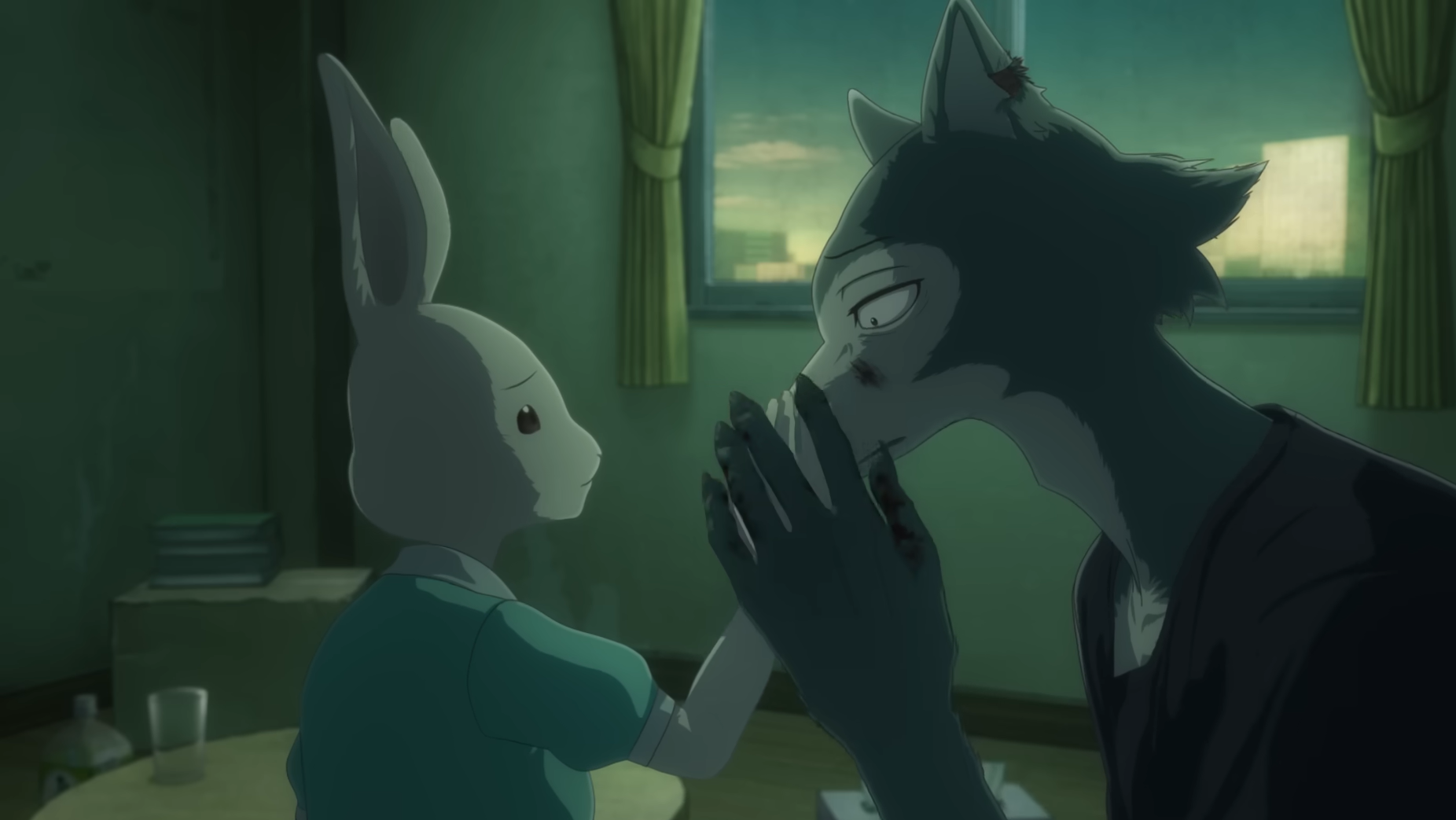
Amidst this escalating turmoil, Haru finds herself more deeply enmeshed in Melon’s perilous obsession than ever before. Simultaneously, Legoshi, having narrowly survived his previous encounters, is inexorably drawn into the shadowy depths of the Black Market. Their relationship, while demonstrating continuous growth and deepening emotional connection, remains a central point of tension. Legoshi grapples with his primal fear of succumbing to his predatory instincts and harming Haru, a fear that is not reciprocated by Haru herself. Her unwavering acceptance and expressed desire for physical intimacy, regardless of the potential consequences, highlight the unique nature of their bond and the societal anxieties it challenges.
Concurrently, Louis navigates a complex web of political pressures and personal dilemmas. His ascent within the surface world’s power structures becomes increasingly complicated. Bound by his father’s unwavering will, Louis faces an arranged marriage with a powerful heiress, a union that, unexpectedly, proves to be far more complicated and potentially beneficial than initially anticipated, further entangling him in the machinations of the elite. Meanwhile, the theatre troupe he once led endeavors to mount a play designed to promote interspecies coexistence. However, their efforts are consistently hampered by internal strife, most notably the presence of a volatile prima donna whose diva-like behavior jeopardizes the production’s message. Looming over all these disparate threads is Melon, who consolidates his control over the Shishigumi crime syndicate and actively incites unrest, solidifying his position as an increasingly unpredictable and formidable antagonist.
Societal Metaphors and The Weight of Backstory
The overarching concept of herbivore and carnivore cohabitation, a central theme since the series’ inception, is masterfully woven throughout this final season, serving as a potent metaphor for real-world societal divisions and prejudices. The introduction of individuals born from mixed-species relationships adds a crucial layer to this discourse, exploring the lived experiences of those who exist at the intersection of societal divides. However, as the narrative delves deeper into Melon’s personal history, the story treads a well-worn path by attributing his villainy to a tragic past. While this approach provides a degree of understanding for his motivations, it risks leaning into a somewhat predictable trope, potentially diminishing the overall impact of his character as a purely antagonistic force.
Beyond the central conflict, the series deftly incorporates elements such as the pervasive influence of drugs, the insidious nature of organized crime, and systemic corruption that permeates all levels of society, particularly between political establishments and governmental bodies. The role of public opinion and the media in shaping perceptions and fueling conflict are also explored with considerable depth, adding further layers to an already intricate narrative. As the murder rate escalates and the inevitable confrontations between Legoshi and Melon, and Louis and his father, draw nearer, the palpable tension escalates. The latter half of the season sees action taking a more prominent role, though it has been a consistent undercurrent throughout. The thriller elements and the deliberate, gradual build-up to the climactic finale prove remarkably effective, even if director Shinichi Matsumi employs a series of narrative detours to reach this crescendo.
A Visual and Auditory Masterpiece
The technical execution of Beastars Final Season Part 2 is nothing short of exceptional, particularly the CGI animation produced by Studio Orange. The studio’s work remains a benchmark in the anime industry, consistently delivering fluid, dynamic, and visually stunning character models and environments. The overall audiovisual presentation complements this high standard, creating an immersive and impactful viewing experience.
Key sequences stand out for their innovative artistry and thematic resonance. A particularly memorable segment features a highly surreal quiz show, presented in a stylized television format, which serves as a stark and unsettling interlude before plunging into a delirious and brutally violent confrontation. This chaotic scene, set against the backdrop of the Black Market descending into pandemonium, showcases the series’ willingness to push creative boundaries. The strategic use of rotoscoping, a powerful drum-driven musical score, and an expertly crafted montage that interweaves Louis’s personal arc with the unfolding chaos, culminates in what is arguably the season’s strongest and most extended sequence, a testament to the creative team’s vision.
The character designs, meticulously crafted by Takuma Norita and Nao Otsu, continue to impress. Their anthropomorphic renderings of the characters are not only aesthetically appealing but also effectively convey the emotional and physical toll of the events unfolding around them. Even subtle elements, such as the characters’ evolving appearances as they endure hardship, contribute to the narrative’s emotional depth. Furthermore, a discreetly introduced erotic element, while present, remains tastefully integrated into the narrative, serving to enhance thematic exploration rather than gratuitously.
Legacy and Conclusion
While the ultimate resolution of Beastars Final Season Part 2 might be described by some as somewhat conventional or "vanilla," it nonetheless provides a deeply rewarding conclusion to an exceptional series. The final episodes successfully tie up the vast majority of narrative threads, offering closure to the complex journeys of its central characters. The season solidifies Beastars‘ legacy as a groundbreaking work in anime, one that fearlessly tackled mature themes with artistic integrity and visual innovation. Its impact on discussions surrounding prejudice, societal structures, and the nature of desire is undeniable, cementing its place as a significant contribution to the medium. The series’ ability to blend intricate storytelling, complex character development, and breathtaking animation has left an indelible mark, ensuring its continued relevance and appreciation for years to come.