


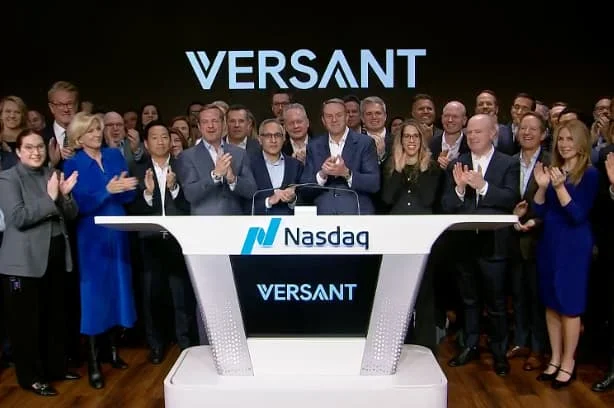
Versant Media Group is set to release its first earnings report as an independent public company this Tuesday, providing Wall Street with its most comprehensive look yet at the financial health of a portfolio composed primarily of legacy cable television networks. The report follows the company’s high-profile spinoff from Comcast Corporation, a transaction that concluded with Versant’s debut on the Nasdaq on January 5, 2026. As the media industry grapples with the accelerating transition from traditional linear broadcasting to digital streaming, analysts are viewing this upcoming financial disclosure as a critical barometer for the viability of "pure-play" cable assets in a post-bundle era.
The spinoff, which includes a roster of prominent cable brands such as CNBC, MS Now, USA Network, Golf Channel, Syfy, E!, and Oxygen, represents a significant decoupling of content from Comcast’s broader distribution and connectivity business. Beyond the television networks, Versant’s portfolio encompasses a suite of digital and transactional properties, including the movie-ticketing giant Fandango, the review aggregator Rotten Tomatoes, and sports-related platforms GolfNow and Sports Engine. While these assets were previously consolidated within Comcast’s NBCUniversal segment, their performance as a standalone entity will now be scrutinized by investors looking for stability in an increasingly volatile sector.
The Financial Foundation and Market Reception
Ahead of its debut as a public entity under the ticker symbol VSNT, Versant released historical financial data that underscored the challenges facing the linear television industry. According to Securities and Exchange Commission (SEC) filings, the assets that now comprise Versant Media Group generated $7.1 billion in revenue in 2024. This figure represents a steady decline from $7.4 billion in 2023 and $7.8 billion in 2022. This downward trajectory reflects broader industry trends, where "cord-cutting"—the practice of consumers canceling traditional pay-TV subscriptions in favor of streaming services—has eroded the subscriber base that provides the foundation for affiliate fees and advertising revenue.
Since its January debut, Versant’s stock has experienced a significant decline, dropping approximately 25%. Market analysts attribute much of this volatility to technical selling pressure typical of large-scale spinoffs, as institutional investors who held Comcast shares for its dividend and growth profile may not necessarily wish to hold a specialized media play. Currently, Versant’s market capitalization sits at roughly $4.8 billion, a valuation that suggests a cautious outlook from the investment community regarding the long-term growth prospects of traditional cable networks.
Strategic Focus on News and Live Sports
A central pillar of Versant’s pitch to the investment community is its heavy weighting toward live, "appointment-viewing" content. Unlike general entertainment networks, which have seen their audiences migrate almost entirely to on-demand streaming platforms like Netflix and Disney+, news and sports remain the primary drivers of the traditional pay-TV bundle.
CEO Mark Lazarus, a veteran media executive who previously led NBCUniversal’s television and streaming divisions, emphasized this competitive advantage during the company’s investor day in December. Lazarus noted that 62% of Versant’s total audience engagement comes from live programming. This includes the influential financial news of CNBC, the political and social commentary of MS Now, and a robust slate of sports programming including NASCAR, the WWE, and extensive golf coverage.
"We feel very confident in our position," Lazarus stated during the investor presentation. "The deals we’ve done over the last year bear that out."
Analysts from Raymond James have echoed this sentiment, noting that Versant’s portfolio is leaner and more focused than many of its peers. By avoiding a heavy reliance on lower-value general entertainment networks, Versant may be better positioned to negotiate favorable terms with distributors. While the company lacks "Tier One" blockbuster rights like the NFL or NBA, its consistent schedule of mid-tier sports and dominant news presence makes it a "must-have" for cable and satellite providers looking to retain their remaining subscriber base.
Distribution Stability and Future Risks
The financial stability of Versant Media Group is largely tied to its carriage agreements with major distributors such as Charter Communications and Google’s YouTube TV. These agreements, which dictate the "affiliate fees" paid to Versant per subscriber, were largely negotiated while the networks were still under the NBCUniversal umbrella.
Crucially, many of these contracts are locked in for the next two to four years. Anand Kini, Versant’s Chief Operating Officer and Chief Financial Officer, highlighted that more than half of the company’s pay-TV subscribers are governed by agreements extending through 2028 and beyond. Furthermore, several of the company’s sports rights agreements are secured past 2030. This provides a "cushion" of predictable revenue as the company navigates its transition into an independent entity.
However, the strength of this cushion will soon be tested. Reports indicate that two major distribution agreements are up for renewal this year. These negotiations will mark the first time Versant must stand alone at the bargaining table without the leverage of Comcast’s broader portfolio, which includes the NBC broadcast network and the Peacock streaming service. In recent years, carriage disputes have increasingly led to "blackouts," where networks are removed from a provider’s lineup during fee disputes. The outcome of these upcoming negotiations will be a significant indicator of Versant’s standalone market power.
The "Business Model Transition": A Pivot to Digital
Recognizing the secular decline of linear television, Versant’s leadership has framed 2026 as the beginning of a fundamental "business model transition." The long-term goal, as articulated by CFO Anand Kini, is to reach a state where revenue is split evenly: 50% from traditional pay-TV and 50% from digital, platform-based, and transactional businesses.
To achieve this, Versant is aggressively investing in its digital properties and expanding its footprint in the "Free Ad-Supported Streaming TV" (FAST) space. The company recently completed the acquisition of Free TV Networks, a provider of over-the-air digital broadcast channels, signaling an intent to capture audiences who have exited the traditional cable bundle.
Furthermore, the company is leveraging its ownership of Fandango and Rotten Tomatoes to create a more integrated digital ecosystem. The recent acquisition of Indy Cinema Group, a cloud-based cinema operating system, has already been folded into Fandango’s operations. By diversifying into the transactional side of the film industry and digital sports platforms like GolfNow, Versant hopes to offset the inevitable declines in cable affiliate fees.
Broader Industry Context and Comparative Analysis
Versant’s journey is being closely watched as a potential blueprint—or a cautionary tale—for other media conglomerates. The decision by Comcast to spin off these assets mirrors similar strategic discussions occurring at Warner Bros. Discovery and Paramount Global.
Warner Bros. Discovery recently contemplated a similar split of its linear networks from its streaming and studio assets before the landscape shifted toward broader consolidation, including the high-profile deal involving Paramount and Skydance. The central question for the industry remains whether cable networks can generate enough free cash flow to fund a transition to digital, or if they are "melting ice cubes" whose value will dissipate faster than new revenue streams can be built.
The market’s skepticism is not without precedent. Newsmax, another pure-play cable network that recently went public, saw its shares surge initially before facing a sharp decline. Goldman Sachs analysts maintained a "Neutral" rating on Versant in January, citing the "secular challenges in the linear networks business" while expressing cautious optimism about the company’s digital platform initiatives.
Outlook for Tuesday’s Earnings Call
When Versant executives address shareholders on Tuesday, the focus will likely remain on three key metrics: subscriber retention rates across their top networks, the growth of digital advertising revenue, and the progress of the "50/50" revenue diversification strategy.
Investors will also be looking for updates on the company’s debt management. Unlike many of its peers that are burdened by massive debt from past mergers, Versant launched with a relatively light debt load, which management argues gives them the flexibility to pursue targeted acquisitions in the digital and streaming space.
As the first quarter of 2026 comes to a close, Versant Media Group stands at a crossroads. It possesses some of the most recognizable brands in news and sports, yet it is tethered to a distribution model that is losing millions of customers annually. Tuesday’s earnings report will not only define Versant’s financial standing but will also offer a definitive look at whether there is a sustainable future for independent, network-heavy media companies in the modern age.