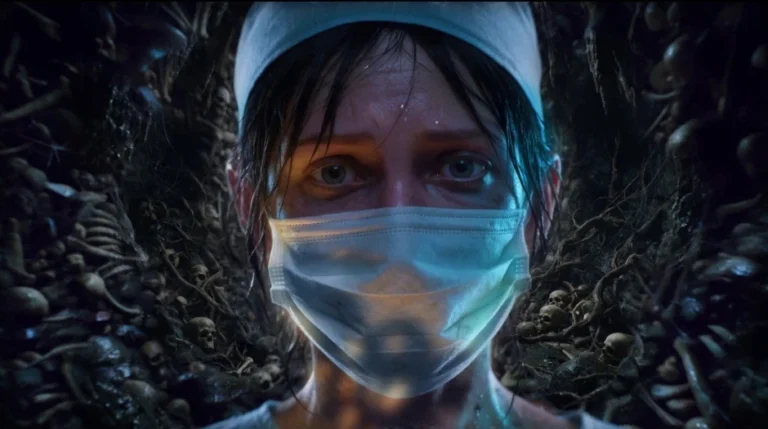
The acclaimed visual effects studio Rodeo FX has once again plunged into the terrifying depths of Stephen King’s universe, meticulously crafting the nightmarish denizens of HBO’s prequel series, IT: Welcome to Derry. This ambitious eight-episode horror event delves into the origins of the malevolent entity known as Pennywise, bringing to life a host of deeply unsettling characters—Mutant Baby, Bed Mom, Pickle Dad, and the titular evil clown—all born from the visceral manifestations of fear. Through a sophisticated new Universal Scene Description (USD) pipeline, Rodeo FX delivered a staggering 740 visual effects shots, pushing the boundaries of digital creature realization.

Rodeo FX’s Continued Legacy in the World of IT
This latest venture marks a significant continuation of Rodeo FX’s profound involvement with the IT franchise. Following their impactful contributions to the blockbuster films IT and IT: Chapter Two, the studio was uniquely positioned to tackle the prequel series, helmed by showrunners Jason Fuchs and Brad Caleb Kane, with Daryl Sawchuk overseeing the visual effects. IT: Welcome to Derry serves as a foundational narrative, exploring the town’s history and the cyclical nature of Pennywise’s terror before the events of the feature films.

The series’ core premise hinges on the idea that its monstrous characters are not merely physical threats but tangible embodiments of an individual’s deepest anxieties. "The manifestation, familiar feeling, and the creepy stuff gets you in the chest, because they’re nightmares of a kid," explained Pier Lefebvre, Visual Effects Supervisor at Rodeo FX, who spearheaded the creation of the 740 shots. This philosophy, deeply rooted in the creative vision of director Andy Muschietti, aimed to tap into primal fears, ensuring each creature’s design and behavior resonated with the unsettling familiarity of a childhood nightmare.
Lefebvre articulated a key tenet of successful horror filmmaking: the creation of "iconic frames which will get printed in your memory forever." This pursuit of indelible imagery drove the team’s creative process. He highlighted a specific moment with Pickle Dad, where a deliberate decision to have him smile while crawling over a girl’s leg, even upon repeated viewing, elicits the same visceral reaction of disgust. This meticulous attention to detail, aiming for sustained psychological impact, underscores Rodeo FX’s commitment to not just visual spectacle but emotional resonance.

Revolutionizing Workflow with a USD Pipeline
A significant technological advancement underpinning the success of IT: Welcome to Derry‘s visual effects was Rodeo FX’s transition to a USD pipeline. This open-source standard for 3D scene description offers unparalleled flexibility and collaboration capabilities. "The power of USD is that everything is accessible to everybody at all times, so it’s a parallel workflow," Lefebvre noted. He contrasted this with traditional pipelines, where assets must be formally published before becoming accessible, a process that could create bottlenecks.

The USD pipeline facilitated a more fluid and iterative creative process. "But now we have a version of the creature effects that is accessible and won’t break the chain of command. You are able to see all of the effects happening even if animation is not done," Lefebvre elaborated. This real-time accessibility allowed different departments to work concurrently and provide feedback earlier, streamlining the complex process of creature animation and effects integration. This technological leap was crucial for managing the sheer volume and complexity of the creature work required for the series.
Crafting Nightmares: The Genesis of Unique Horrors

The creative latitude afforded to Rodeo FX, guided by the discerning eyes of Daryl Sawchuk and Andy Muschietti, allowed for extensive experimentation. "Daryl and Andy don’t try to steer us too much toward certain things because they like to see how far we can take it," Lefebvre observed. This trust empowered the artists to explore the full spectrum of their imagination, leading to some of the series’ most memorable and disturbing creations.
The process was often one of meticulous trial and error, a testament to the dedication of the artists involved. Lefebvre recounted a humorous anecdote regarding Pickle Dad’s grotesque bodily fluids. While the practical effects supervisor initially devised a simulation where pickle juice erupted from the creature’s eyes, director Andy Muschietti judiciously reined in the excess, emphasizing the need for clarity and narrative coherence over gratuitous gore. "Andy was like, ‘What the hell are we guys doing? Let’s take it down a notch, and then we can see what he’s actually saying.’ There’s lots of trial and error to see what’s going to work and when it’s not going to work." This iterative approach, balancing artistic ambition with narrative purpose, was fundamental to achieving the desired level of horror.

The Mutant Baby: A Study in Scale and Agitation
The Mutant Baby, a creature that vacillates between unnervingly small and terrifyingly large, presented unique challenges in terms of scale and behavior. "The biggest challenge for Mutant Baby was that the timeline was shorter than the other episodes," Lefebvre stated, underscoring the production pressures. Despite the compressed schedule, the team leveraged strong concept art to rapidly move into animation.

Director Andy Muschietti’s brief for the Mutant Baby emphasized bat-like wings but a behavioral profile akin to an agitated, injured bird. "If you have a wild bird inside your house, it’s going to smash itself on the window," Lefebvre explained, illustrating the creature’s erratic and self-destructive tendencies. The goal was to avoid a majestic or graceful portrayal, instead focusing on an unpredictable, almost pathetic yet terrifying, vulnerability. This included a pivotal scene where the Mutant Baby, seeing its reflection, repeatedly smashes its head against a window, culminating in its pacifier dislodging just before the main title card.
The transition from a small, infantile form to an eight-foot terror in the theater required meticulous attention to detail. "The small baby has thinner fingers, and there’s so much subsurface and translucency in their skin. Our bigger baby had different values for that, so it was more like a human," Lefebvre elaborated. The larger iteration featured a broader subsurface scattering effect, making its skin appear more human-like, while the wings and extremities exhibited less translucency. Furthermore, the "gooey and slimy" wet patterns were re-scaled to maintain their visual impact and believability at the larger size.

The team also employed fractal principles, drawing parallels to natural phenomena like plants and rocks, to inform the scaling of details. "There’s some stuff that you can scale and other stuff that you can’t, such as the pores of the skin," Lefebvre explained. This meant that elements like blood patches, skin pores, and nail textures were not simply enlarged but recreated with appropriate detail for the larger scale. "For some of the nails, we had added a bit more crack on the contours. The vein texture was updated to make sure that you didn’t have a huge vein going through the webbing. We scaled down a lot of those textures to make sure that it was more faithful." This granular approach ensured the Mutant Baby’s terrifying presence was consistent across its varied manifestations.
Bed Mom: A Labyrinth of Limbs and Deception

The character known internally as the Mother Thing, or Bed Mom, presented a complex logistical and visual puzzle. "Her body is the bed," Lefebvre stated matter-of-factly, highlighting the creature’s insidious integration with its surroundings. The initial setup involved two actresses: one positioned at the head of the bed, and another at the foot, their limbs cleverly obscured by the bedding.
The visual effects team employed a multi-plate compositing technique to seamlessly merge these elements and create the illusion of a singular, horrifying entity. This involved separate plates for the room without the bed, the top of the bed with the actress portraying the mother’s head and arm, and an additional plate featuring the second actress for the front legs, hidden beneath the sheets. A prosthetic was used to create the unsettling belly that emerges as Bed Mom attempts to consume a child.

A particularly ingenious aspect of Bed Mom’s realization involved a reversed shot. The actress performed her movements backward, with two crew members in blue suits catching her fall. Rodeo FX then played this footage in reverse, creating the disorienting effect of Bed Mom rising from a lying position, veil in place, and emitting a chilling scream. "Then, to make her look big, since we had the model, we scaled the room down so she looks 10 feet tall," Lefebvre explained, a clever application of forced perspective to enhance the creature’s imposing stature.
Pickle Dad: A Viscous Nightmare from a Jar

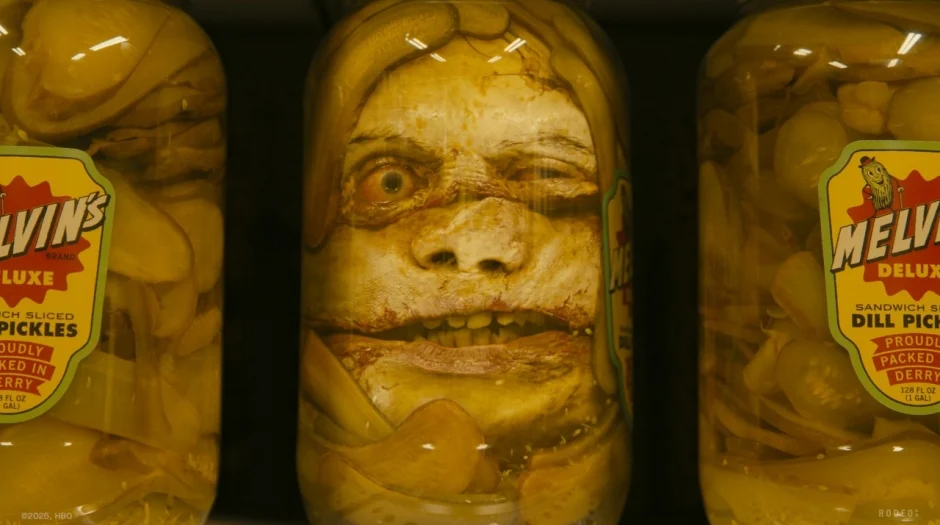
The Pickle Dad, a character born from the brine of a pickle jar, presented a unique set of technical and aesthetic hurdles. "The biggest challenge from a technical standpoint was to put the head in the jar," Lefebvre admitted. This required specialized animation rigs to simulate the head pressing against the glass, leading to intricate shader work that mimicked the subtle color shifts and distortions of flesh against a solid surface. "When you close your fingers, your knuckle gets white… It’s the same thing with a piece of flesh. If you press it against the glass, then the color slightly changes. We had to do dynamic shaders for all of the collision."
The simulation of the green-yellow pickle brine also posed a significant challenge, requiring careful consideration of fluid dynamics and how it would interact with the creature’s form. Lefebvre described the learning curve involved in accurately depicting these interactions, particularly the nose sliding and lips being compressed against the glass.

Once outside the jar, Pickle Dad transformed into a horrifying amalgamation of organs, resembling an octopus made of its own viscera. "The head is constrained by the hand, and the bottom of the wrist is like your torso. The way that we played it, the hand and the head are pushing on the gut; it’s sitting on top of everything," Lefebvre explained. The animation process involved a base octopus-like structure with simulated organs, layered with keyframe animation to suggest movement and impact. The creature effects team then added a substantial layer of simulation to achieve the final, unsettling organic fluidity.
Pennywise: Evolution of an Icon

Pennywise, the ancient, shape-shifting entity at the heart of IT‘s terror, received a meticulous reimagining for the prequel series. Rodeo FX focused on evolving its iconic visages, ensuring each iteration felt both familiar and terrifyingly new. Lefebvre detailed two key variations: the "Kill Mouth," characterized by protruding gums, sharp teeth, and copious saliva, designed for visceral attacks; and the "Dead Light Mouth," a more open, hypnotic maw accompanied by a bright lens flare and three hypnotic spheres of light. This latter form was central to Pennywise’s ability to levitate children and drain their life force.
With eight episodes providing ample screen time, Andy Muschietti aimed to revamp Pennywise’s classic appearances. Rodeo FX approached this with a more methodological mindset, meticulously studying the anatomical implications of Pennywise’s extreme contortions. "Our approach was more methodological. If you stretch the top of your mouth backwards, what does it do to your eyes? We tried to respect more of the cranium property and the facial structure," Lefebvre stated. This scientific approach to monstrous anatomy ensured that even in its most exaggerated forms, Pennywise’s transformations felt grounded in a disturbing, albeit twisted, biological reality.

The studio acknowledged the significant contribution of actor Bill Skarsgård, whose performance as Pennywise in the films set a high bar. "Bill does a lot by himself and gives you at least a good reference for the staccato attack. Even if we enhanced it or made it faster or replaced his hands with CG to make it broader or faster, 80 percent of the performance is usually Bill," Lefebvre emphasized, highlighting the symbiotic relationship between practical performance and digital enhancement.
Penny Bird: A Fearsome Avian Hybrid

One of the most striking new manifestations of Pennywise was the "Penny Bird," a terrifying fusion of the clown with bat-like wings. Lefebvre described it as the "final boss" of the series’ creature designs. The transformation involved Pennywise’s hands morphing into finger-like bat wings with webbing. As the creature moved, the hands would extend, and the webbing would stretch, creating a dynamic and unsettling visual.
The design deliberately avoided a purely organic feel, aiming instead for wings that appeared to be an extension of Pennywise’s costume, incorporating elements of silk and fabric. The creature’s feet also transformed into talons as it advanced. For aerial sequences, the team utilized wirework and replaced much of Skarsgård’s body, retaining only his face to maintain the performance’s integrity while adapting the posture to a more hunched, bird-like stance.

The climax of the series involved a dramatic confrontation where a force, described as the "Antichrist of IT," pushed Pennywise away from the children. This was visualized as a natural phenomenon triggered by a dagger striking a tree, manifesting as a pillar of light, reminiscent of Norwegian light pillars. The surrounding mist and snow were displaced, creating a powerful and visually arresting expulsion of the evil entity.
Conclusion: A Testament to Digital Craftsmanship

IT: Welcome to Derry stands as a testament to Rodeo FX’s unparalleled skill in digital creature creation. By embracing new technologies like the USD pipeline and meticulously dissecting the anatomy of fear, the studio has not only honored the legacy of Stephen King’s terrifying creation but has also pushed the boundaries of what is possible in visual effects. The series’ success in delivering genuinely horrifying and memorable creatures is a direct result of their technical prowess, artistic vision, and unwavering dedication to crafting nightmares that linger long after the screen fades to black. The 740 shots delivered represent a significant undertaking, showcasing a studio at the apex of its craft, capable of transforming abstract fears into chillingly tangible realities.