
Prime Video’s high-octane spy thriller Citadel made a triumphant return to global streaming screens this past May, releasing all seven episodes of its highly anticipated second season simultaneously across more than 240 countries and territories. Produced by Anthony and Joe Russo’s independent studio AGBO alongside Amazon MGM Studios, the ambitious television event continues to push the boundaries of episodic filmmaking. Showrunner David Weil reunited the star-studded main cast, welcoming back Richard Madden and Priyanka Chopra Jonas as elite espionage agents Mason Kane and Nadia Sinh, alongside Stanley Tucci as the ingenious intelligence operative Bernard Orlick. Following the catastrophic collapse of their global spy agency, the surviving protagonists must regroup to dismantle Manticore, the shadow network of immensely powerful families responsible for their organization’s downfall.

While the narrative stakes reached new heights in Season 2, the technical and artistic ambitions behind the scenes scaled up commensurately. Following a massive first season that relied on a staggering 1,796 visual effects shots overseen by a diverse vendor roster led by premier visual effects powerhouse DNEG, the studio returned as the primary lead vendor for Season 2. DNEG’s global teams once again plunged deep into the clandestine world of espionage, delivering complex digital sequences ranging from harrowing psychological visions and intricate action set pieces to photorealistic digital doubles and awe-inspiring celestial disasters.

The Evolution of Collaboration: A Streamlined Pipeline
The seamless execution of Season 2’s extensive visual effects package was largely attributed to the established creative synergy between production and post-production leadership. DNEG Visual Effects Supervisor Daniel Baldwin highlighted the profound advantage of returning for a sophomore season with a familiar core team. Production Visual Effects Supervisor Wesley Froud and Baldwin, longtime industry colleagues, utilized their existing rapport to fast-track the creative development process.

According to Baldwin, working alongside Froud through the rigorous production schedule of Season 1 allowed both artists to bypass the typical preliminary phases of mutual discovery. Instead of spending weeks aligning on aesthetic preferences, tone, and technical specifications, the creative units immediately dove into the granular details required for the new scripts. This established trust also extended to showrunner David Weil and executive producer Joe Russo, enabling rapid decision-making and efficient resource allocation across DNEG’s international facilities, notably including the Sydney team under the supervision of Renaud Madeline.

Deconstructing the Impossible: From Practical Tests to CG Spectacles
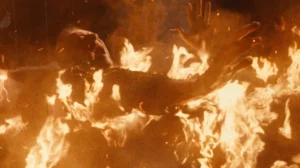
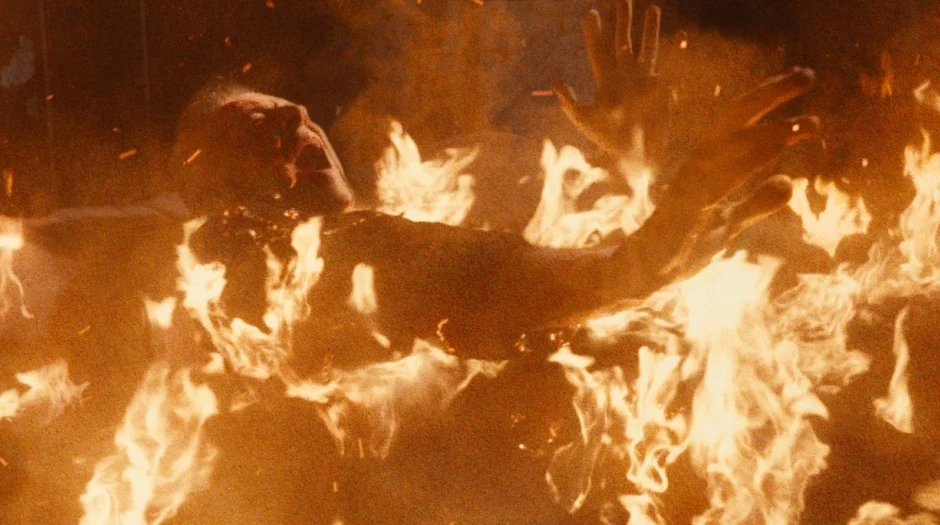
Season 2 required DNEG to tackle several massive narrative set pieces, each presenting distinct technical hurdles that bridged practical filmmaking with advanced computer-generated imagery (CGI). Among the most emotionally charged sequences was Mason Kane’s haunting psychological vision of his father engulfed in flames.

Rather than relying solely on post-production effects, the creation of the burning-man sequence began with extensive conceptual artwork. Baldwin and his team focused heavily on balancing realistic physical fire dynamics with the emotional resonance of the actor’s performance. The primary objective was to preserve the recognizability of the father’s face and costume while maintaining an atmospheric, visceral horror. The team analyzed historical archival footage of stunt performers intentionally set on fire to understand the organic propagation of flames, smoke density, and ember distribution.

To further ground the sequence in physical reality, Production VFX Supervisor Wesley Froud conducted exhaustive practical tests using life-sized mannequins. These tests provided crucial empirical data regarding how various fabrics combust, how smoke behaves under specific atmospheric conditions, and how intense light interacts with surrounding environments. Armed with this knowledge, the on-set practical effects crew engineered a specialized LED-embedded suit worn by the actor. This innovative wardrobe allowed for accurate, dynamic interactive lighting to cast authentic glows onto the actor’s face, neighboring performers, and the surrounding physical set, vastly simplifying the subsequent digital compositing phase.

Engineering High-Speed Destruction and Extraterrestrial Chaos
In addition to intimate psychological sequences, DNEG was tasked with choreographing large-scale physical destruction, including a complex full-CG car crash set in a simulated Frankfurt environment. To achieve absolute physical authenticity, the visual effects artists studied real-world vehicle collisions and rigorous manufacturer crash-test footage. This data informed how automobiles absorb kinetic energy, deform upon impact, and rotate through space during high-speed accidents.

The Frankfurt setting itself required meticulous digital world-building. Collaborating closely with the show’s location management team, DNEG scouts identified authentic Gothic architectural references around London that mirrored the specific aesthetic of the scripted German location. The digital artists then captured comprehensive photogrammetry and lidar scans to construct an expansive, highly detailed CG environment.

The season’s climax—a catastrophic satellite malfunction in Earth orbit—presented a unique conceptual challenge: synthesizing accurate orbital physics with cinematic spectacle. Real-world space phenomena often lack the immediate visual drama required for mainstream narrative storytelling. Consequently, DNEG balanced scientific plausibility with dramatic impact, drawing on historical space films—many of which DNEG had previously contributed to—alongside authentic NASA photography.

Utilizing the studio’s proprietary Earth setup, which generates photorealistic planetary terrain, atmospheric oceans, and volumetric clouds, the artists meticulously designed the orbital backdrop. Creative decisions involved deliberating over specific terrestrial coordinates, cloud cover densities, and sun angles. Ultimately, the team favored a universally recognizable, aesthetically striking representation of Earth that maintained spatial continuity without becoming overly rigid regarding real-world orbital mechanics.

Blending Worlds: Digital Doubles and the 80-Second Oner
Among the season’s most technically demanding feats was an 80-second continuous shot—commonly referred to as a "oner"—that required a seamless transition between drone cinematography and Steadicam photography. Although the on-set camera operators executed the physical choreography with remarkable precision, micro-variations in lens positioning, actor trajectory, and ambient natural lighting between different takes made a simple two-dimensional cut impossible.

To solve this, DNEG’s layout team, under the supervision of Shailendra Swarnkar, reconstructed the entire environment in a three-dimensional space using match-moved camera data. The animation department then implemented subtle adjustments to carry the digital double of the actor smoothly across the plate boundary without altering his physical performance. Cloth simulation (CFX) artists further refined the movement of the actor’s apparel, while lighting artists relit the digital asset to ensure absolute visual continuity across the disparate exposure conditions of the original source plates.

Digital doubles were similarly crucial during high-risk action sequences, such as the abduction of Abby Conroy, portrayed by Ashleigh Cummings. During this sequence, a Swedish assassin named Hugo is struck by a moving vehicle. DNEG captured high-resolution photogrammetry scans of both the actor and the physical vehicle on set, supplementing the geometry with High Dynamic Range Imaging (HDRI) maps and chrome-ball reference captures. An additional wire-pass reference element helped lighting and compositing teams anchor the CG asset convincingly into the live-action plate.

The Art of Subtlety: Gore, Muzzle Flashes, and Practical Integration
Balancing visceral action with emotional nuance remained a core mandate throughout the production of Season 2. The integration of ballistic impacts, muzzle flashes, and trauma wounds required a multi-tiered approach. While DNEG maintained a proprietary library of 2D visual effects elements for standard gunplay, complex camera angles and challenging lighting conditions necessitated advanced Houdini fluid and particle simulations.

On-set weapon rigging played a critical role; LED lighting arrays mounted directly onto firearms emitted precise, synchronized interactive flashes onto the actors’ skin and surrounding props. This practical lighting setup provided the foundational data necessary for the compositing teams to seamlessly merge real-world footage with digital enhancements.

Similarly, the application of digital blood and physical trauma on principal characters was handled with rigorous editorial care. Baldwin emphasized that gore must effectively communicate the severity and horror of a narrative situation without overshadowing the actors’ performances. By combining practical makeup effects with tracked digital matte painting (DMP) and bespoke Houdini simulations, DNEG ensured that every wound looked organic, grounded, and emotionally resonant.

Industry Implications and the Future of Episodic VFX
The scale and sophistication of the visual effects deployed in Citadel Season 2 underscore a broader evolution within the streaming television landscape. As platforms like Amazon Prime Video continue to invest heavily in cinematic-quality event television, the boundaries between feature film production standards and episodic pipelines have effectively dissolved. Vendors like DNEG are increasingly tasked with delivering theatrical-grade assets—such as global-scale environmental destruction, orbital mechanics, and complex digital doubles—within the compressed delivery schedules typical of modern television series.

The success of DNEG’s work on Citadel highlights the critical importance of early prep-phase collaboration between production supervisors and post-production vendor leads. By utilizing rigorous empirical testing—such as physical fire burn trials and manufacturer crash analysis—production teams can mitigate downstream creative friction, ensuring that digital assets interact convincingly with practical photography. As audiences demand higher fidelity and narrative immersion from streaming blockbusters, the technical workflows pioneered on projects like Citadel establish a new benchmark for complex visual storytelling in the global streaming era.