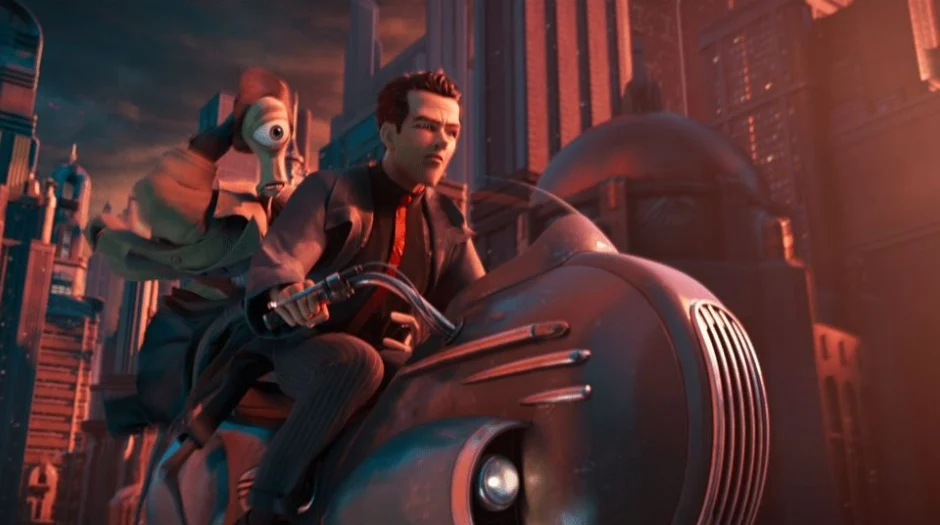
After more than thirty years in various stages of conceptualization, development, and studio limbo, director Brad Bird’s ambitious animated feature Ray Gunn is officially set for release this December. Produced by Skydance Animation in partnership with Netflix, the sci-fi noir project represents a long-awaited milestone for the two-time Academy Award-winning filmmaker, whose previous credits include such critical and commercial successes as The Incredibles, Ratatouille, and The Iron Giant. The film combines a nostalgic, retro-futuristic aesthetic inspired by 1930s and 1940s detective fiction with advanced computer-generated imagery, creating a distinct visual landscape that has captured the attention of the animation industry since its initial conception decades ago.

Chronology of a Decades-Long Production Journey
The genesis of Ray Gunn dates back more than thirty years, during which time the project experienced numerous shifts in industry trends, technological capabilities, and corporate ownership. For much of this period, the film was widely discussed within animation circles as a legendary unproduced property—a passion project that Bird continually refined while pursuing other high-profile animated and live-action endeavors.

The trajectory of the film shifted significantly in February 2022, when Skydance Animation formally acquired the project and placed it into active development. This acquisition provided the necessary institutional backing to translate Bird’s original vision into a fully realized production. Throughout the ensuing production cycle, the film garnered substantial industry anticipation, culminating in the release of early promotional materials by Netflix in April of the following year.
The distribution rollout begins next month with a high-profile world premiere at the BFI London Film Festival. Following its festival debut, Ray Gunn will receive a limited theatrical release—including specialized runs on 70mm screens—on December 4, before premiering globally on Netflix on December 18. This hybrid release strategy highlights both the theatrical ambitions of the production team and the expanding reach of streaming platforms in distributing prestige animated features.

Narrative Framework and All-Star Voice Cast
Set in the sprawling, alternate-future metropolis of Metropia—visualized as an extrapolation of 1939 architectural and cultural motifs featuring mile-high skyscrapers—Ray Gunn follows private investigator Raymond Gunn. Voiced by Sam Rockwell, the cynical detective is drawn into a complex criminal conspiracy involving extraterrestrial elements, homicide, and Venus Nova, a high-profile multimedia star voiced by Scarlett Johansson.

The production has assembled a notable ensemble cast to populate its retro-futuristic world. Tom Waits voices the character Eyera, while Alan Tudyk portrays Barry Vogel. The broader supporting cast features prominent actors and comedians, including Matt Berry, Bobby Cannavale, Michael Chernus, Kether Donohue, Michelle Rodriguez, Aasif Mandvi, Matt Jones, Kathryn Hunter, John Ratzenberger, Justin Peck, and Patton Oswalt.
Behind the camera, Bird directs from an original story he conceived, collaborating on the screenplay with Matthew Robbins. The production is produced by John Lasseter, Brad Bird, Lisa Beroud, David Ellison, and Dana Goldberg. The creative department is rounded out by production designer Paul Felix, art director Wendell Luebbe, animation director Jason Ryan, director of photography Erik Smitt, editor Darren Holmes, and costume designer Neysa Bove. The musical score is composed by Michael Giacchino, with visual effects supervision led by Josh Herring and Cinesite’s Adel Abada.

Technical Innovation and the Evolution of Animation
While Bird originally conceptualized Ray Gunn as a hand-drawn 2D feature, the transition to computer-generated imagery ultimately afforded the production a level of technical and emotional nuance that would have been difficult to achieve through traditional animation methods. According to the director, CG technology allowed the animators to execute extremely subtle character performances without the visual noise that can sometimes interfere with delicate line work in hand-drawn formats.

In discussing the animation process, Bird highlighted the methodology employed by his animators to capture authentic performances. Drawing on mentorship from legendary Disney animator Milt Kahl, the production encouraged artists to study live-action reference material thoroughly before internalizing the movements and translating them into stylized animation. This approach avoided the literal replication often associated with motion capture, ensuring that the characters retained the specific timing, exaggeration, and emotional clarity characteristic of traditional animation principles.
Furthermore, Bird incorporated complex technical challenges into the production schedule, such as continuous, unbroken master shots involving multiple characters interacting simultaneously. Scenes featuring Venus Nova and her entourage required animators to maintain spatial clarity and specific character motivation over extended sequences without relying on rapid editing cuts—a technique more commonly associated with live-action filmmaking than standard animation workflows.

Industry Implications and Cross-Medium Expertise
The completion of Ray Gunn underscores the growing viability of high-budget, creator-driven animated features designed for mature audiences. By blending traditional genre tropes—specifically film noir detective stories and classic science fiction—the film attempts to bridge the gap between nostalgic storytelling conventions and modern digital techniques.

Bird’s ability to navigate both animation and live-action filmmaking throughout his career has consistently influenced his approach to visual composition. Having directed live-action features such as Mission: Impossible – Ghost Protocol and Tomorrowland, Bird has frequently applied cinematic staging principles, standard lens selections, and realistic spatial geography to his animated projects. This cross-pollination of techniques has contributed to a distinct directorial style that emphasizes clear spatial relationships, deliberate camera movement, and seamless transitions between emotional states.
As Ray Gunn prepares for its theatrical and streaming debuts, industry observers will closely monitor its reception. The film stands as a testament to the persistence of its creator, the evolution of studio-backed original animation, and the ongoing convergence of traditional cinematic craftsmanship with advanced digital production tools.