
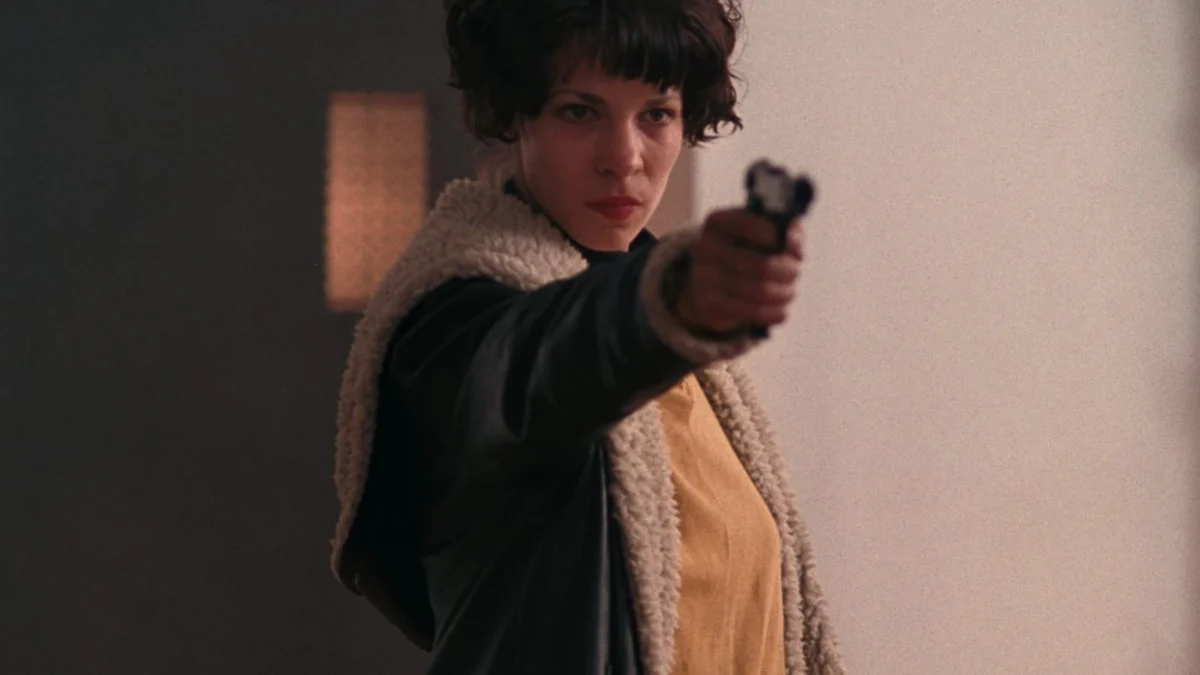
Thirty years after its initial release, Mary Harron’s groundbreaking feature directorial debut, I Shot Andy Warhol, is returning to theatrical screens in a meticulously crafted 4K restoration. The film, which originally premiered in 1996, explores the turbulent life of Valerie Solanas, the radical feminist writer who shot pop art icon Andy Warhol in 1968, nearly ending his life. Before Harron directed the iconic 2000 adaptation of Bret Easton Ellis’s American Psycho, her lens was fixed on the margins of New York City’s downtown art scene, capturing an era of gritty independence, artistic experimentation, and fierce socio-political friction.
The new 4K restoration, supervised by acclaimed cinematographer Ellen Kuras, preserves the distinct, naturalistic visual texture that defined the film’s gritty aesthetic. As the film makes its modern-day return to cinemas, conversations surrounding Solanas’s infamous text, the SCUM Manifesto, and the broader implications of gender politics in media have found renewed relevance. In a wide-ranging discussion with film critic Elissa Suh, Harron reflected on the long, arduous journey of bringing Solanas’s story to the screen, the nuanced dynamics of the 1960s Factory, and how contemporary cultural shifts continue to reframe the film’s core themes.
The Genesis of a Cult Classic and the Road to Production
The journey to bring I Shot Andy Warhol to the screen was neither swift nor straightforward. Developing the project took nearly five years of persistent effort in an era when female-led, explicitly feminist narratives faced significant skepticism from traditional financiers. Harron, who began her career directing comedic parodies and satirical cultural essays for the BBC, found initial backing through a British producer intrigued by radical politics who offered a modest £100,000 to jumpstart the venture.
It wasn’t until Harron crossed paths with legendary independent producers Christine Vachon and Tom Kalin that the project gained the structural momentum necessary to thrive. Emerging at the vanguard of the 1990s New York independent film explosion, the production assembled a stellar ensemble cast. Lili Taylor delivered a career-defining, deadpan performance as Valerie Solanas, capturing the tragic isolation and intellectual swagger of an outsider who rejected societal norms. The supporting cast—featuring Martha Plimpton, Michael Imperioli, and Stephen Dorff as iconic Factory fixture Candy Darling—helped cement the film as a cultural time capsule of the decade’s independent arts community.
Complementing the visual atmosphere is a score composed by John Cale. After Lou Reed denied permission to use original Velvet Underground tracks, Harron enlisted Cale, ensuring that the film’s auditory landscape maintained a living, breathing connection to the era without relying on direct historical mimicry.
Visual Aesthetics and the Reconstruction of the Factory
The new 4K restoration highlights the collaborative vision of Harron and cinematographer Ellen Kuras. Eschewing the hyper-stylized polish common in modern biopics, Kuras utilized available light and poetic realism to evoke the atmosphere of mid-century Manhattan. Drawing inspiration from documentary photography—including the Magnum photo archives and the empty, negative-space compositions of Diane Arbus—the filmmakers constructed a world that balanced magical surrealism with authentic urban grunge.
In discussing the visual restoration, Harron noted how stripping away the audio during playback highlighted the mastery of Kuras’s lighting. The Factory is depicted not as a mythical monolith, but as a real, lived-in space where creative energy flourished before inevitably burning out. This commitment to documentary-style realism extended to the film’s avoidance of clear-cut heroes and villains, a choice that initially drew criticism from contemporary reviewers expecting a traditional moral narrative.
The Enduring Legacy of the SCUM Manifesto
At the epicenter of the film is Solanas’s 1967 text, the SCUM Manifesto. In the late 1980s and early 1990s, when Harron first encountered the document in a left-wing bookstore while researching a Warhol documentary, the manifesto was largely viewed as an obscure outlier. Written with sharp irony, stylistic elegance, and uncompromising cynicism toward male-dominated society, the text initially struck Harron as a darkly comic piece of radical literature akin to the biting satire of Evelyn Waugh.
Over the decades, the cultural perception of the SCUM Manifesto has evolved dramatically. Once marginalized as the work of an unstable fringe figure, the text has seen recurrent waves of rediscovery, being analyzed, republished, and reinterpreted by successive generations of feminists, radicals, and academics.
Harron deliberately chose to leave the question of Solanas’s sanity and the text’s literal intent productively open. Rather than attempting to categorize the manifesto as a straightforward political platform or a neat work of satire, Harron argues that its power lies in its unresolved contradictions. The work combines brilliant social critique with deeply disturbing nihilism, forcing audiences to grapple with discomfort rather than accepting easy moral categorizations.
Navigating Power Dynamics in Warhol’s Factory
The film’s portrayal of Andy Warhol, brilliantly brought to life by Jared Harris, avoids simplistic demonization or hagiography. Warhol is presented as an elusive, fragile figure with an extraordinary eye for unrecognized talent, yet operating within a ruthless socio-economic ecosystem reminiscent of classical Hollywood studio dynamics.
Just as Hollywood studios discarded stars when they became commercially inconvenient, Warhol’s Factory often nurtured hungry-for-attention artists—such as Edie Sedgwick and Valerie Solanas—before abruptly withdrawing attention. For Solanas, whose marginalization and economic desperation fueled her deep-seated grievances against male control, this dynamic proved fatal. While Warhol introduced marginalized figures, including drag queens and transgender women, into the mainstream consciousness, the structural inequities of his inner circle left little room for individuals unable to navigate the social demands of the scene.
Furthermore, Harron addresses the historical complexities surrounding Solanas’s views on gender. While Solanas maintained an essentialist philosophy rooted in biological determinism—arguing that men were biologically inferior due to chromosomal differences—contemporary critics have increasingly re-examined her texts through modern lenses, with some even arguing for trans-affirming interpretations. Harron emphasizes the importance of contextualizing historical figures within the framework of their own time, noting that while modern audiences inevitably project contemporary understandings of identity onto historical texts, the primary value of Solanas’s work remains its ferocious dismantling of institutional power and societal conformity.
Cultural Implications and Modern Resonance
As the 4K restoration of I Shot Andy Warhol returns to theaters, its themes resonate deeply within contemporary cultural landscapes. The 1990s release coincided with a period of intense conservative backlash against feminism, a climate exhaustively documented by writers like Susan Faludi. Today, the film arrives amid a rapidly shifting digital culture where radical ideas, irony, and public persona can be weaponized or amplified instantaneously.
Harron observes that in the era of Gen Z and digital self-publishing, a figure like Solanas might have found immediate avenues for expression and audience-building that were entirely unavailable in the analog world of 1968. Yet, the foundational questions raised by the film—regarding the costs of artistic ambition, the mechanisms of cultural exclusion, and the various acceptable forms of public rage—remain as urgent and fiercely debated as ever.
By refusing to offer tidy resolutions or comforting moral binaries, I Shot Andy Warhol continues to challenge viewers. As the new restoration introduces the film to a generation of moviegoers unacquainted with its initial theatrical run, Harron’s debut feature stands as a timeless exploration of the outsider experience, capturing the volatile intersection of art, gender, and societal rebellion.